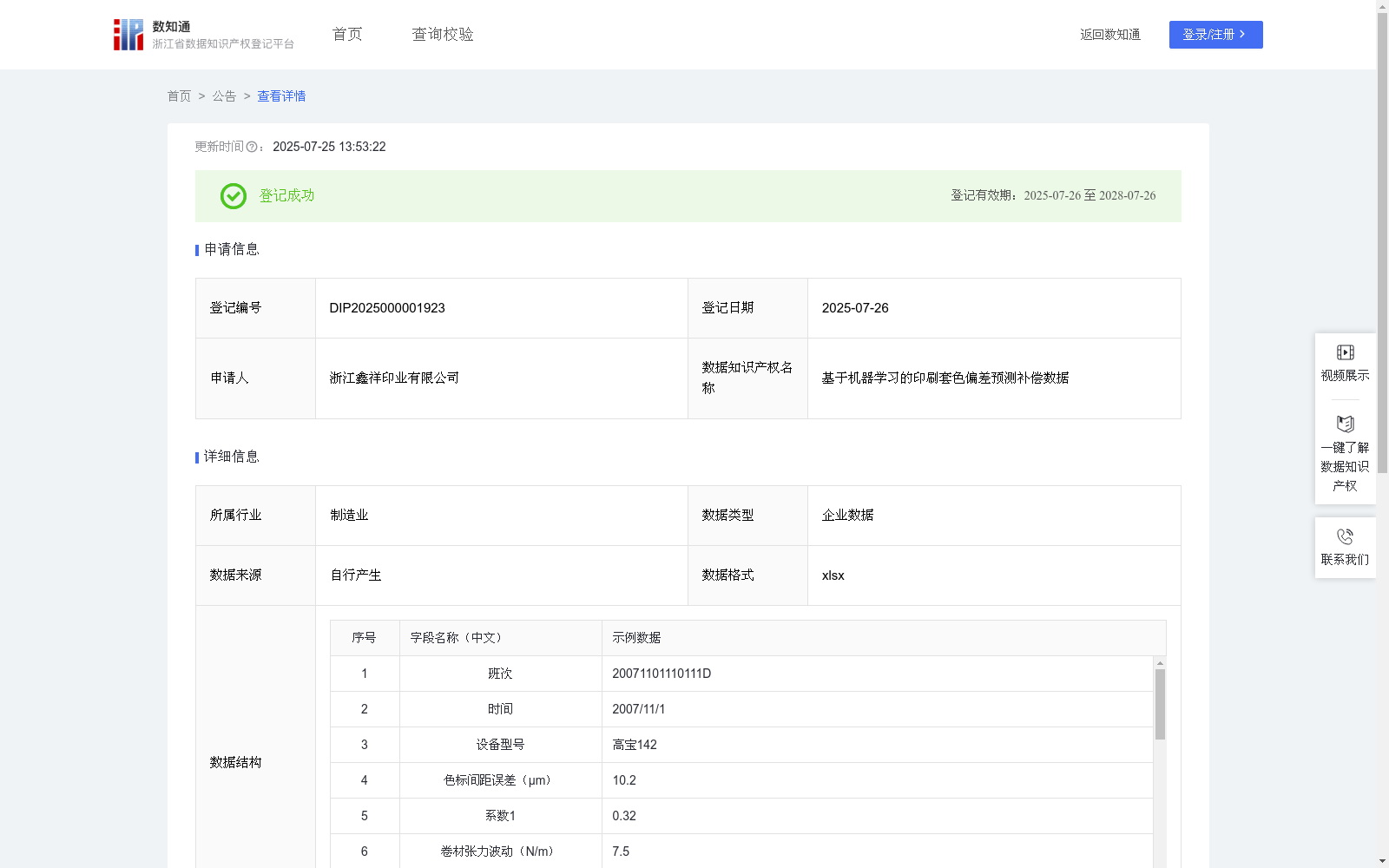
基于机器学习的印刷套色偏差预测补偿数据
收藏资源简介:
印刷套色偏差指多色印刷过程中各色版因机械误差、材料形变或环境因素导致的颜色层叠错位现象。基于机器学习的预测与补偿技术通过分析历史及实时数据,构建算法模型对偏差进行动态修正。本预测补偿原理是利用传感器采集印刷机运行参数(如张力、速度、色标位置等)及环境参数(温度),输入神经网络机器学习模型,训练偏差预测关系,再根据预测偏差值调整印刷机滚筒压力、套准电机位移量等参数,实现闭环控制。本偏差预测补偿数据有以下应用场景:通过实时偏差预测与补偿,减少停机调试时间,提升印刷套准精度;将输出结果与质量管理系统(QMS)集成,实现自动分拣缺陷品并触发工艺参数迭代;基于历史偏差数据训练设备健康模型,预判滚筒磨损、电机老化等故障;向上下游企业共享补偿算法参数,提升整体供应链印刷品一致性。1、数据收集:数据采集来源于色标传感器、张力传感器、温度传感器以及生产日志,每日实时采集印刷机色标间距误差、卷材张力波动、印刷速度、环境温度和历史偏差均值等运行参数,对印刷机设备采集到的数据进行降噪、清洗、加工后进行处理。 2、数据处理:、偏差预测公式:偏差预测值=色标间距误差*系数1+卷材张力波动*系数2+印刷速度*系数3+环境温度*系数4+历史偏差均值*系数5+ 偏置项,5个系数值需通过机器学习训练确定,总和为1。补偿量=偏差预测值*比例系数+偏差变化率*动态响应系数,基于补偿后的残余偏差为偏差预测值与补偿量差值的绝对值。3、残余偏差越小,表明设备越健康。残余偏差大于等于10μm,这代表了设备补偿失效,应立即停机检修;补偿量小于等于3μm,这代表了设备补偿完全覆盖偏差,应维持当前补偿参数;补偿量在3μm至10μm范围内,这代表了设备补偿不足或过冲,应微调比例系数和动态响应系数。通过监控每个班次的残余偏差值,采用通信技术和数据分析平台可以帮助企业生产设备保持良好的正常运转,降低设备的故障以及维修成本,加强设备管理以延长设备的使用寿命。
Printing registration deviation refers to the misalignment of color layers caused by mechanical errors, material deformation or environmental factors among different color plates in multi-color printing processes. Machine learning-based prediction and compensation technologies construct algorithmic models by analyzing historical and real-time data to dynamically correct deviations. The principle of this prediction and compensation system is to collect operating parameters of the printing press (such as tension, speed, color mark position, etc.) and environmental parameters (temperature) via sensors, input them into the neural network-based machine learning model to train the deviation prediction relationship, then adjust parameters like printing press cylinder pressure and registration motor displacement based on the predicted deviation values to achieve closed-loop control. This deviation prediction and compensation data has the following application scenarios: Firstly, real-time deviation prediction and compensation reduce downtime for debugging and improve printing registration accuracy; Secondly, integrate the output results with the Quality Management System (QMS) to automatically sort defective products and trigger iterative optimization of process parameters; Thirdly, train equipment health models based on historical deviation data to predict faults such as cylinder wear and motor aging; Fourthly, share compensation algorithm parameters with upstream and downstream enterprises to improve the consistency of printed products across the entire supply chain. 1. Data Collection: Data is collected from color mark sensors, tension sensors, temperature sensors and production logs. Real-time operating parameters including printing press color mark spacing error, web tension fluctuation, printing speed, ambient temperature and historical deviation mean are collected daily. The data collected by the printing press equipment is denoised, cleaned and preprocessed before being formally processed. 2. Data Processing: Deviation prediction formula: Predicted deviation value = Coefficient 1 × Color mark spacing error + Coefficient 2 × Web tension fluctuation + Coefficient 3 × Printing speed + Coefficient 4 × Ambient temperature + Coefficient 5 × Historical deviation mean + Bias term. The sum of the 5 coefficients must be 1, which is determined through machine learning training. Compensation amount = Predicted deviation value × Proportional coefficient + Deviation change rate × Dynamic response coefficient. The residual deviation after compensation is the absolute value of the difference between the predicted deviation value and the compensation amount. 3. The smaller the residual deviation, the healthier the equipment. When the residual deviation is greater than or equal to 10μm, it indicates that the equipment's compensation has failed and an immediate shutdown for maintenance is required; when the compensation amount is less than or equal to 3μm, it indicates that the equipment's compensation fully covers the deviation and the current compensation parameters should be maintained; when the compensation amount is within the range of 3μm to 10μm, it indicates that the equipment's compensation is insufficient or overshot, and the proportional coefficient and dynamic response coefficient should be fine-tuned. By monitoring the residual deviation value of each shift, enterprises can use communication technologies and data analysis platforms to maintain their production equipment in good operating condition, reduce equipment failures and maintenance costs, strengthen equipment management and extend the service life of the equipment.