QCRI/MultiNativQA
收藏资源简介:
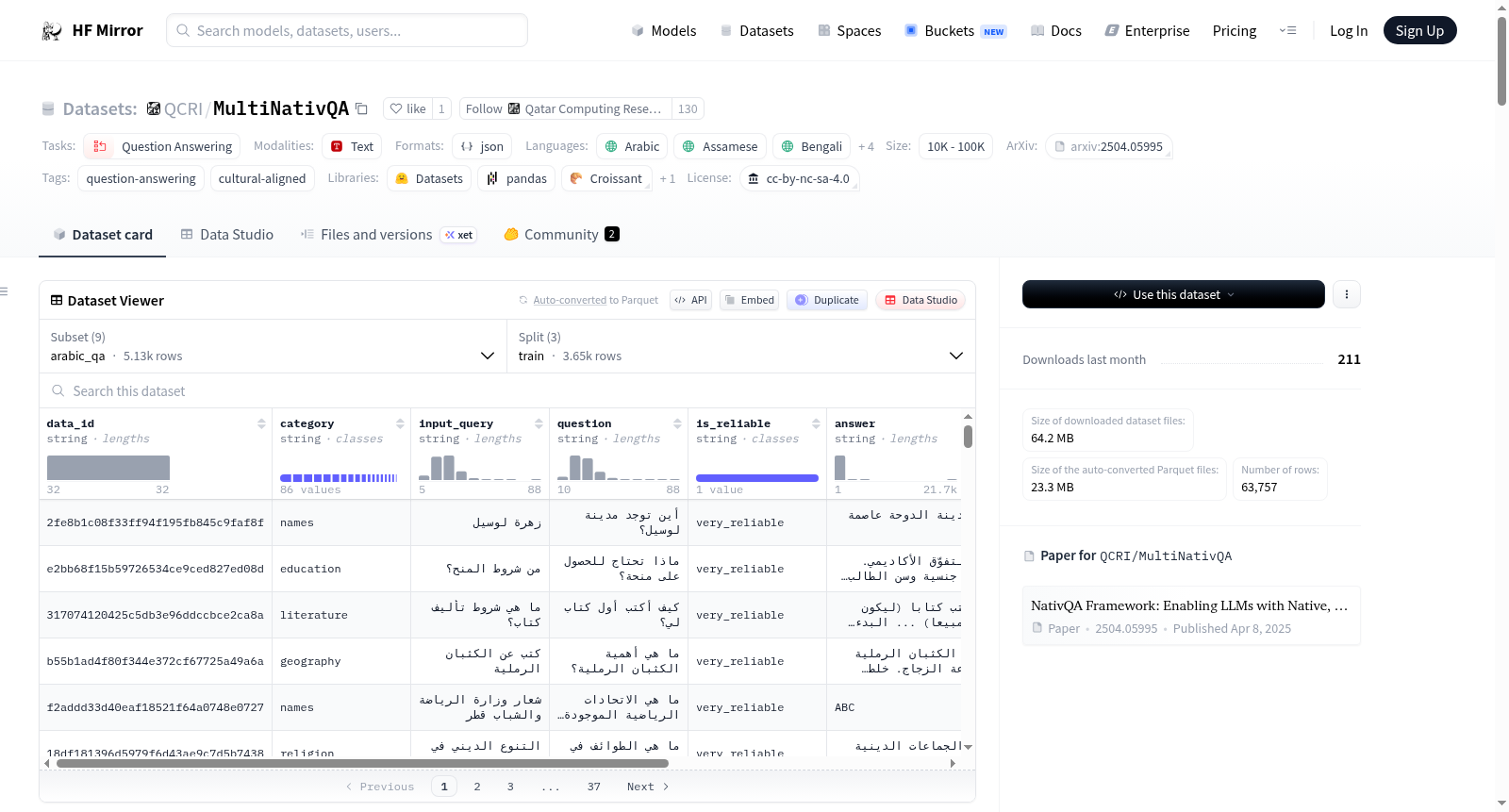
--- license: cc-by-nc-sa-4.0 task_categories: - question-answering language: - ar - asm - bn - en - hi - ne - tr tags: - question-answering - cultural-aligned pretty_name: 'MultiNativQA -- Multilingual Native and Culturally Aligned QA' size_categories: - 10K<n<100K dataset_info: - config_name: Arabic splits: - name: train num_examples: 3649 - name: dev num_examples: 492 - name: test num_examples: 988 - config_name: Assamese splits: - name: train num_examples: 1131 - name: dev num_examples: 157 - name: test num_examples: 545 - config_name: Bangla-BD splits: - name: train num_examples: 7018 - name: dev num_examples: 953 - name: test num_examples: 1521 - config_name: Bangla-IN splits: - name: train num_examples: 6891 - name: dev num_examples: 930 - name: test num_examples: 2146 - config_name: English-BD splits: - name: train num_examples: 4761 - name: dev num_examples: 656 - name: test num_examples: 1113 - config_name: English-QA splits: - name: train num_examples: 8212 - name: dev num_examples: 1164 - name: test num_examples: 2322 - config_name: Hindi splits: - name: train num_examples: 9288 - name: dev num_examples: 1286 - name: test num_examples: 2745 - config_name: Nepali splits: - name: test num_examples: 561 - config_name: Turkish splits: - name: train num_examples: 3527 - name: dev num_examples: 483 - name: test num_examples: 1218 configs: - config_name: arabic_qa data_files: - split: train path: arabic_qa/NativQA_ar_msa_qa_train.json - split: dev path: arabic_qa/NativQA_ar_msa_qa_dev.json - split: test path: arabic_qa/NativQA_ar_msa_qa_test.json - config_name: assamese_in data_files: - split: train path: assamese_in/NativQA_asm_NA_in_train.json - split: dev path: assamese_in/NativQA_asm_NA_in_dev.json - split: test path: assamese_in/NativQA_asm_NA_in_test.json - config_name: bangla_bd data_files: - split: train path: bangla_bd/NativQA_bn_scb_bd_train.json - split: dev path: bangla_bd/NativQA_bn_scb_bd_dev.json - split: test path: bangla_bd/NativQA_bn_scb_bd_test.json - config_name: bangla_in data_files: - split: train path: bangla_in/NativQA_bn_scb_in_train.json - split: dev path: bangla_in/NativQA_bn_scb_in_dev.json - split: test path: bangla_in/NativQA_bn_scb_in_test.json - config_name: english_bd data_files: - split: train path: english_bd/NativQA_en_NA_bd_train.json - split: dev path: english_bd/NativQA_en_NA_bd_dev.json - split: test path: english_bd/NativQA_en_NA_bd_test.json - config_name: english_qa data_files: - split: train path: english_qa/NativQA_en_NA_qa_train.json - split: dev path: english_qa/NativQA_en_NA_qa_dev.json - split: test path: english_qa/NativQA_en_NA_qa_test.json - config_name: hindi_in data_files: - split: train path: hindi_in/NativQA_hi_NA_in_train.json - split: dev path: hindi_in/NativQA_hi_NA_in_dev.json - split: test path: hindi_in/NativQA_hi_NA_in_test.json - config_name: nepali_np data_files: - split: test path: nepali_np/NativQA_ne_NA_np_test.json - config_name: turkish_tr data_files: - split: train path: turkish_tr/NativQA_tr_NA_tr_train.json - split: dev path: turkish_tr/NativQA_tr_NA_tr_dev.json - split: test path: turkish_tr/NativQA_tr_NA_tr_test.json --- # MultiNativQA: Multilingual Culturally-Aligned Natural Queries For LLMs ### Overview The **MultiNativQA** dataset is a multilingual, native, and culturally aligned question-answering resource. It spans 7 languages, ranging from high- to extremely low-resource, and covers 9 different locations/cities. To capture linguistic diversity, the dataset includes several dialects for dialect-rich languages like Arabic. In addition to Modern Standard Arabic (MSA), **MultiNativQA** features six Arabic dialects — *Egyptian, Jordanian, Khaliji, Sudanese, Tunisian*, and *Yemeni*. The dataset also provides two linguistic variations of Bangla, reflecting differences between speakers in *Bangladesh* and *West Bengal, India*. Additionally, **MultiNativQA** includes English queries from *Dhaka* and *Doha*, where English is commonly used as a second language, as well as from *New York, USA*. The QA pairs in this dataset cover 18 diverse topics, including: *Animals, Business, Clothing, Education, Events, Food & Drinks, General, Geography, Immigration, Language, Literature, Names & Persons, Plants, Religion, Sports & Games, Tradition, Travel*, and *Weather*. **MultiNativQA** is designed to evaluate and fine-tune large language models (LLMs) for long-form question answering while assessing their cultural adaptability and understanding. **Note.** The location information in the dataset is determined by the geographic targeting capabilities supported by Google Search. As a result, minor inconsistencies or approximations in location assignment may occasionally occur. ### Directory Structure (JSON files only) The dataset is organized into directories based on language and region. Each directory contains JSON files for the train, development, and test sets, with the exception of Nepali, which consists of only a test set. - `arabic_qa/` - `NativQA_ar_msa_qa_dev.json` - `NativQA_ar_msa_qa_test.json` - `NativQA_ar_msa_qa_train.json` - `assamese_in/` - `NativQA_asm_NA_in_dev.json` - `NativQA_asm_NA_in_test.json` - `NativQA_asm_NA_in_train.json` - `bangla_bd/` - `NativQA_bn_scb_bd_dev.json` - `NativQA_bn_scb_bd_test.json` - `NativQA_bn_scb_bd_train.json` - `bangla_in/` - `NativQA_bn_scb_in_dev.json` - `NativQA_bn_scb_in_test.json` - `NativQA_bn_scb_in_train.json` - `english_bd/` - `NativQA_en_NA_bd_dev.json` - `NativQA_en_NA_bd_test.json` - `NativQA_en_NA_bd_train.json` - `english_qa/` - `NativQA_en_NA_qa_dev.json` - `NativQA_en_NA_qa_test.json` - `NativQA_en_NA_qa_train.json` - `hindi_in/` - `NativQA_hi_NA_in_dev.json` - `NativQA_hi_NA_in_test.json` - `NativQA_hi_NA_in_train.json` - `nepali_np/` - `NativQA_ne_NA_np_test.json` - `turkish_tr/` - `NativQA_tr_NA_tr_dev.json` - `NativQA_tr_NA_tr_test.json` - `NativQA_tr_NA_tr_train.json` #### Example of a data ``` { "data_id": "cf92ec1e52b4b3071d263a1063b43928", "category": "immigration", "input_query": "How long can you stay in Qatar on a visitors visa?", "question": "Can I extend my tourist visa in Qatar?", "is_reliable": "very_reliable", "answer": "If you would like to extend your visa, you will need to proceed to immigration headquarters in Doha prior to the expiry of your visa and apply there for an extension.", "source_answer_url": "https://hayya.qa/en/web/hayya/faq" } ``` ##### Field Descriptions: - **`data_id`**: Unique identifier for each data entry. - **`category`**: General topic or category of the query (e.g., "health", "religion"). - **`input_query`**: The original user-submitted query. - **`question`**: The formalized question derived from the input query. - **`is_reliable`**: Indicates the reliability of the provided answer (`"very_reliable"`, `"somewhat_reliable"`, `"unreliable"`). - **`answer`**: The system-provided answer to the query. - **`source_answer_url`**: URL of the source from which the answer was derived. ### Statistics Distribution of the **MultiNativQA** dataset across different languages. <p align="left"> <img src="./language_donut_chart.png" style="width: 60%;" id="title-icon"> </p> This dataset consists of two types of data: annotated and un-annotated. We considered the un-annotated data as additional data. Please find the data statistics below: Statistics of our **MultiNativQA** dataset including languages with the final annotated QA pairs from different location. | Language | City | Train | Dev | Test | Total | |-------------|------------|---------|-------|--------|--------| | Arabic | Doha | 3,649 | 492 | 988 | 5,129 | | Assamese | Assam | 1,131 | 157 | 545 | 1,833 | | Bangla | Dhaka | 7,018 | 953 | 1,521 | 9,492 | | Bangla | Kolkata | 6,891 | 930 | 2,146 | 9,967 | | English | Dhaka | 4,761 | 656 | 1,113 | 6,530 | | English | Doha | 8,212 | 1,164 | 2,322 | 11,698 | | Hindi | Delhi | 9,288 | 1,286 | 2,745 | 13,319 | | Nepali | Kathmandu | -- | -- | 561 | 561 | | Turkish | Istanbul | 3,527 | 483 | 1,218 | 5,228 | | **Total** | | **44,477** | **6,121** | **13,159** | **63,757** | We provide the un-annotated additional data stats below: | Language-Location | # of QA | |-------------------------|---------------| | Arabic-Egypt | 7,956 | | Arabic-Palestine | 5,679 | | Arabic-Sudan | 4,718 | | Arabic-Syria | 11,288 | | Arabic-Tunisia | 14,789 | | Arabic-Yemen | 4,818 | | English-New York | 6,454 | | **Total** | **55,702** | ### How to download data ``` import os import json from datasets import load_dataset dataset_names = ['arabic_qa', 'assamese_in', 'bangla_bd', 'bangla_in', 'english_bd', 'english_qa', 'hindi_in', 'nepali_np', 'turkish_tr'] base_dir="./MNQA/" for dname in dataset_names: output_dir = os.path.join(base_dir, dname) # load each language dataset = load_dataset("QCRI/MultiNativQA", name=dname) # Save the dataset to the specified directory. This will save all splits to the output directory. dataset.save_to_disk(output_dir) # iterate over splits to save the data into json format for split in ['train','dev','test']: data = [] if split not in dataset: continue for idx, item in enumerate(dataset[split]): data.append(item) output_file = os.path.join(output_dir, f"{split}.json") with open(output_file, 'w', encoding='utf-8') as f: json.dump(data, f, ensure_ascii=False, indent=4) ``` ### License The dataset is distributed under the Creative Commons Attribution-NonCommercial-ShareAlike 4.0 International License (CC BY-NC-SA 4.0). The full license text can be found in the accompanying licenses_by-nc-sa_4.0_legalcode.txt file. ### Contact & Additional Information For more details, please visit our [official website](http://nativqa.gitlab.io/). ### Citation You can access the full paper [here](https://aclanthology.org/2025.findings-acl.770.pdf). ``` @inproceedings{hasan-etal-2025-nativqa, title = "{N}ativ{QA}: Multilingual Culturally-Aligned Natural Query for {LLM}s", author = "Hasan, Md. Arid and Hasanain, Maram and Ahmad, Fatema and Laskar, Sahinur Rahman and Upadhyay, Sunaya and Sukhadia, Vrunda N and Kutlu, Mucahid and Chowdhury, Shammur Absar and Alam, Firoj", editor = "Che, Wanxiang and Nabende, Joyce and Shutova, Ekaterina and Pilehvar, Mohammad Taher", booktitle = "Findings of the Association for Computational Linguistics: ACL 2025", month = jul, year = "2025", address = "Vienna, Austria", publisher = "Association for Computational Linguistics", url = "https://aclanthology.org/2025.findings-acl.770/", doi = "10.18653/v1/2025.findings-acl.770", pages = "14886--14909", ISBN = "979-8-89176-256-5", abstract = "Natural Question Answering (QA) datasets play a crucial role in evaluating the capabilities of large language models (LLMs), ensuring their effectiveness in real-world applications. Despite the numerous QA datasets that have been developed and some work done in parallel, there is a notable lack of a framework and large-scale region-specific datasets queried by native users in their own languages. This gap hinders effective benchmarking and the development of fine-tuned models for regional and cultural specificities. In this study, we propose a scalable, language-independent framework, NativQA, to seamlessly construct culturally and regionally aligned QA datasets in native languages for LLM evaluation and tuning. We demonstrate the efficacy of the proposed framework by designing a multilingual natural QA dataset, MultiNativQA, consisting of approximately {\textasciitilde}64K manually annotated QA pairs in seven languages, ranging from high- to extremely low-resource, based on queries from native speakers from 9 regions covering 18 topics. We benchmark both open- and closed-source LLMs using the MultiNativQA dataset. The dataset and related experimental scripts are publicly available for the community at: https://huggingface.co/datasets/QCRI/MultiNativQAand https://gitlab.com/nativqa/multinativqa." } @article{alam2025nativqa, title = {{NativQA Framework:} Enabling llms with native, local, and everyday knowledge}, author = {Alam, Firoj and Hasan, Md Arid and Laskar, Sahinur Rahman and Kutlu, Mucahid and Darwish, Kareem and Chowdhury, Shammur Absar}, journal = {arXiv preprint arXiv:2504.05995}, year = {2025}, } ```