
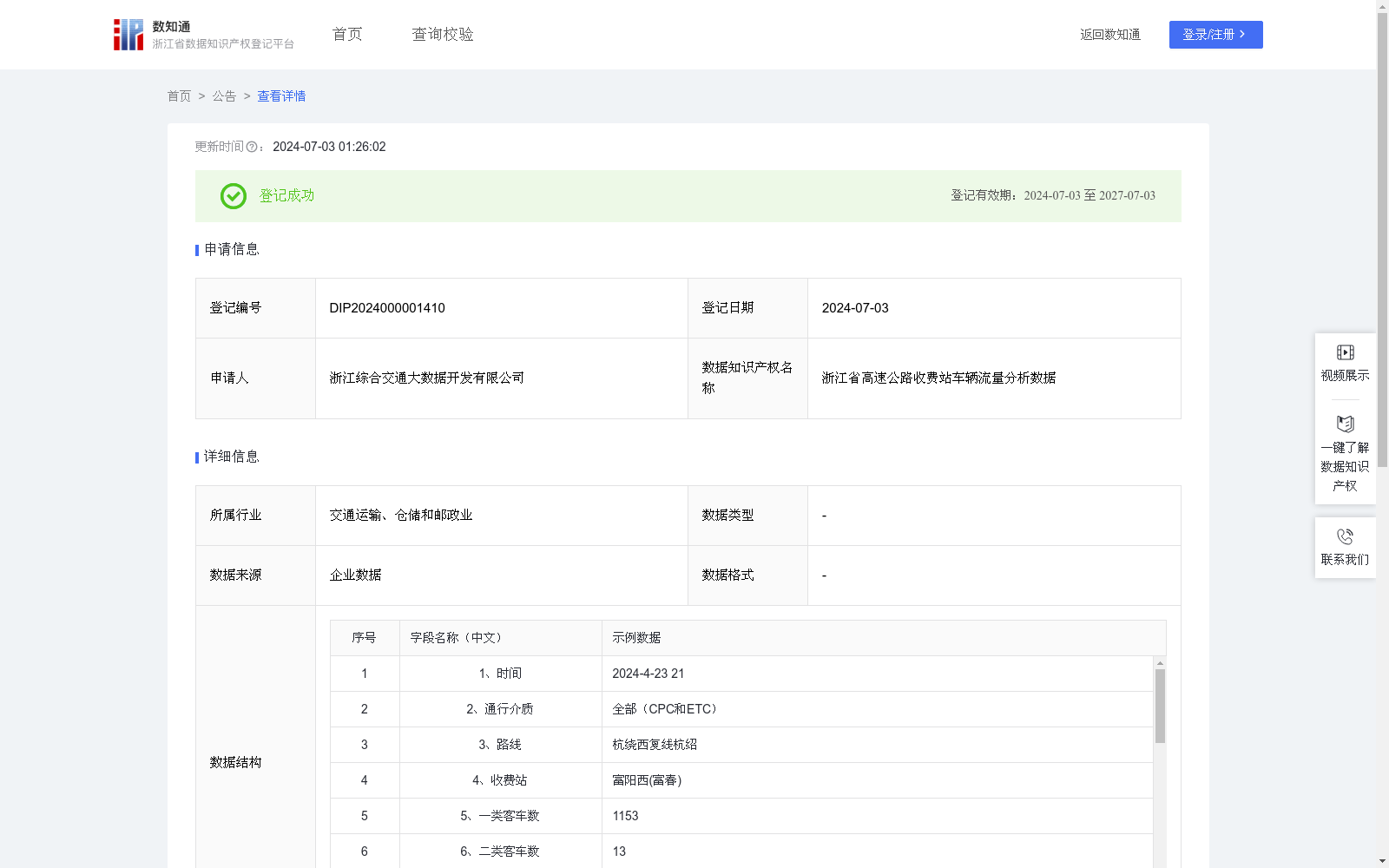
浙江省高速公路收费站车辆流量分析数据
收藏浙江省数据知识产权登记平台2024-07-03 更新2024-07-04 收录
下载链接:
https://www.zjip.org.cn/home/announce/trends/36101
下载链接
链接失效反馈资源简介:
1、交通拥堵管理:通过对不同时间段、不同路段的车辆流量进行分析,可以及时发现交通拥堵点,采取措施如发布实时路况信息、引导车辆绕行等,有效缓解交通压力。 路网规划与优化:长期的车辆流量数据可以帮助交通规划部门了解哪些路段经常处于高负荷状态,据此规划新建道路、拓宽车道或是优化现有路网结构,提升整体路网的通行效率。 安全与事故预防:分析特定时段的车辆流量和速度,有助于识别事故高发区域和时段,提前布置救援资源。 2、服务区管理与运营:基于服务区附近车流数据,分析服务区的车流量,为服务区的资源配置(如停车位、餐饮服务、加油站)提供数据支持,优化运营策略。 3、收费策略制定:结合ETC门架数据,分析车辆类型、行驶路径及高峰低谷时段的流量差异,为动态费率调整、优惠政策设计提供依据,平衡交通流量,提高收费效率。 4、环境与能源管理:通过分析车辆流量与排放的关系,评估高速公路对周边环境的影响,以及对节能减排政策的响应,如鼓励使用新能源汽车,减少高峰期碳排放。 5、应急响应与灾害管理:在自然灾害或紧急事件发生时,实时的车流量数据对于快速疏散人群、调配救援资源至关重要,可以基于数据快速判断最佳撤离路线1、数据收集:收集高速公路上的交通数据,包括通过ETC系统、雷达数据、卡口抓拍等方式获取的车辆信息。 2、数据清洗:去除重复、错误或无效的数据记录,数据标准化和归一化处理。 定义集合 D = {d1, d2, ..., dn} 定义集合 D_unique = {} 对于 D 中的每个元素 x: 如果 x 不在 D_unique 中: 将 x 添加到 D_unique 中 输出 D_unique 3、数据分类:其中每个数据点di都具有一个或多个属性,分类操作可以表示为一个映射f:S->C,其中C是类别集,则: c_j=f(d_i) ,for d_i∈D,c_j ∈C 4、流量计算:计算每个时间段内X={x1,x2,...,xn}通过特定收费站或断面的车辆数量,得到流量数据。
1. Traffic Congestion Management: By analyzing vehicle flow across different time periods and road segments, traffic congestion points can be identified in a timely manner, and measures such as releasing real-time traffic information and guiding vehicles to detour can be taken to effectively alleviate traffic pressure. Road Network Planning and Optimization: Long-term vehicle flow data can assist traffic planning departments in identifying sections that frequently operate under high load, so as to plan new roads, widen lanes, or optimize existing road network structures, thereby improving the overall traffic efficiency of the road network. Safety and Accident Prevention: Analyzing vehicle flow and speed during specific periods helps identify high-risk accident areas and time periods, enabling the pre-deployment of rescue resources.
2. Service Area Management and Operations: Based on vehicle flow data near service areas, the traffic volume of service areas can be analyzed to provide data support for resource allocation of service areas (including parking spaces, catering services, and gas stations) and optimize operational strategies.
3. Toll Strategy Formulation: Combining data from ETC gantries, analyze vehicle types, travel routes, and flow differences between peak and off-peak hours, providing a basis for dynamic toll rate adjustment and preferential policy design, balancing traffic flow and improving toll collection efficiency.
4. Environmental and Energy Management: By analyzing the relationship between vehicle flow and emissions, evaluate the impact of expressways on the surrounding environment and the response to energy conservation and emission reduction policies, such as encouraging the use of new energy vehicles to reduce carbon emissions during peak periods.
5. Emergency Response and Disaster Management: In the event of natural disasters or emergencies, real-time vehicle flow data is critical for rapid crowd evacuation and deployment of rescue resources, and can be used to quickly determine the optimal evacuation routes.
1. Data Collection: Collect traffic data on expressways, including vehicle information obtained via ETC systems, radar detectors, and checkpoint camera captures.
2. Data Cleaning: Remove duplicate, erroneous or invalid data records, and perform data standardization and normalization processing. Define set $D = {d_1, d_2, ..., d_n}$. Define set $D_{ ext{unique}} = emptyset$. For each element $x$ in $D$: If $x$ is not present in $D_{ ext{unique}}$: Add $x$ to $D_{ ext{unique}}$. Output $D_{ ext{unique}}$.
3. Data Classification: Each data point $d_i$ has one or more attributes. The classification operation can be represented as a mapping $f: S o C$, where $C$ is the category set. Then: $c_j = f(d_i)$ for $d_i in D, c_j in C$.
4. Traffic Volume Calculation: Calculate the number of vehicles passing through a specific toll station or road section within each time period in the set $X = {x_1, x_2, ..., x_n}$, thereby obtaining traffic volume data.
提供机构:
浙江综合交通大数据开发有限公司
创建时间:
2024-05-24
AI搜集汇总
数据集介绍
以上内容由AI搜集并总结生成



