
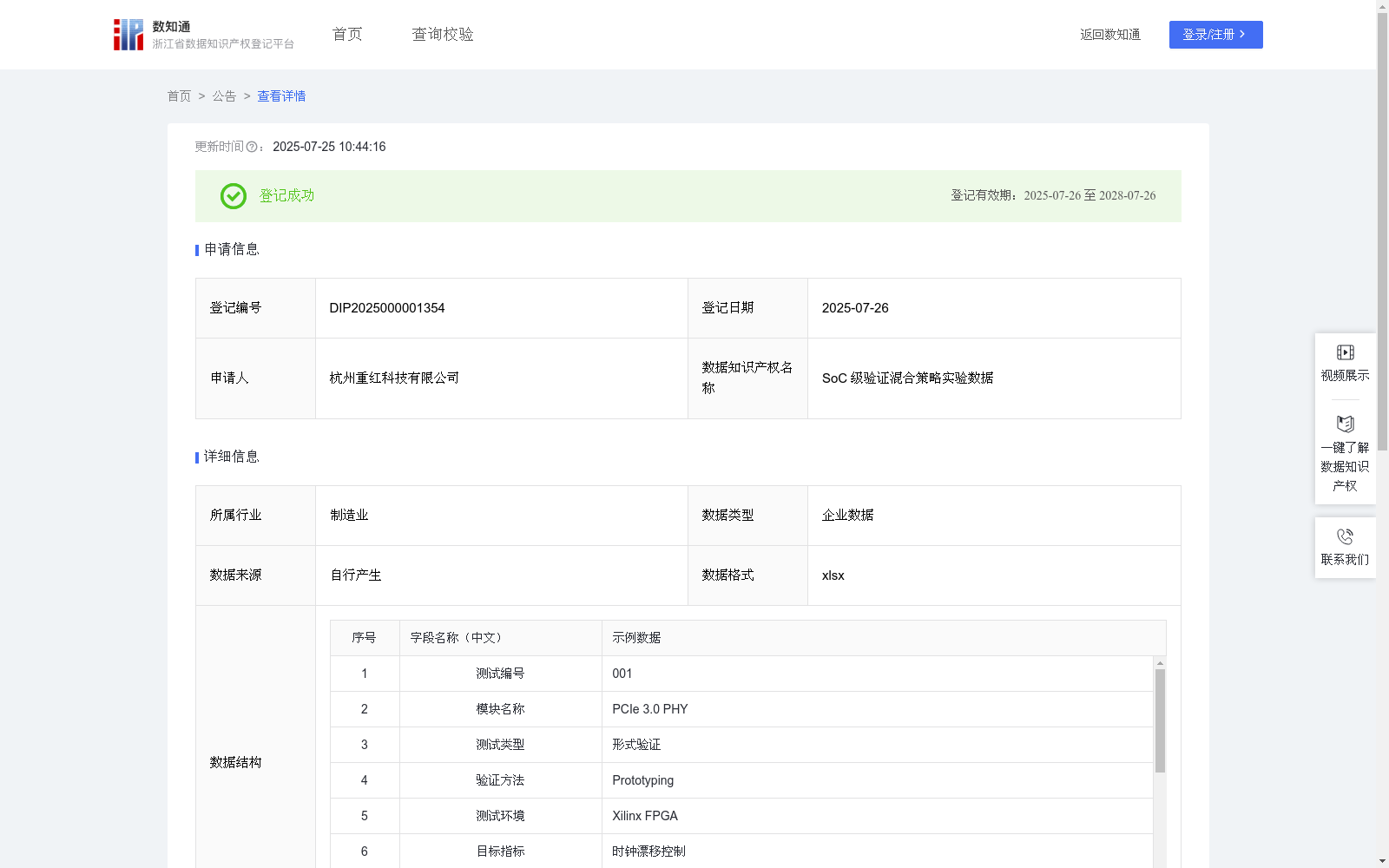
SoC 级验证混合策略实验数据
收藏浙江省数据知识产权登记平台2025-07-25 更新2025-07-26 收录
下载链接:
https://www.zjip.org.cn/home/announce/trends/154646
下载链接
链接失效反馈官方服务:
资源简介:
本实验数据集适用于 SoC 级验证与优化,涵盖 逻辑仿真、硬件加速仿真、FPGA 原型验证、形式验证、低功耗验证 等方法,可用于 高性能计算 SoC(如 AI 处理器、GPU、RISC-V 处理器、服务器芯片)、高速通信 SoC(PCIe、USB、DDR)、低功耗嵌入式 SoC(IoT 设备、无线芯片) 的功能、功耗、时序和片上通信验证。本数据可帮助发现 指令错误、数据溢出、信号丢失、寄存器未初始化、功耗异常 等关键问题,优化 时序收敛、低功耗管理、片上数据一致性,适用于 台积电(TSMC)、三星(Samsung)、英特尔(Intel)、中芯国际(SMIC) 等制程工艺节点。然而,本数据集不适用于 纯模拟 IC(如 RF 芯片、ADC/DAC)、极端低功耗芯片(1nW 级)、安全性抗攻击验证(如抗侧信道攻击)、后硅验证(Post-Silicon ATE 测试)等场景。本数据基于随机采样、规则约束、概率分布建模等方法,以确保数据符合 SoC 级验证的行业标准。
模块选择:从常见 SoC 组件(CPU、GPU、片上总线、DDR 控制器、PCIe、USB 3.1 等)中随机采样,每个模块具有不同的验证需求。
测试方法:依据 SoC 设计流程,按照验证阶段(逻辑仿真、硬件加速仿真、形式验证等)匹配合适的测试类型。
关键指标建模:代码覆盖率、功能覆盖率:使用 正态分布(N(92, 4)) 生成,确保数据集中度较高。
时序收敛、低功耗模式、硬件加速仿真:根据覆盖率阈值设定通过概率(如 代码覆盖率 < 90% 时,时序收敛概率下降)。
Bug 发生概率:基于 离散概率模型,当某项测试失败(Fail)时,按 Poisson 分布(λ=1.5) 生成 Bug 数量。
算法模型构建:
规则约束模型:代码覆盖率与时序收敛的相关性:低覆盖率(<90%)时,时序收敛通过概率下降。
低功耗模式与功能覆盖率的相关性:低功能覆盖率时,低功耗验证容易失败。
条件概率建模:若 代码覆盖率 < 90%,则时序收敛失败概率提升 40%。若 功能覆盖率 < 85%,低功耗模式失败概率提升 35%。若 Bug 发生,则随机选择 "时序问题"、"数据溢出"、"功耗激增" 等 Bug 描述。
数据优化:采用 分布平衡策略,避免某些模块或测试方法数据分布不均匀。
设定合理范围约束(如 代码覆盖率 85%-100%,功能覆盖率 80%-100%)。
This experimental dataset is designed for SoC-level verification and optimization, covering multiple verification methodologies including logic simulation, hardware-assisted simulation, FPGA prototyping verification, formal verification, and low-power verification. It can be applied to verify the functionality, power consumption, timing, and on-chip communication of three categories of SoCs: high-performance computing SoCs (e.g., AI processors, GPUs, RISC-V processors, server chips), high-speed communication SoCs (e.g., PCIe, USB, DDR subsystems), and low-power embedded SoCs (e.g., IoT devices and wireless chips). This dataset aids in detecting critical issues including instruction errors, data overflow, signal loss, uninitialized registers, and power anomalies, and supports optimization of timing closure, low-power management, and on-chip data coherence. It is compatible with process technology nodes from manufacturers such as TSMC, Samsung, Intel, and SMIC. However, this dataset is not applicable for scenarios including pure analog ICs (e.g., RF chips, ADC/DAC devices), ultra-low-power chips (1nW-level), security anti-attack verification (e.g., side-channel attack resistance testing), and post-silicon verification (Post-Silicon ATE testing).
This dataset is constructed via methods including random sampling, rule-based constraint, and probability distribution modeling, to ensure compliance with industry standards for SoC-level verification.
### Module Selection
Common SoC components (e.g., CPU, GPU, on-chip bus, DDR controller, PCIe, USB 3.1) are randomly sampled, with each module having distinct verification requirements.
### Test Methods
Appropriate test types are matched to corresponding verification stages (e.g., logic simulation, hardware-assisted simulation, formal verification) based on the SoC design flow.
### Key Indicator Modeling
Code coverage and functional coverage are generated using a normal distribution N(92, 4) to ensure a high degree of data concentration.
### Timing Closure, Low-Power Mode, and Hardware-Assisted Simulation
Pass probabilities are set based on coverage thresholds; for example, when code coverage is below 90%, the pass probability of timing closure decreases.
### Bug Occurrence Probability
Based on a discrete probability model, the number of bugs is generated following a Poisson distribution (λ=1.5) when a test fails.
### Algorithm Model Construction
1. Rule-based Constraint Model: Correlation between code coverage and timing closure: When coverage is low (<90%), the pass probability of timing closure decreases. Correlation between low-power mode and functional coverage: Low functional coverage leads to a higher failure rate of low-power verification.
2. Conditional Probability Modeling: If code coverage is below 90%, the failure probability of timing closure increases by 40%. If functional coverage is below 85%, the failure probability of low-power mode increases by 35%. When a bug occurs, bug descriptions such as "timing issue", "data overflow", and "power surge" are randomly selected.
### Data Optimization
A distribution balancing strategy is adopted to avoid uneven data distribution across modules or test methods. Reasonable range constraints are set, e.g., code coverage ranges from 85% to 100%, and functional coverage ranges from 80% to 100%.
提供机构:
杭州重红科技有限公司
创建时间:
2025-03-18
搜集汇总
数据集介绍
背景与挑战
背景概述
该数据集为SoC级验证混合策略实验数据,包含570条记录,涵盖多种验证方法和指标,适用于高性能计算、高速通信和低功耗嵌入式SoC的验证与优化。数据生成基于随机采样和概率分布建模,符合行业标准。
以上内容由遇见数据集搜集并总结生成


