机器人运动规划数据
收藏资源简介:
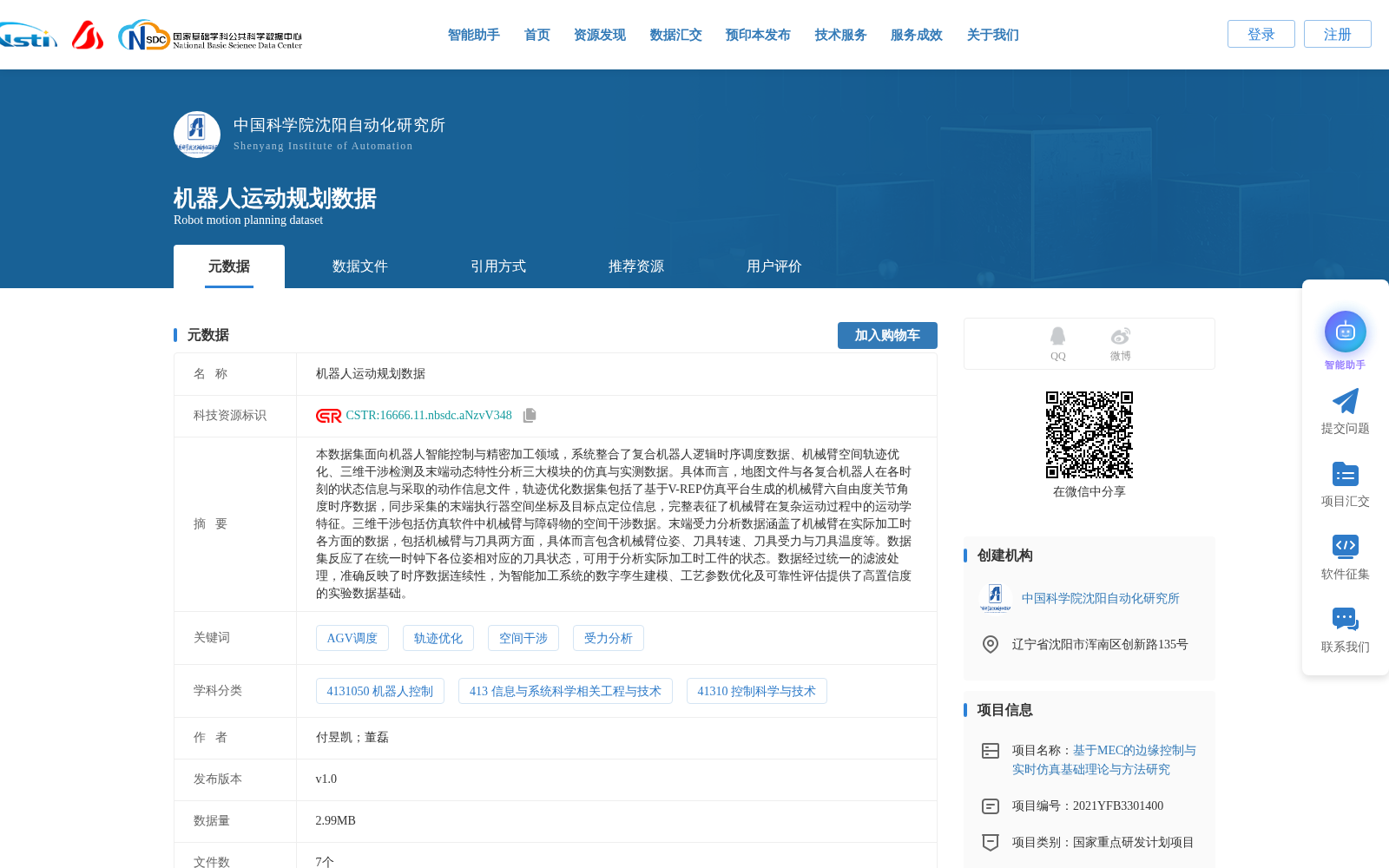
本数据集面向机器人智能控制与精密加工领域,系统整合了复合机器人逻辑时序调度数据、机械臂空间轨迹优化、三维干涉检测及末端动态特性分析三大模块的仿真与实测数据。具体而言,地图文件与各复合机器人在各时刻的状态信息与采取的动作信息文件,轨迹优化数据集包括了基于V-REP仿真平台生成的机械臂六自由度关节角度时序数据,同步采集的末端执行器空间坐标及目标点定位信息,完整表征了机械臂在复杂运动过程中的运动学特征。三维干涉包括仿真软件中机械臂与障碍物的空间干涉数据。末端受力分析数据涵盖了机械臂在实际加工时各方面的数据,包括机械臂与刀具两方面,具体而言包含机械臂位姿、刀具转速、刀具受力与刀具温度等。数据集反应了在统一时钟下各位姿相对应的刀具状态,可用于分析实际加工时工件的状态。数据经过统一的滤波处理,准确反映了时序数据连续性,为智能加工系统的数字孪生建模、工艺参数优化及可靠性评估提供了高置信度的实验数据基础。
This dataset targets the fields of robotic intelligent control and precision machining, and systematically integrates simulation and measured data from three modules: logical timing scheduling data of collaborative robots, spatial trajectory optimization of robotic arms, and 3D collision detection combined with end-effector dynamic characteristic analysis. More specifically, it includes map files, as well as files storing state information and executed action data of each collaborative robot at each time stamp. The trajectory optimization dataset contains time-series data of 6-degree-of-freedom joint angles of robotic arms generated based on the V-REP simulation platform, along with synchronously collected spatial coordinates of the end-effector and positioning data of target points, which fully characterizes the kinematic characteristics of the robotic arm during complex motion processes. The 3D collision detection module holds spatial collision data between robotic arms and obstacles within the simulation environment. The end-effector dynamic characteristic analysis dataset covers multi-dimensional data collected during actual machining, involving both the robotic arm and the cutting tool, specifically including the robotic arm's pose, cutting tool rotational speed, cutting tool stress, cutting tool temperature, and other relevant parameters. The dataset records the tool state corresponding to each pose under a unified clock, enabling analysis of the workpiece state during actual machining. All data has undergone unified filtering processing to accurately preserve the continuity of time-series data, providing a high-confidence experimental data basis for digital twin modeling, process parameter optimization, and reliability assessment of intelligent machining systems.