Nicholson_etal_2019_Wild_bee_occurrence_traits
收藏资源简介:
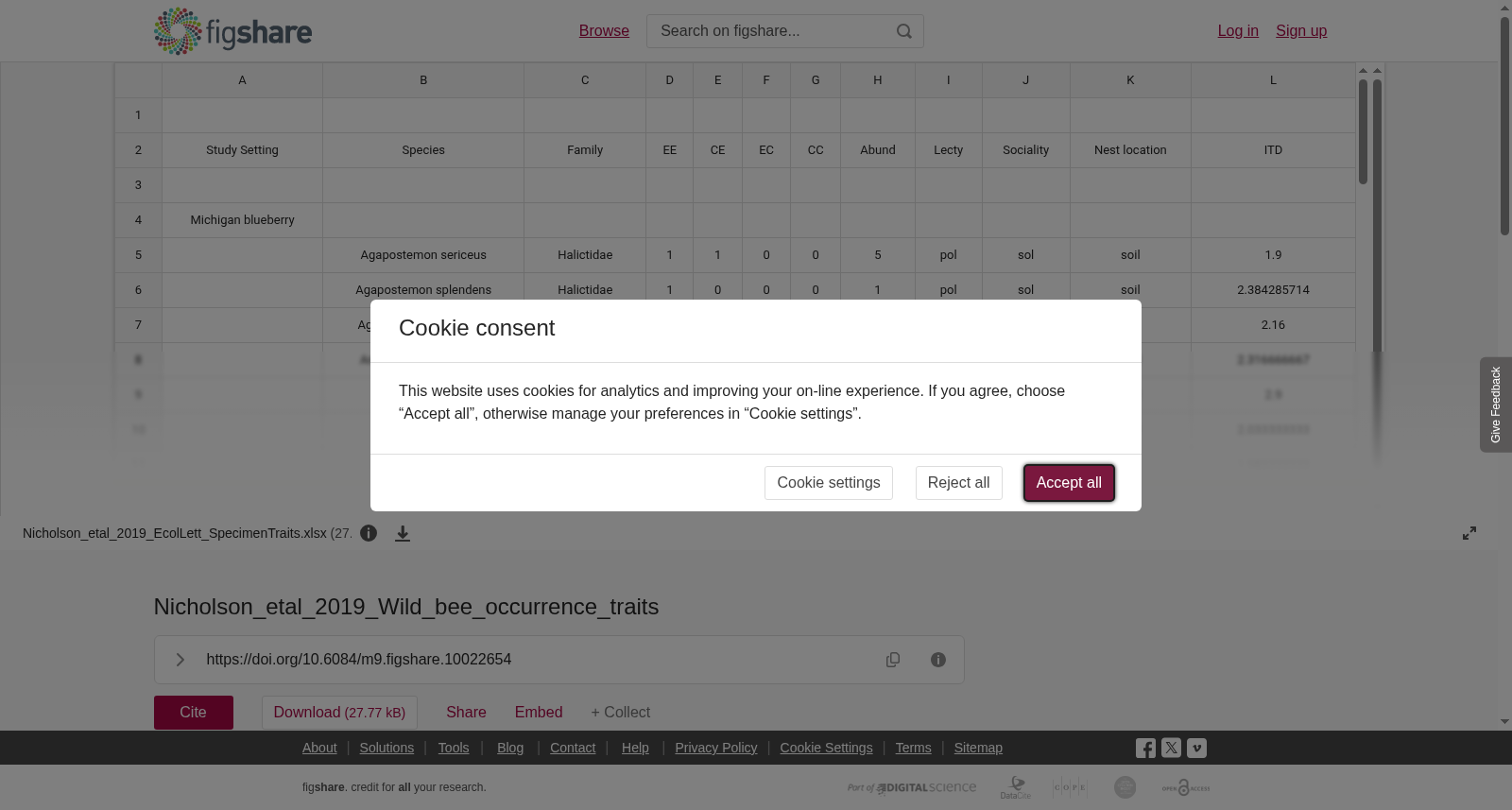
These data are species lists for each study setting (i.e. MI blueberry, MI Cherry, Oregon, blueberry, and California watermelon). The data present two main pieces of information: (1) species occurrence and abundance & (2) species functional traits. The occurrence of each species is denoted by a '1' for each site type ('EE" = enhanced edge, 'CE' = control edge, 'EC' = enhanced crop, 'CC' = control crop). The column 'Abund' gives to total nujmber of specimens collected across these site types for both years (2015 & 2016). The functional traits are lecty, sociality, nest location and intertegular distance (ITD, a body size metric). The first 3 traits are categorical, their categories are: Lecty - polylectic ('pol') or oligolectic ('oli')Sociality - solitary ('sol'), social ('soc'), or faculatively social ('fac')Nest location - soil, stem, cavity, wood ITD is given in mm. The categorization of these traits follows other published resources (see Methods and Appendices in Nicholson et al 2019 Ecology Letters). For some species traits have not been published and these are given a 'NA' value.
本数据集涵盖各研究样地的物种名录,具体包括密歇根州(MI)蓝莓样地、密歇根州(MI)樱桃样地、俄勒冈州蓝莓样地以及加利福尼亚州西瓜样地。数据集包含两类核心信息:其一为物种出现情况与种群丰度,其二为物种功能性状。各物种的出现情况以数值‘1’标记,对应四种样地类型:‘EE’代表增强型边缘样地(enhanced edge)、‘CE’代表对照边缘样地(control edge)、‘EC’代表增强型种植样地(enhanced crop)、‘CC’代表对照种植样地(control crop)。‘Abund’列记录了2015年与2016年两年间,所有样地类型中采集到的标本总数量。功能性状涵盖取食特化性(lecty)、社会性行为、筑巢位置以及翅基间距(intertegular distance, ITD,一种体型大小衡量指标)。前三项功能性状为分类变量,其分类标准如下:取食特化性(lecty)分为泛食性(polylectic,缩写‘pol’)与专食性(oligolectic,缩写‘oli’)两类;社会性行为分为独居性(solitary,缩写‘sol’)、社会性(social,缩写‘soc’)以及兼性社会性(facultatively social,缩写‘fac’)三类;筑巢位置分为土壤、茎秆、洞穴以及木质环境四类。翅基间距(ITD)的单位为毫米(mm)。上述性状的分类标准参考已发表的相关研究(详见Nicholson等人2019年发表于《Ecology Letters》的研究中的方法与附录部分)。部分物种的功能性状尚未有公开研究数据,此类情况以‘NA’标记。