
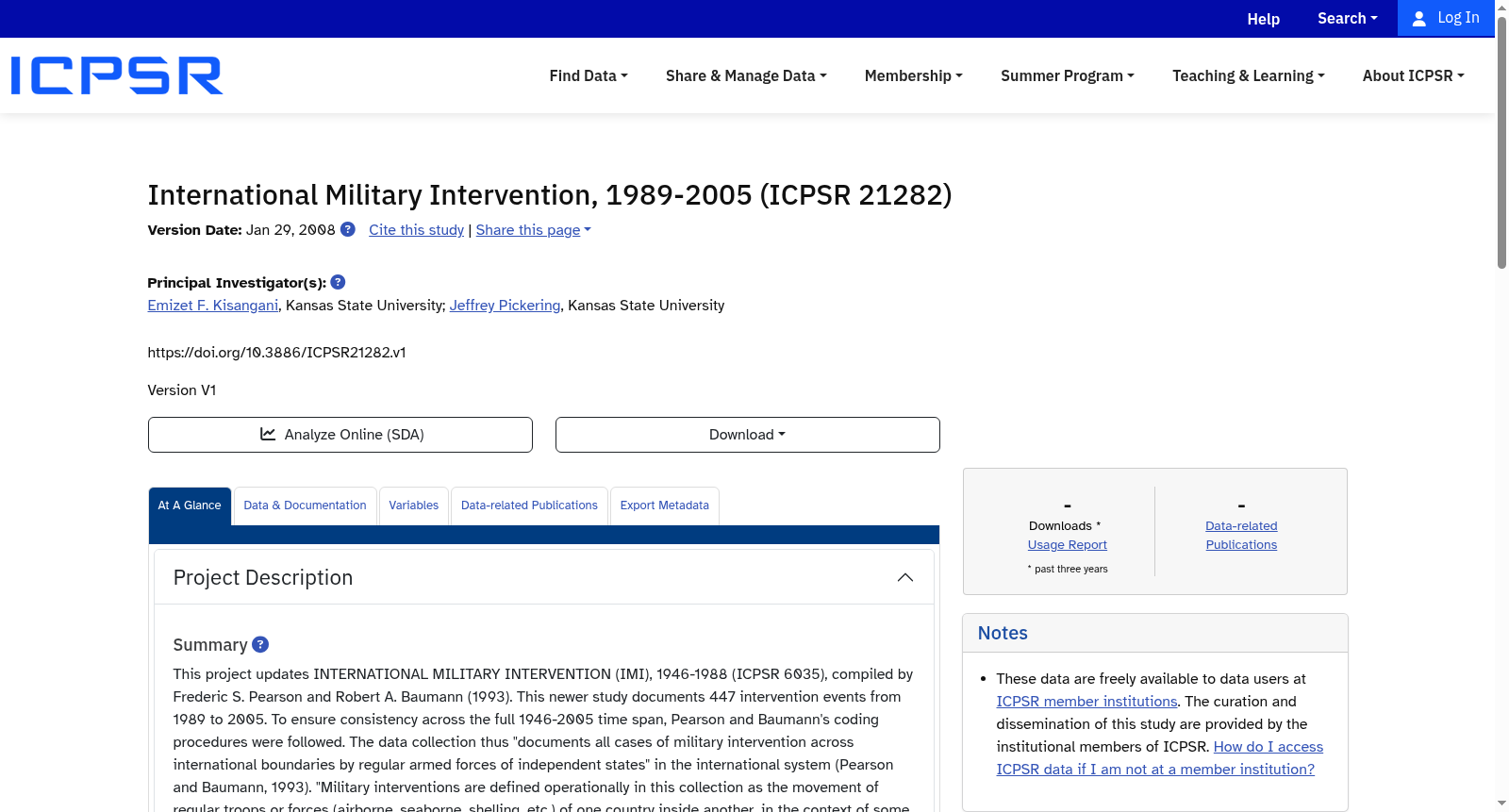
International Military Intervention, 1989-2005
收藏DataCite Commons2026-03-11 更新2025-04-16 收录
下载链接:
https://www.icpsr.umich.edu/web/ICPSR/studies/21282
下载链接
链接失效反馈官方服务:
资源简介:
This project updates INTERNATIONAL MILITARY INTERVENTION
(IMI), 1946-1988 (ICPSR 6035), compiled by Frederic S. Pearson and
Robert A. Baumann (1993). This newer study documents 447 intervention
events from 1989 to 2005. To ensure consistency across the full
1946-2005 time span, Pearson and Baumann's coding procedures were
followed. The data collection thus "documents all cases of military
intervention across international boundaries by regular armed forces
of independent states" in the international system (Pearson and
Baumann, 1993). "Military interventions are defined operationally in
this collection as the movement of regular troops or forces (airborne,
seaborne, shelling, etc.) of one country inside another, in the
context of some political issue or dispute" (Pearson and Baumann,
1993). As with the original IMI (OIMI) collection, the 1989-2005
dataset includes information on actor and target states, as well as
starting and ending dates. It also includes a categorical variable
describing the direction of the intervention, i.e., whether it was
launched in support of the target government, in opposition to the
target government, or against some third party actor within the target
state's borders. The intensity of the military intervention is
captured in ordinal variables that document the scale of the actor's
involvement, "ranging from minor engagement such as evacuation, to
patrols, act of intimidation, and actual firing, shelling or bombing"
(Pearson and Baumann, 1993). Casualties that are a direct result of
the military intervention are coded as well. A novel aspect of IMI is
the inclusion of a series of variables designed to ascertain the
motivations or issues that prompted the actor to intervene, including
to take sides in a domestic dispute in the target state, to affect
target state policy, to protect a socio-ethnic or minority group, to
attack rebels in sanctuaries in the target state, to protect economic
or resource interests, to intervene for strategic purposes, to lend
humanitarian aid, to acquire territory or to dispute its ownership,
and to protect its own military/diplomatic interests. There are three
main differences between OIMI and this update. First, the variable,
civilian casualties, which complements IMI's information on the
casualties suffered by actor and target military personnel has been
added. Second, OIMI variables on colonial history, previous
intervention, alliance partners, alignment of the target, power size
of the intervener, and power size of the target have been deleted. The
Web-based resources available today, such as the CIA World Fact Book,
make information on the colonial history between actor and target
readily available. Statistical programs allow researchers to generate
all previous interventions by the actor into the target state. Since
competing measures and data collections are used for alliances and
state power, it was thought best to allow analysts who use IMI the
freedom to choose the variables or dataset that measure the phenomena
of their choice. Third, the data collection techniques differ from
OIMI. OIMI relied on the scouring of printed news sources such as the
New York Times Index, Facts on File, and Keesing's to collect
information on international military interventions, whereas the
computer-based search engine, Lexis-Nexis Academic, was used as the
foundation for the new study's data search. Lexis-Nexis Academic
includes print sources as well as news wire reports and many others.
After Lexis-Nexis searches were conducted for each year in the update
by at least four different investigators, regional sources, the United
Nations Web site, and secondary works were consulted.
提供机构:
ICPSR - Interuniversity Consortium for Political and Social Research
创建时间:
2014-01-10
搜集汇总
数据集介绍
背景与挑战
背景概述
该数据集是“International Military Intervention, 1946-1988”的更新版本,覆盖1989年至2005年期间,记录了447个国际军事干预事件,并遵循原始编码程序以确保一致性。它新增了平民伤亡变量,同时删除了部分变量以增强灵活性,并采用计算机搜索技术(如Lexis-Nexis)进行数据收集,专注于国家行为体的军事干预行为。
以上内容由遇见数据集搜集并总结生成



