
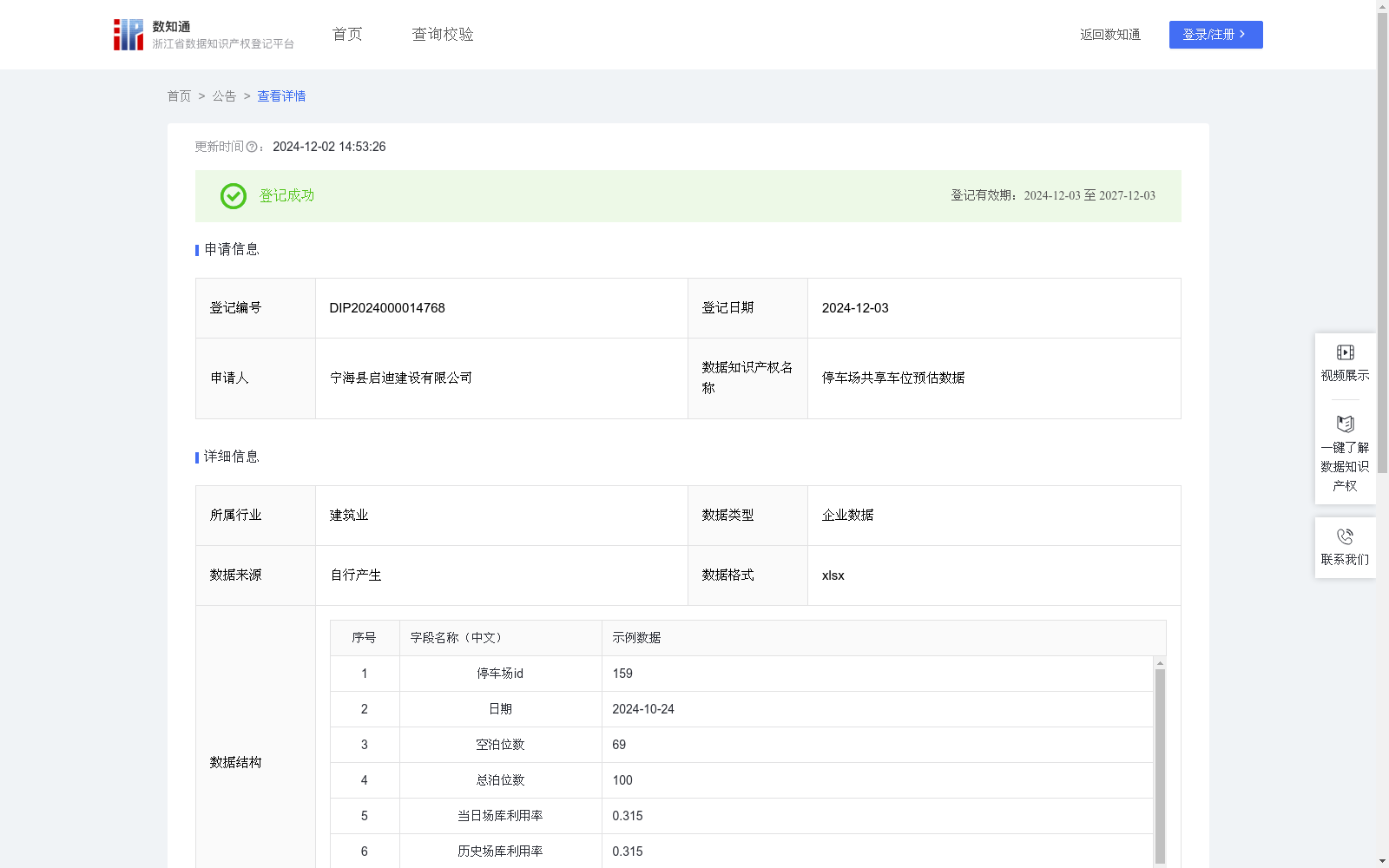
停车场共享车位预估数据
收藏浙江省数据知识产权登记平台2024-12-02 更新2024-12-03 收录
下载链接:
https://www.zjip.org.cn/home/announce/trends/92367
下载链接
链接失效反馈官方服务:
资源简介:
随着城市化进程的加快和汽车保有量的不断增加,城市停车难问题日益凸显,尤其在商业区、居民区和办公区等高需求区域。共享车位的概念应运而生,旨在通过提高车位利用率来缓解停车难的问题。例如在商业中心或办公区的停车场中,白天车位需求较大,夜间需求较低。通过共享车位预估数据,可以在非高峰时段(如夜间)提供更多共享车位,增加车位利用率。而住宅小区白天空置车位较多,夜间满员。共享车位预估数据能够在白天时段提供更多共享车位,供附近商户或访客使用,降低空置率。 停车场共享车位预估数据通过智能化系统采集并分析停车场空车位、使用率等数据,利用算法生成共享车位数量的预估值。这些数据的应用帮助停车场管理者合理设置共享停车位数量,优化资源配置、提升车位利用率、增加收益,并改善车主的停车体验,是智能化停车管理中的重要组成部分。1、数据采集:通过智能停车的道闸系统采集车辆进出停车场的数据,包括停车场id,车辆id,日期,空泊位数,总泊位数等;2、数据处理:对停车场进行编码,用id码指向唯一停车场,对数据进行清洗、去噪、补全;3、数据加工:停车场id指向告警的具体停车场,日期代表数据记录的时间,空泊位数代表当天全天没有车辆停入的车位数,总泊位数是该停车场总共的泊位数合计,当日场库利用率代表该停车场当日车位实际被占用的比例,当日场库利用率的算法为当日场库利用率=1-(空泊位数/总泊位数),历史场库利用率代表该停车场近一段时间内车位实际被占用的平均比例,历史场库利用率的算法为历史场库利用率=1-(∑空泊位数/∑总泊位数),共享车位需求系数代表停车场平均日空车位与可指定为共享车位的数量之间的比例关系,该数值会受到停车场的地理位置、周边设施、时间段和停车需求波动等多种因素的影响,预计共享车位数代表该停车场预估要留出设置为共享车位的数量,预计共享车位数的算法为预计共享车位数=总泊位数*(∑空泊位数/∑总泊位数)*共享车位需求系数,计算结果取整数。
Against the backdrop of accelerating urbanization and the continuous growth of vehicle ownership, the problem of urban parking scarcity has grown increasingly acute, particularly in high-demand areas such as commercial districts, residential neighborhoods, and office zones.
The concept of shared parking spaces has emerged as a solution aimed at alleviating parking shortages by enhancing the utilization rate of existing parking spaces. For example, parking lots in commercial centers or office districts experience high demand during daytime but low demand at night. By utilizing shared parking space prediction data, additional shared parking spaces can be made available during off-peak hours such as nighttime, thereby boosting parking space utilization. In contrast, residential communities typically have a surplus of vacant parking spots during the daytime but reach full occupancy at night; shared parking space prediction data can allocate more shared parking spots during the daytime for nearby businesses or visitors, reducing overall vacancy rates.
The shared parking space prediction data for parking lots is collected and analyzed through intelligent parking management systems, which gather metrics including parking lot ID, vehicle ID, recording date, number of available parking spots, total parking capacity, and generate predicted values for the number of shared parking spaces using algorithms. The application of this dataset helps parking lot managers rationally set the quantity of shared parking spaces, optimize resource allocation, improve parking space utilization, increase revenue, and enhance drivers' parking experience, making it an important component of intelligent parking management.
1. Data Collection: Vehicle entry and exit data are collected via the barrier gate systems of intelligent parking facilities, including parking lot ID, vehicle ID, recording date, number of available parking spots, total parking capacity, and other relevant metrics.
2. Data Preprocessing: Each parking lot is assigned a unique ID for standardized identification, and data cleaning, denoising, and missing value completion are performed on the collected dataset.
3. Data Refinement: The parking lot ID corresponds to the specific alert-generating parking lot; the recording date indicates the time when the data was logged; the number of available parking spots refers to the count of spots that remained unoccupied throughout the entire day; total parking capacity represents the total number of parking spots in the lot. The daily parking lot utilization rate, which reflects the actual occupancy ratio of the parking lot on the recorded day, is calculated as:
daily parking lot utilization rate = 1 - (number of available parking spots / total parking capacity)
The historical parking lot utilization rate, which represents the average occupancy ratio of the parking lot over a recent time period, is calculated as:
historical parking lot utilization rate = 1 - (∑available parking spots / ∑total parking capacity)
The shared parking space demand coefficient describes the proportional relationship between the average daily number of available parking spots and the number of spots that can be designated as shared parking spaces; this coefficient is influenced by multiple factors including the parking lot's geographical location, surrounding facilities, time period, and fluctuations in parking demand. The estimated number of shared parking spaces, which refers to the predicted number of spots to be designated as shared parking spaces for the lot, is calculated as:
estimated number of shared parking spaces = total parking capacity * (∑available parking spots / ∑total parking capacity) * shared parking space demand coefficient
The result of the calculation is rounded to an integer.
提供机构:
宁海县启迪建设有限公司
创建时间:
2024-11-05
搜集汇总
数据集介绍
以上内容由遇见数据集搜集并总结生成


