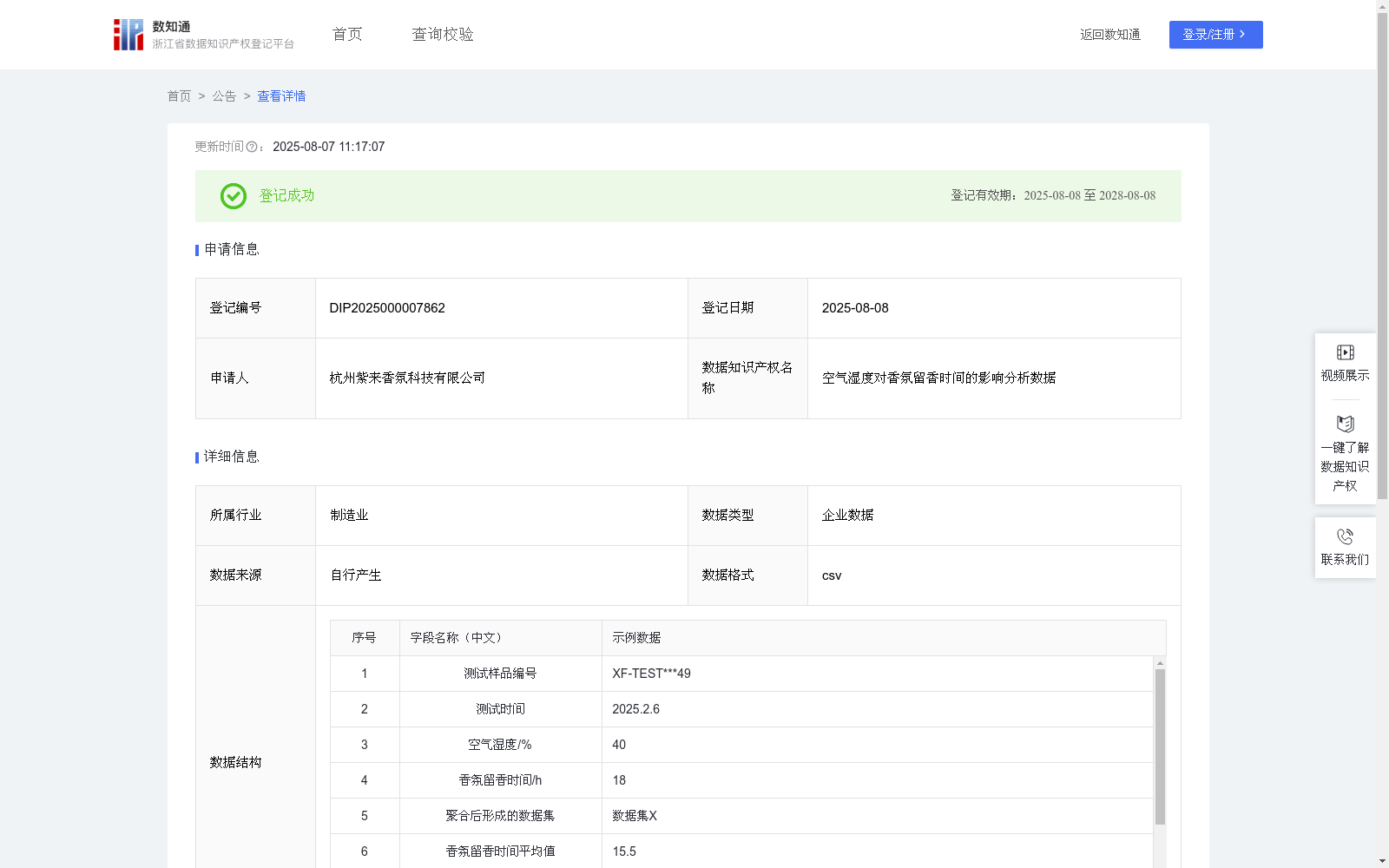
空气湿度对香氛留香时间的影响分析数据
收藏资源简介:
本数据聚焦于分析空气湿度对香氛留香时间的影响,揭示了空气湿度与香氛留香时长之间的量化关系,为公司(作为经销商)及外部相关方提供了重要的决策依据,具有显著的应用价值。具体体现在以下方面: 1.优化产品销售:不同地区空气湿度差异显著,如沿海城市湿度较高,而内陆干旱地区湿度较低。公司借助空气湿度对香氛留香时间的影响数据,能够依据目标销售区域的湿度特点,有针对性地调整香氛产品销售策略。 2.推动行业标准制定:本数据作为香氛行业关于空气湿度影响留香时间的重要研究资料,可为香氛行业标准制定机构提供科学依据。在制定香氛产品性能标准、质量检测标准以及使用说明规范等方面,充分考虑空气湿度因素对香氛留香时间的影响,使行业标准更加全面、准确、科学,能够更好地适应不同环境条件下的市场需求,促进整个香氛行业的规范化发展。1.数据采集:实时记录不同空气湿度下的香氛留香时间测试数据,包括测试样品编号、测试时间、空气湿度/%、香氛留香时间/h等字段。 2.数据预处理:(1)对采集的数据进行去噪处理,确保数据准确性。(2)将历史采集的数据(包含本次采集)进行聚合,形成数据集X,并针对数据集X中的香氛留香时间字段,计算出其平均值。 3.计算线性回归斜率a和截距b:基于数据集X(以空气湿度为自变量、香氛留香时间为因变量),运用SLOPE函数,基于最小二乘法原理确定斜率a,运用INTERCEPT函数确定截距b。斜率a表示单位空气湿度变化对香氛留香时间的影响程度,截距b表示基准空气湿度下香氛的留香时间值。 4.结果运用:(1)计算比例系数k:k=|a/香氛留香时间平均值|×100%;(2)若k≥10%,则判定为“高影响”,若5%≤k<10%,则判定为“中影响”,若k<5%,则判定为“低影响”。
This dataset focuses on analyzing the impact of air humidity on fragrance retention time, revealing the quantitative relationship between air humidity and fragrance retention duration. It provides important decision-making basis for the company (as a distributor) and external stakeholders, with significant application value, which is reflected in the following aspects: 1. Optimizing product sales: There are significant differences in air humidity across regions. For example, coastal cities have relatively high humidity, while inland arid regions have relatively low humidity. With the data on the impact of air humidity on fragrance retention time, the company can tailor its fragrance product sales strategies according to the humidity characteristics of the target sales area. 2. Promoting the formulation of industry standards: As an important research material for the fragrance industry regarding the impact of air humidity on fragrance retention time, this dataset can provide scientific evidence for fragrance industry standard-setting bodies. When formulating performance standards, quality inspection standards, and usage instruction specifications for fragrance products, fully considering the impact of air humidity on fragrance retention time will make industry standards more comprehensive, accurate, and scientific, better adapt to market demand under different environmental conditions, and promote the standardized development of the entire fragrance industry. 1. Data collection: Real-time recording of test data on fragrance retention time under different air humidity levels, including fields such as test sample ID, test time, air humidity (unit: %), and fragrance retention time (unit: h). 2. Data preprocessing: (1) Denoise the collected data to ensure data accuracy. (2) Aggregate all historically collected data (including this batch of collected data) to form dataset X, and calculate the mean value of the fragrance retention time field in dataset X. 3. Calculating the linear regression slope a and intercept b: Based on dataset X (with air humidity as the independent variable and fragrance retention time as the dependent variable), use the SLOPE function to determine the slope a according to the principle of least squares, and use the INTERCEPT function to determine the intercept b. The slope a represents the degree of impact of unit air humidity change on fragrance retention time, while the intercept b represents the fragrance retention time value under the reference air humidity. 4. Result application: (1) Calculate the proportional coefficient k: k = |a / mean value of fragrance retention time| × 100%; (2) Classify as "high impact" if k ≥ 10%, "moderate impact" if 5% ≤ k < 10%, and "low impact" if k < 5%.