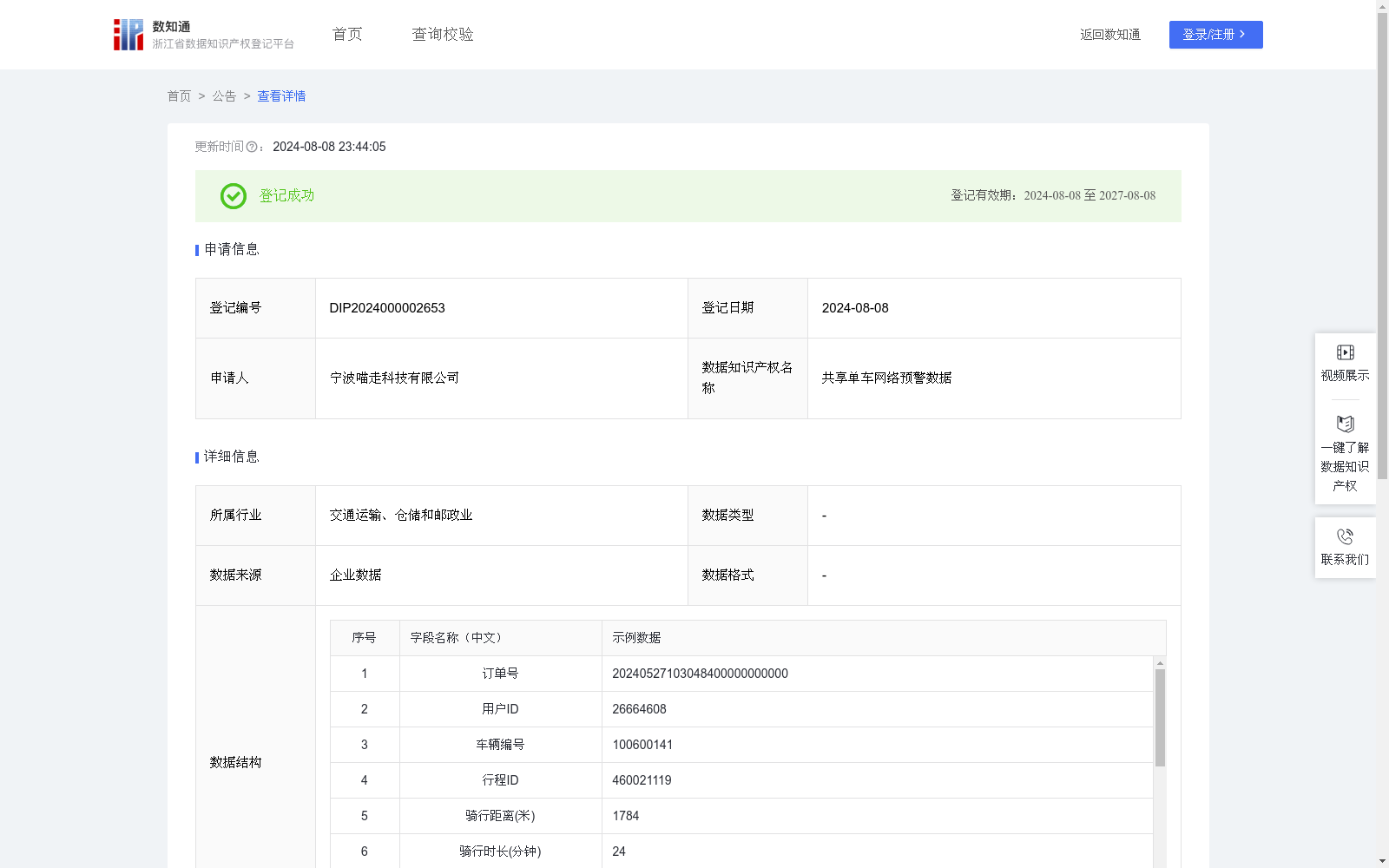
共享单车网络预警数据
收藏资源简介:
通过判断区域内日常业务规模是否超出网络容量警戒值,区域内高峰时段业务规模是否即将超出网络容量警戒值,来安排及时进行网络扩容,保证该区域内的用户的网络使用,提升用户用车体验及出行效率。1、数据采集:订单号,用户ID,车辆编号,行程ID,骑行距离(米),骑行时长(分钟),车辆定位,支付状态,订单费用,骑行卡抵扣,优惠券抵扣,实际支付金额,支付时间,订单时间。 2、数据处理:对采集到的原始数据进行处理,去除缺失和异常数据。统计预设周期内基站覆盖区域内车载终端+移动终端的总业务量F1,统计预设周期内基站覆盖区域内车载终端+移动终端的总峰值业务量F2。3、数据分析:通过数据拟合、线性规划预估参数。第一预设基站配置阈值N1*T1,N1为基站满负荷下业务量,T1是固定参数,第二预设基站配置阈值N1*T2,T2是固定参数,A1=IFS(F1>N1*T1, "预警", "良好"),A2=IFS(F2>N1*T2, "预警", "良好"),A1:判断区域内日常业务规模是否超出网络容量警戒值,A2:判断区域内高峰时段业务规模是否即将超出网络容量警戒值。4、数据应用:通过判断区域内日常业务规模是否超出网络容量警戒值,区域内高峰时段业务规模是否即将超出网络容量警戒值,来安排及时进行网络扩容,保证该区域内的用户的网络使用,提升用户用车体验及出行效率。
This dataset is designed to enable timely network capacity expansion by evaluating whether the daily business scale in a target area exceeds the network capacity warning threshold and whether the peak-hour business scale in the area is about to exceed the threshold, so as to ensure network access for local users and enhance users' vehicle usage experience and travel efficiency. 1. Data Collection: The collected data includes order number, user ID, vehicle ID, trip ID, riding distance (meters), riding duration (minutes), vehicle positioning, payment status, order fee, riding card deduction, coupon deduction, actual payment amount, payment time, and order time. 2. Data Processing: Process the collected raw data by eliminating missing and abnormal data. Calculate the total business volume F1 of vehicle-mounted terminals and mobile terminals within the base station coverage area during a preset cycle, and calculate the total peak business volume F2 of vehicle-mounted terminals and mobile terminals within the same base station coverage area during the preset cycle. 3. Data Analysis: Estimate relevant parameters via data fitting and linear programming. The first preset base station configuration threshold is N1*T1, where N1 represents the business volume when the base station is fully loaded, and T1 is a fixed parameter; the second preset base station configuration threshold is N1*T2, where T2 is a fixed parameter. Define two assessment indicators: A1=IFS(F1 > N1*T1, "Warning", "Good") and A2=IFS(F2 > N1*T2, "Warning", "Good"). Here, A1 is used to judge whether the daily business scale in the area exceeds the network capacity warning threshold, while A2 is used to judge whether the peak-hour business scale in the area is about to exceed the network capacity warning threshold. 4. Data Application: Arrange timely network capacity expansion by judging whether the daily business scale in the area exceeds the network capacity warning threshold and whether the peak-hour business scale in the area is about to exceed the network capacity warning threshold, so as to guarantee network usage for users in the area and improve users' vehicle usage experience and travel efficiency.