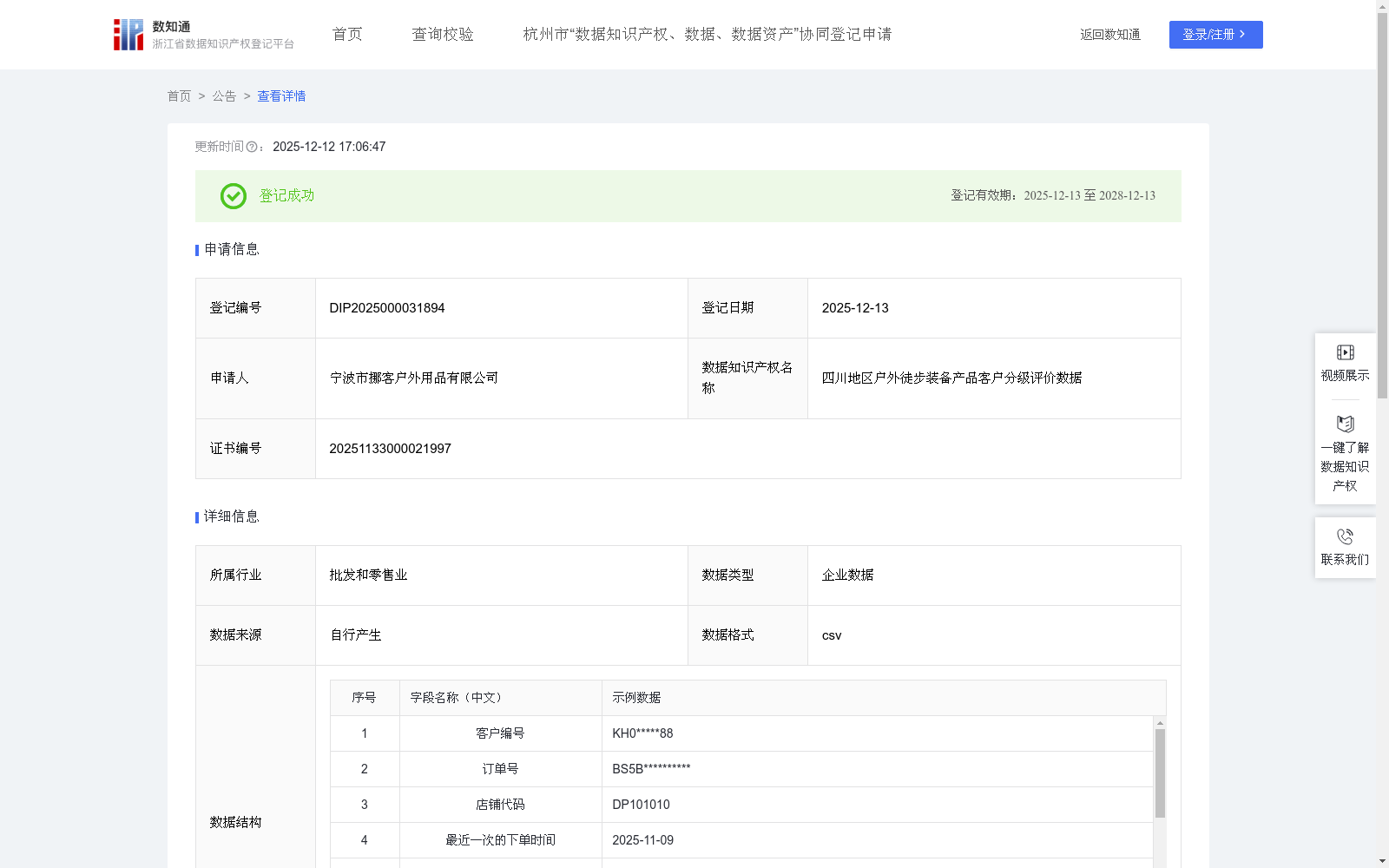
四川地区户外徒步装备产品客户分级评价数据
收藏资源简介:
户外徒步装备产品四川地区客户分级评价数据,对客户的购买行为进行量化评估和等级划分,实现销售资源的精准配置。针对A级客户,建议每月沟通1至2次,优先配置技术支持与产品定制服务资源,深度挖掘客户装备升级、团队采购、户外活动组织等需求;针对B级客户,建议每季度沟通1至2次,维护长期合作关系,关注其户外活动频次变化,适时推动其向A级客户转化;针对C级客户,建议每半年沟通1至2次,了解户外运动趋势和潜在需求,识别高成长性客户;针对D级客户,建议年度回访,通过节日促销、新品推荐等方式激活沉睡用户。本数据不仅支撑企业内部销售管理,更具备显著的产业链协同价值:对于上游供应商(铝合金材料供应商、碳纤维制造商、户外面料生产商),客户采购频次和金额数据可预测市场需求趋势,优化库存和生产计划;对于下游渠道商(户外运动专卖店、电商平台、旅游服务机构),按省份划分的装备采购数据反映了区域户外运动热度和消费能力,为其市场布局和营销策略提供参考;对于金融服务机构,客户分级数据可作为消费金融服务、信用评估和授信决策的重要依据。1.数据采集 采集本公司户外徒步装备产品四川地区客户的相关购买数据。其中,采集数据字段包括"客户编号"、"订单号"、"店铺代码"、"省份"、"产品名称"、"订单金额(元)"等信息;通过数据汇总计算得出"历史购买总次数"和"历史购买总金额(元)",用于评估客户的购买频次和消费能力。历史服务时间段:2020年1月1日至统计时间期间。字段说明:其中"订单号"、"最近一次的下单时间"、"产品名称"、"订单金额(元)"这四个字段表示客户最近一次购买的具体信息。2. 数据处理 对采集的历史购买总金额(元)与历史购买总次数等数据进行分类、合并、累加,以便模型分析使用;客户编号等敏感信息均已进行脱敏处理。数据处理步骤:按客户编号汇总订单数据,计算每位客户的历史购买总次数和历史购买总金额;识别每位客户的最近一次的下单时间和订单金额;计算最近一次的下单时间距离统计时间的天数。 3. 算法加工 (1)R评分:根据客户最近一次的下单时间距离统计时间的天数(D)划分为5个等级:0 ≤ D ≤ 10天为5分;10 < D ≤ 30天为4分;30 < D ≤ 60天为3分;60 < D ≤ 120天为2分;120 < D为1分。(2)F评分:根据客户历史购买总次数(S)划分为5个等级:0≤S ≤1次为1分;1 < S ≤ 3次为2分;3 < S ≤ 5次为3分;5 < S ≤ 7次为4分;7 < S为5分。(3)M评分:根据客户历史购买总金额(元)(Z)划分为5个等级:0 < Z ≤ 100元为1分;100 < Z ≤ 350元为2分;350 < Z ≤ 800元为3分;800 < Z ≤ 1500元为4分;1500 < Z为5分。(4)RFM总分(X) = 0.3 × R评分 + 0.3 × F评分 + 0.4 × M评分。客户等级分为ABCD四级:D级客户:1.0 ≤ X < 2.0(低活跃客户)- 建议年度回访,通过促销激活;C级客户:2.0 ≤ X < 3.0(普通客户)- 建议每半年沟通1至2次;B级客户:3.0 ≤ X < 4.0(重要客户)- 建议每季度沟通1至2次;A级客户:4.0 ≤ X ≤ 5.0(高价值客户)- 建议每月沟通1至2次。
This is a customer hierarchical evaluation dataset for outdoor hiking gear products in Sichuan Province, which quantitatively evaluates and grades customers' purchasing behaviors to enable precise allocation of sales resources. For Tier A customers, it is recommended to communicate 1 to 2 times per month, prioritize the allocation of technical support and product customization service resources, and deeply tap into customers' demands for gear upgrades, team purchases, organizing outdoor activities and other needs; For Tier B customers, it is recommended to communicate 1 to 2 times per quarter to maintain long-term cooperative relationships, pay attention to changes in their outdoor activity frequency, and timely promote their transformation to Tier A customers; For Tier C customers, it is recommended to communicate 1 to 2 times per semi-annual period to understand outdoor sports trends and potential demands, and identify high-growth customers; For Tier D customers, it is recommended to conduct annual revisit and activate dormant customers through holiday promotions, new product recommendations and other methods. This dataset not only supports the internal sales management of the enterprise, but also has significant industrial chain synergy value: For upstream suppliers (aluminum alloy material suppliers, carbon fiber manufacturers, outdoor fabric manufacturers), the customer purchase frequency and amount data can forecast market demand trends and optimize inventory and production plans; For downstream channel merchants (outdoor sports specialty stores, e-commerce platforms, tourism service institutions), the provincial-level gear purchase data reflects regional outdoor sports popularity and consumption capacity, providing reference for their market layout and marketing strategies; For financial service institutions, customer hierarchical data can serve as an important basis for consumer financial services, credit assessment and credit granting decisions. 1. Data Collection Collect relevant purchase data of customers of the company's outdoor hiking gear products in Sichuan Province. The collected data fields include customer ID, order number, store code, province, product name, order amount (CNY) and other information; Total historical purchase times and total historical purchase amount (CNY) are calculated via data aggregation to evaluate customers' purchase frequency and consumption capacity. The historical service timeframe spans from January 1, 2020 to the statistical cutoff time. Field description: The four fields of order number, latest order time, product name and order amount (CNY) represent the specific information of the customer's most recent purchase. 2. Data Processing The collected data including total historical purchase amount (CNY) and total historical purchase times are classified, merged and accumulated for model analysis; Sensitive information such as customer IDs has undergone data desensitization processing. Data processing steps: 1. Aggregate order data by customer ID, calculate the total historical purchase times and total historical purchase amount for each customer; 2. Identify the latest order time and order amount for each customer; 3. Calculate the number of days between the latest order time and the statistical cutoff time. 3. Algorithm Processing (1) R Score: Divided into 5 levels based on the number of days (D) between the customer's latest order time and the statistical cutoff time: 5 points for 0 ≤ D ≤ 10 days; 4 points for 10 < D ≤ 30 days; 3 points for 30 < D ≤ 60 days; 2 points for 60 < D ≤ 120 days; 1 point for D > 120 days. (2) F Score: Divided into 5 levels based on the customer's total historical purchase times (S): 1 point for 0 ≤ S ≤ 1; 2 points for 1 < S ≤ 3; 3 points for 3 < S ≤ 5; 4 points for 5 < S ≤ 7; 5 points for S > 7. (3) M Score: Divided into 5 levels based on the customer's total historical purchase amount (CNY) (Z): 1 point for 0 < Z ≤ 100; 2 points for 100 < Z ≤ 350; 3 points for 350 < Z ≤ 800; 4 points for 800 < Z ≤ 1500; 5 points for Z > 1500. (4) Total RFM Score (X) = 0.3 × R Score + 0.3 × F Score + 0.4 × M Score. Customer levels are divided into four tiers: Tier D customers: 1.0 ≤ X < 2.0 (low-activity customers) - recommended annual revisit and activation via promotions; Tier C customers: 2.0 ≤ X < 3.0 (ordinary customers) - recommended 1-2 communications per semi-annual period; Tier B customers: 3.0 ≤ X < 4.0 (key customers) - recommended 1-2 communications per quarterly period; Tier A customers: 4.0 ≤ X ≤ 5.0 (high-value customers) - recommended 1-2 communications per monthly period.