Knockdown of fatty acid binding protein 3 attenuates cerebral Ischemia-reperfusion injury <i>via</i> inhibiting neuronal apoptosis in mice
收藏资源简介:
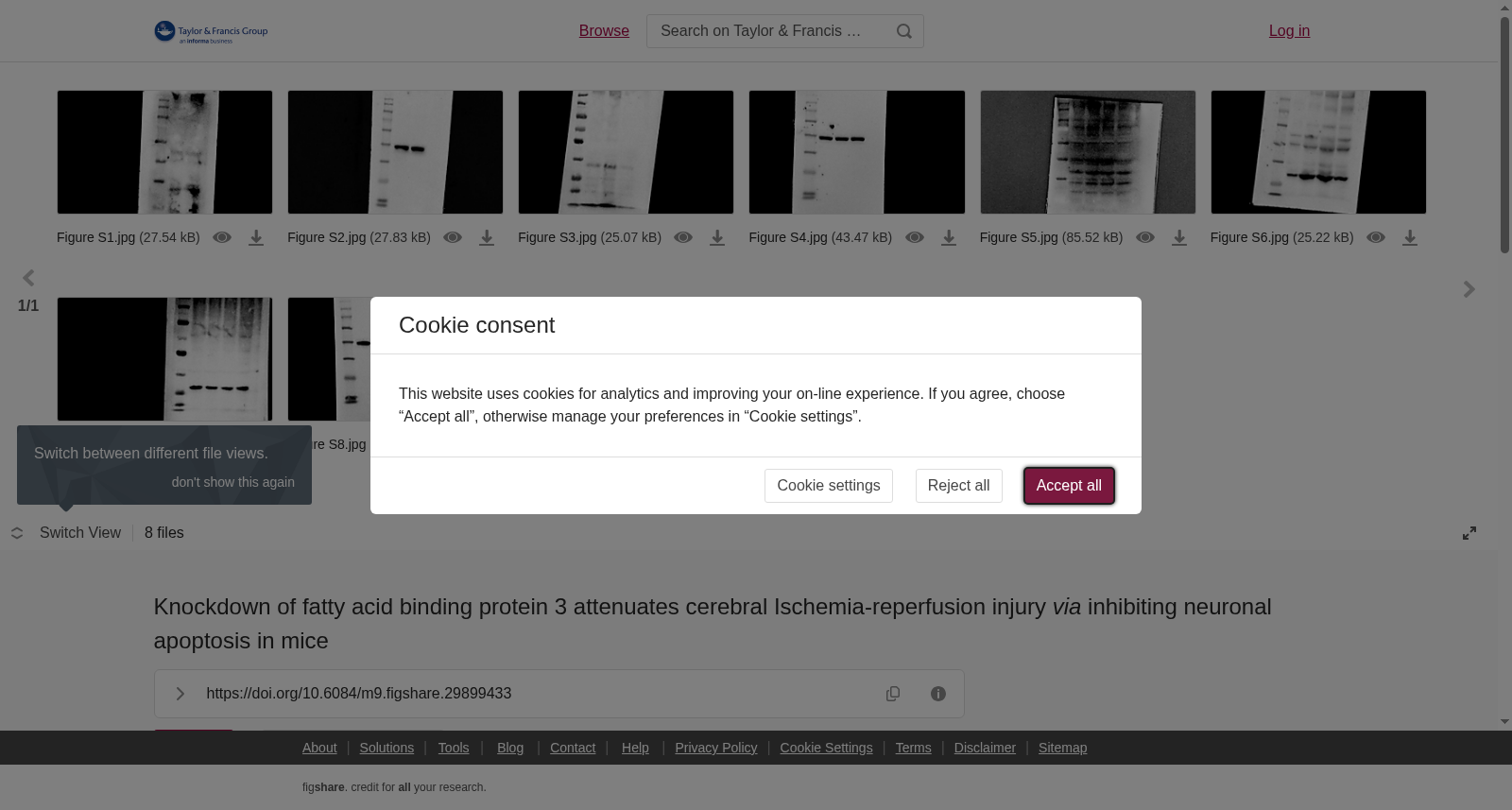
Background: Stroke remains a leading cause of death and disability worldwide, with ischemic stroke accounting for approximately 87% of cases. Although timely reperfusion is crucial for salvaging the ischemic penumbra, it can paradoxically exacerbate tissue damage through ischemia-reperfusion (I/R) injury. Recent studies have demonstrated that I/R significantly upregulates fatty acid binding protein 3(FABP3) expression, which has been shown to play a crucial role in mitochondrial dysfunction and neuronal apoptosis. However, the role of FABP3 in cerebral I/R injury remains poorly understood. Methods: Adult male C57BL/6 mice underwent transient middle cerebral artery occlusion (tMCAO) for 2 h followed by 24 h of reperfusion. Mice were randomly assigned to four groups (<i>n</i> = 5 per group): control (sham), model (I/R), negative control (sh-NC I/R), and experimental group (sh-FABP3 I/R). FABP3-specific shRNA lentivirus was administered <i>via</i> intracerebroventricular injection. Infarct volume was assessed by 2,3,5-triphenyltetrazolium chloride (TTC) staining, neurological function by behavioral scoring, and neuronal damage by hematoxylin-eosin (H&E) staining. Western blot analysis was performed to evaluate the expression of apoptosis-related proteins. Results: FABP3 expression was significantly upregulated following cerebral I/R injury. FABP3 knockdown markedly reduced infarct volume (20 ± 3.16% <i>vs</i>. 35 ± 2.43% in I/R group, <i>p</i> < 0.001) and improved neurological scores. Histological analysis revealed that FABP3 inhibition significantly attenuated neuronal damage in the penumbra cortex and hippocampal Cornu Ammonis area 1(CA1) region. Moreover, FABP3 knockdown decreased the expression of pro-apoptotic proteins (Bax, cleaved-caspase-3) while increasing anti-apoptotic Bcl-2 levels. Conclusions: This study demonstrates for the first time that FABP3 knockdown confers neuroprotection against cerebral I/R injury by suppressing neuronal apoptosis. These findings suggest that FABP3 is a promising therapeutic target for ischemic stroke treatment. FABP3 knockdown reduces infarct volume and neurological deficits after cerebral ischemia‑reperfusion injury by suppressing neuronal apoptosis, suggesting FABP3 is a potential therapeutic target. FABP3 is significantly up-regulated in mouse brain after transient cerebral I/R injury.Intracerebroventricular FABP3-shRNA lentivirus was used to down-regulate FABP3 expression in tMCAO mice.FABP3 inhibition reduces infarct volume and improves neurological scores. FABP3 knockdown suppressing neuronal apoptosis.FABP3 is a potential therapeutic target for ischemic stroke. FABP3 is significantly up-regulated in mouse brain after transient cerebral I/R injury. Intracerebroventricular FABP3-shRNA lentivirus was used to down-regulate FABP3 expression in tMCAO mice. FABP3 inhibition reduces infarct volume and improves neurological scores. FABP3 knockdown suppressing neuronal apoptosis. FABP3 is a potential therapeutic target for ischemic stroke.
背景:脑卒中仍是全球范围内致死与致残的首要病因之一,其中缺血性脑卒中(ischemic stroke)约占所有病例的87%。尽管及时再灌注对挽救缺血半暗带(ischemic penumbra)至关重要,但该过程反而可能通过缺血再灌注(ischemia-reperfusion, I/R)损伤加重组织损伤。近期研究表明,缺血再灌注可显著上调脂肪酸结合蛋白3(fatty acid binding protein 3, FABP3)的表达,而该蛋白已被证实与线粒体功能障碍(mitochondrial dysfunction)及神经元凋亡(neuronal apoptosis)密切相关。然而,FABP3在脑缺血再灌注损伤中的具体作用仍有待阐明。 方法:选用成年雄性C57BL/6小鼠,接受2小时的暂时性大脑中动脉阻塞(transient middle cerebral artery occlusion, tMCAO)造模,随后再灌注24小时。将小鼠随机分为4组(每组n=5):假手术对照组(sham组)、缺血再灌注模型组(I/R组)、阴性对照组(sh-NC I/R组)以及实验组(sh-FABP3 I/R组)。通过侧脑室注射(intracerebroventricular injection)给予靶向FABP3的短发夹RNA(short hairpin RNA, shRNA)慢病毒。采用2,3,5-三苯基氯化四氮唑(2,3,5-triphenyltetrazolium chloride, TTC)染色检测脑梗死体积,通过行为学评分(behavioral scoring)评估神经功能,利用苏木精-伊红(hematoxylin-eosin, H&E)染色观察神经元损伤情况。采用蛋白质印迹法(Western blot)检测凋亡相关蛋白的表达水平。 结果:脑缺血再灌注损伤后,小鼠脑组织中FABP3的表达显著上调。敲低FABP3可显著降低脑梗死体积[(20±3.16)% vs 模型组的(35±2.43)%,P<0.001],并改善神经功能评分。组织学分析显示,抑制FABP3可显著减轻半暗带皮层及海马CA1区(hippocampal Cornu Ammonis area 1, CA1)的神经元损伤。此外,敲低FABP3可下调促凋亡蛋白(Bax、裂解型半胱氨酸天冬氨酸蛋白酶3,cleaved-caspase-3)的表达,同时上调抗凋亡蛋白B细胞淋巴瘤-2(B-cell lymphoma-2, Bcl-2)的水平。 结论:本研究首次证实,敲低FABP3可通过抑制神经元凋亡,对脑缺血再灌注损伤发挥神经保护作用。上述研究结果表明,FABP3是缺血性脑卒中极具潜力的治疗靶点。 敲低FABP3可通过抑制神经元凋亡,减轻脑缺血再灌注损伤后的脑梗死体积与神经功能缺损,提示FABP3是缺血性脑卒中的潜在治疗靶点。 脑缺血再灌注损伤后,小鼠脑组织中FABP3的表达显著上调。 通过侧脑室注射靶向FABP3的短发夹RNA慢病毒,可在tMCAO小鼠中下调FABP3的表达。 抑制FABP3可降低脑梗死体积并改善神经功能评分。 敲低FABP3可抑制神经元凋亡。 FABP3是缺血性脑卒中的潜在治疗靶点。 脑缺血再灌注损伤后,小鼠脑组织中FABP3的表达显著上调。 通过侧脑室注射靶向FABP3的短发夹RNA慢病毒,可在tMCAO小鼠中下调FABP3的表达。 抑制FABP3可降低脑梗死体积并改善神经功能评分。 敲低FABP3可抑制神经元凋亡。 FABP3是缺血性脑卒中的潜在治疗靶点。