
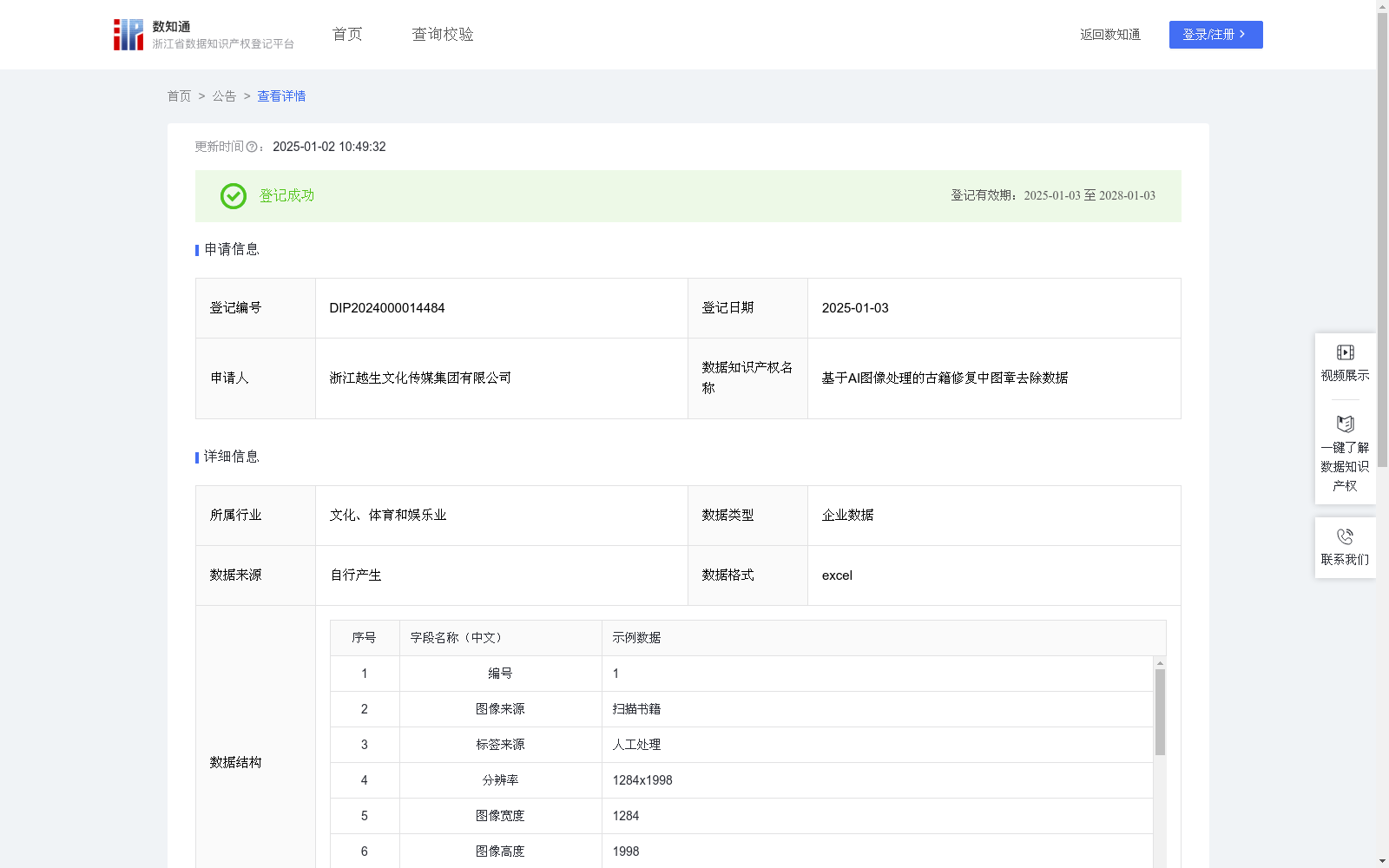
基于AI图像处理的古籍修复中图章去除数据
收藏浙江省数据知识产权登记平台2025-01-02 更新2025-01-03 收录
下载链接:
https://www.zjip.org.cn/home/announce/trends/109792
下载链接
链接失效反馈官方服务:
资源简介:
本数据集利用AI图像修复中的图章去除技术,提取了图像来源、分辨率、尺寸、条码印章污点和笔迹占比等关键数据,不仅增强了OCR的准确性,还支持自动化批量处理历史文献,通过数据分析筛选出清晰电子版本以利于长期保存和研究。通过PSNR和SSIM等模型数据,评估指标确保修复效果。同时,数据增强参数数据(如随机裁剪、旋转等)提高了模型训练的泛化能力,而风格损失和感知损失分析数据评价图像生成质量。像素密度、分辨率等参数数据有助于调优打印与扫描质量,污点和笔迹占比数据用于图像质量控制,通过颜色模式调整数据可以优化图像的颜色和格式转换。本算法旨在对文献图像进行数字化处理,包括数据采集、图像预处理、训练和模型评估四个主要阶段。以下是每个阶段的技术参数和操作流程:1.数据采集阶段:通过高分辨率扫描仪,逐页扫描文献,生成电子图像。并按照书籍和页码顺序存放扫描后的电子图像。2.图像预处理阶段:通过聚类式自适应二值化算法与图像处理软件,涂抹、擦除和替换等方法去除图像中的污点、条码、印章和手写笔迹,最终生成原始图像和修复图像一对一的数据集。3.训练阶段:通过使用生成对抗网络(GAN)模型架构,使生成的图像尽可能接近修复图像。其中包括数据增强训练、损失函数训练:颜色损失:衡量生成图像与真实图像的颜色差异、风格损失:确保生成图像在风格上与真实图像一致、感知损失:基于高层次特征的损失,帮助改善图像质量、结构损失:关注图像的结构相似性。4.模型评估阶段:性能指标评估:PSNR(峰值信噪比):用于衡量图像质量,值越高表示质量越好、SSIM(结构相似性指数):评估图像的结构相似性,值接近1表示图像质量极高;模型损失评估:风格损失:较小的值表示生成图像与目标风格接近、感知损失,表示生成图像在感知特征上与真实图像差异较小。
This dataset leverages stamp removal techniques in AI image inpainting to extract key data including image source, resolution, dimensions, barcode, seal stains and handwriting proportion. It not only improves the accuracy of OCR, but also supports automated batch processing of historical documents, and filters clear electronic versions via data analysis to facilitate long-term preservation and research. Evaluation indicators such as PSNR and SSIM are used to validate the effectiveness of image restoration. Meanwhile, data augmentation parameters (e.g., random cropping, rotation, etc.) enhance the generalization ability of model training, while style loss and perceptual loss analysis data are used to evaluate the quality of image generation. Parameter data such as pixel density and resolution help optimize printing and scanning quality, while stain and handwriting proportion data are used for image quality control. Color mode adjustment data can optimize image color and format conversion. This algorithm is designed for digitization of document images, which includes four main stages: data collection, image preprocessing, training and model evaluation. The technical parameters and operation procedures of each stage are as follows:
1. Data Collection Stage: Scan documents page by page using high-resolution scanners to generate electronic images, and store the scanned electronic images in the order of books and page numbers.
2. Image Preprocessing Stage: Use cluster-based adaptive binarization algorithms and image processing software, along with methods such as smearing, erasing and replacing, to remove stains, barcodes, seals and handwritten traces from images, and finally generate a one-to-one dataset of original images and restored images.
3. Training Stage: Adopt the Generative Adversarial Network (GAN) model architecture to make the generated images as close as possible to the restored images. This includes data augmentation training and loss function training:
- Color loss: measures the color difference between generated images and real images
- Style loss: ensures that the generated images are consistent with real images in terms of style
- Perceptual loss: a loss based on high-level features that helps improve image quality
- Structural loss: focuses on the structural similarity of images
4. Model Evaluation Stage:
- Performance indicator evaluation:
- PSNR (Peak Signal-to-Noise Ratio): used to measure image quality, with higher values indicating better quality
- SSIM (Structural Similarity Index): evaluates the structural similarity of images, with values close to 1 indicating extremely high image quality
- Model loss evaluation:
- Style loss: smaller values indicate that the generated images are close to the target style
- Perceptual loss: indicates that the generated images have small differences from real images in terms of perceptual features
提供机构:
浙江越生文化传媒集团有限公司
创建时间:
2024-11-01
搜集汇总
数据集介绍
以上内容由遇见数据集搜集并总结生成



