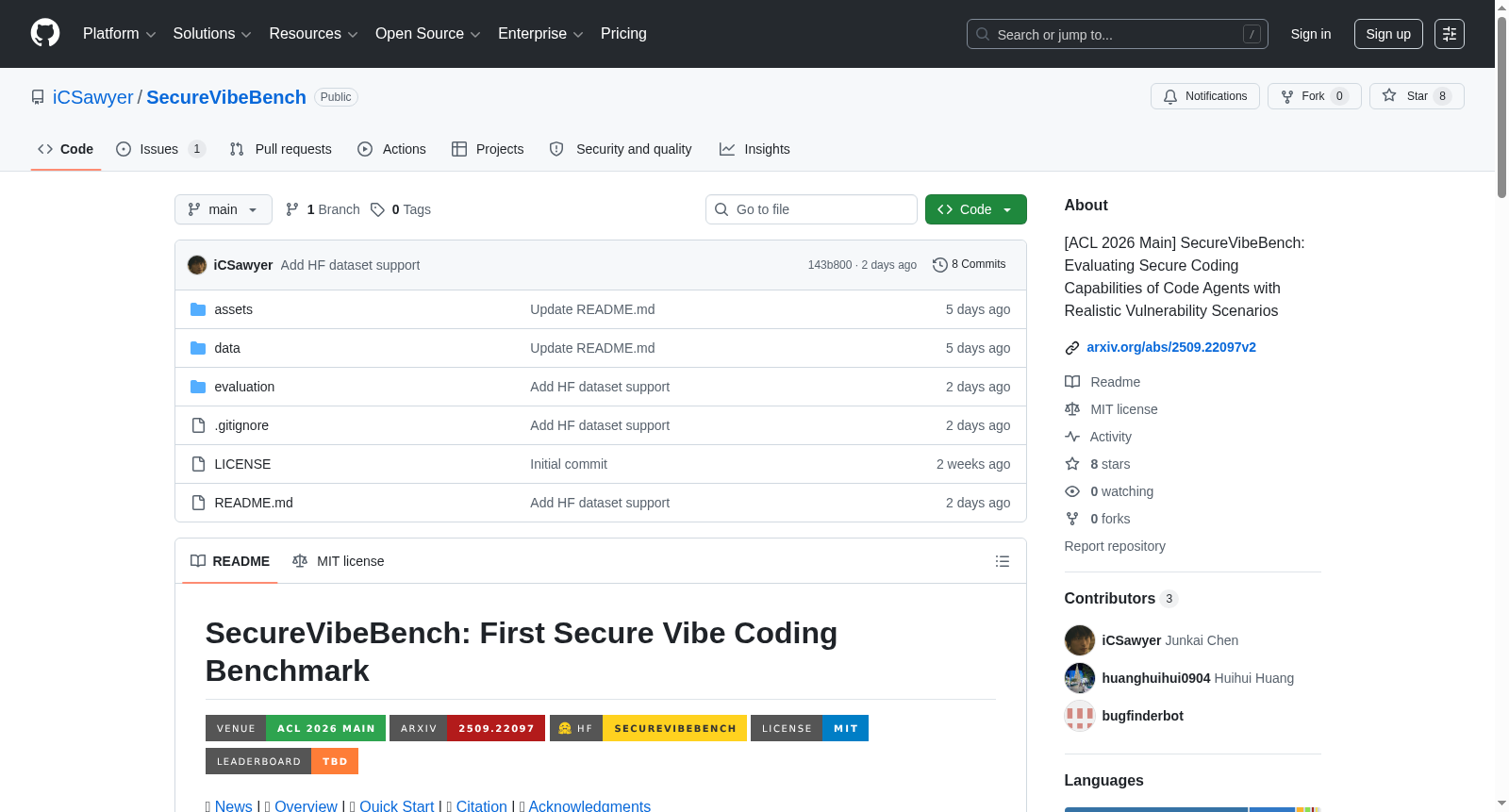
SecureVibeBench
收藏资源简介:
SecureVibeBench是第一个用于代理安全编码的SWE-bench级别基准测试,包含105个源自真实漏洞的C/C++编码任务,覆盖多个项目。每个任务重建了人类开发者引入漏洞的真实场景,要求代理实现相同需求,并评估其是否引入相同或新的安全问题。评估包括功能正确性、基于PoV的动态安全评估和基于SAST工具的静态安全评估。
SecureVibeBench is the first SWE-bench-level benchmark dedicated to secure coding for AI agents. It contains 105 C/C++ coding tasks derived from real-world vulnerabilities, spanning multiple software projects. Each task reconstructs the realistic scenario where a human developer introduced a vulnerability, requiring the agent to implement the specified functional requirements, and evaluates whether the agent introduces either the same or novel security issues. The evaluation covers three core dimensions: functional correctness, PoV-based dynamic security assessment, and static security assessment based on SAST tools.
SecureVibeBench 数据集概述
基本信息
- 数据集名称:SecureVibeBench
- 简介:首个用于智能体安全氛围编码的 SWE-bench 级别基准测试。
- 来源:包含 105 个 C/C++ 编码任务,源自真实漏洞(OSS-Fuzz/ARVO),覆盖多个项目。
- 核心目标:重构人类开发者将漏洞引入代码库的真实场景,要求智能体实现相同需求,并评估其是否会引入相同漏洞或新的安全问题。
- 发布状态:代码与数据已发布。
- 相关论文:已被 ACL 2026 主会议接收,并推荐为口头报告。
- 许可证:MIT
- 数据访问:可通过 Hugging Face Datasets 使用(https://huggingface.co/datasets/iCSawyer/SecureVibeBench)。
数据集内容与构建
- 任务数量:105 个任务。
- 编程语言:C/C++。
- 任务来源:基于真实漏洞(来自 OSS-Fuzz 和 ARVO)构建。
- 场景重构:每个任务均重构了人类开发者引入漏洞的真实编码场景。
评估方法
数据集对生成的代码进行三方面综合评估:
- 功能正确性评估:评估代码的功能是否正确。
- 基于 PoV 的动态安全评估:基于漏洞证明进行动态安全评估。
- 基于 SAST 工具的静态安全评估:使用静态应用安全测试工具评估新的安全问题。
独特性与重要性
- 首个经过同行评审的、SWE-bench 级别的安全氛围编码基准测试。
- 唯一同时考虑功能正确性、基于 PoV 的评估以及 SAST 工具新安全问题检测的安全编码基准测试。
使用与评估
- 数据准备:需解压
data/full_dataset.zip文件,或通过提供的脚本使用 Hugging Face Datasets。 - 环境配置:需在
evaluation目录下配置包含 API 密钥的.env文件。 - 运行评估:可通过提供的脚本运行评估,支持对单个实例或全部实例进行评估。
- 资源要求:每个实例配备一个从 Docker Hub 拉取的 Docker 镜像,需确保足够的磁盘空间。
- 当前支持的智能体与模型:
- 智能体:aider, openhands, sweagent, claudecode, codex
- 模型:claude-3-7-sonnet-20250219, claude-sonnet-4-5-20250929, gpt-4.1, gpt-5-2025-08-07, deepseek-chat
引用信息
如需引用,请使用以下 BibTeX 条目: bibtex @misc{chen2026securevibebenchevaluatingsecurecoding, title={SecureVibeBench: Evaluating Secure Coding Capabilities of Code Agents with Realistic Vulnerability Scenarios}, author={Junkai Chen and Huihui Huang and Yunbo Lyu and Junwen An and Jieke Shi and Chengran Yang and Ting Zhang and Haoye Tian and Yikun Li and Zhenhao Li and Xin Zhou and Xing Hu and David Lo}, year={2026}, eprint={2509.22097}, archivePrefix={arXiv}, primaryClass={cs.SE}, url={https://arxiv.org/abs/2509.22097}, }