Benchmarking_markerless
收藏资源简介:
我们提出了一个用于无标记运动捕捉分析的基准平台,将无标记方法与传统的基于标记的运动分析进行比较。该平台包含两个主要组件:1) 一个包含实验数据(视频+标记轨迹)的数据存储库;2) 这个GitHub仓库,其中包括:使用几种无标记方法获得的关节运动估计(每种方法的描述);使用基于标记的数据获得的关节运动估计;用于比较结果的示例代码。
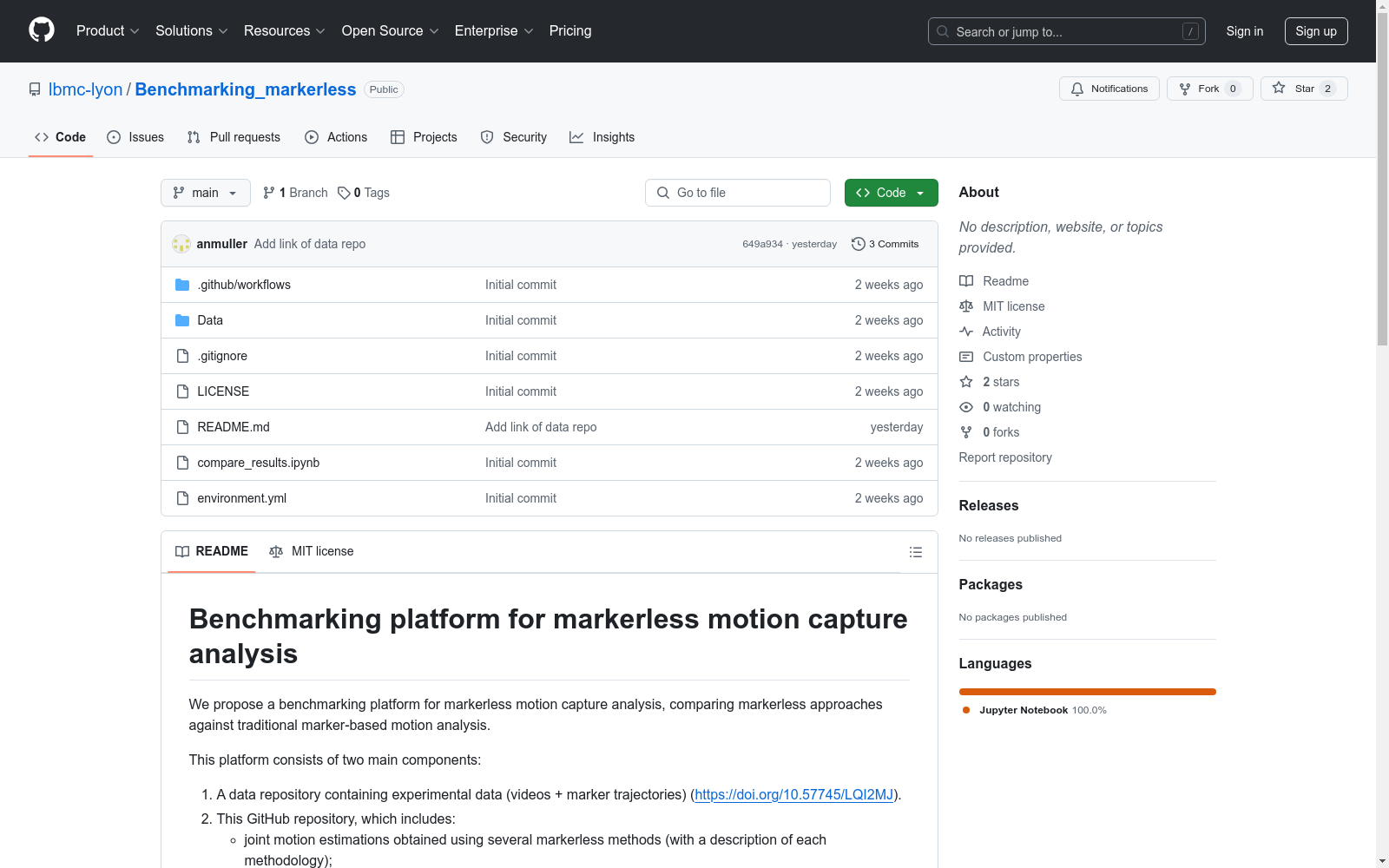
We propose a benchmark platform for markerless motion capture analysis, which facilitates the comparison between markerless motion analysis approaches and traditional marker-based methods. The platform comprises two primary components: 1) a data repository storing experimental data (video + marker trajectories); 2) this GitHub repository, which includes: joint motion estimates obtained using several markerless methods (with respective descriptions of each method), joint motion estimates derived from marker-based data, and sample code for result comparison.
数据集概述
数据集简介
- 名称:Benchmarking platform for markerless motion capture analysis
- 目的:提供无标记运动捕捉分析的基准测试平台,用于比较无标记方法与传统的基于标记的运动分析方法。
数据集组成
- 数据存储库:包含实验数据(视频+标记轨迹),可通过DOI访问(https://doi.org/10.57745/LQI2MJ)。
- GitHub存储库:
- 使用多种无标记方法获得的关节运动估计(包含每种方法的描述);
- 使用基于标记的数据获得的关节运动估计;
- 用于比较结果的示例代码(
compare_results.ipynb)。
标记工作流程
- 基于回归方法生成生物力学模型(参考Dumas和Wojtusch, 2018);
- 使用多体运动学优化(MKO)计算关节坐标;
- 每个关节定义为自由关节(6自由度);
- MKO使用biorbd库实现(Michaud和Begon, 2021)。
分析变量
针对每个任务和每个参与者,关注的10个关节运动:
- 右髋关节屈曲/伸展(
RHip_FE); - 右髋关节内收/外展(
RHip_AA); - 右膝关节屈曲/伸展(
RKnee_FE); - 右踝关节屈曲/伸展(
RAnkle_FE); - L5/S1关节屈曲/伸展(
L5S1_FE); - 右肩关节内收/外展(
RShoulder_AA); - 右肩关节内旋/外旋(
RShoulder_RIE); - 右肘关节屈曲/伸展(
RElbow_FE); - 右肘关节旋前/旋后(
RElbow_PS); - 右腕关节屈曲/伸展(
RWrist_FE)。
数据组织
- 每个无标记方法的输出数据存储在专用文件夹中,包含:
- 每个参与者每个任务的CSV文件(
task_participant.csv); - 汇总CSV文件(
Summary.csv),提供分析方法的概述。
- 每个参与者每个任务的CSV文件(
- 文件模板可在
Template文件夹中找到。
比较工具
- 使用Jupyter笔记本
compare_results.ipynb比较不同结果。
如何贡献
- 提交Pull Request,包含您的数据;
- 数据必须包括
Summary.xlsx文件和一组task_participant.csv文件。
参考文献
- Dumas, R., & Wojtusch, J. (2018). Estimation of the Body Segment Inertial Parameters for the Rigid Body Biomechanical Models Used in Motion Analysis. Handbook of Human Motion, pp-47.
- Michaud, B., & Begon, M. (2021). biorbd: A c++, python and matlab library to analyze and simulate the human body biomechanics. Journal of open source software, 6(57), 2562. (https://doi.org/10.21105/joss.02562)