
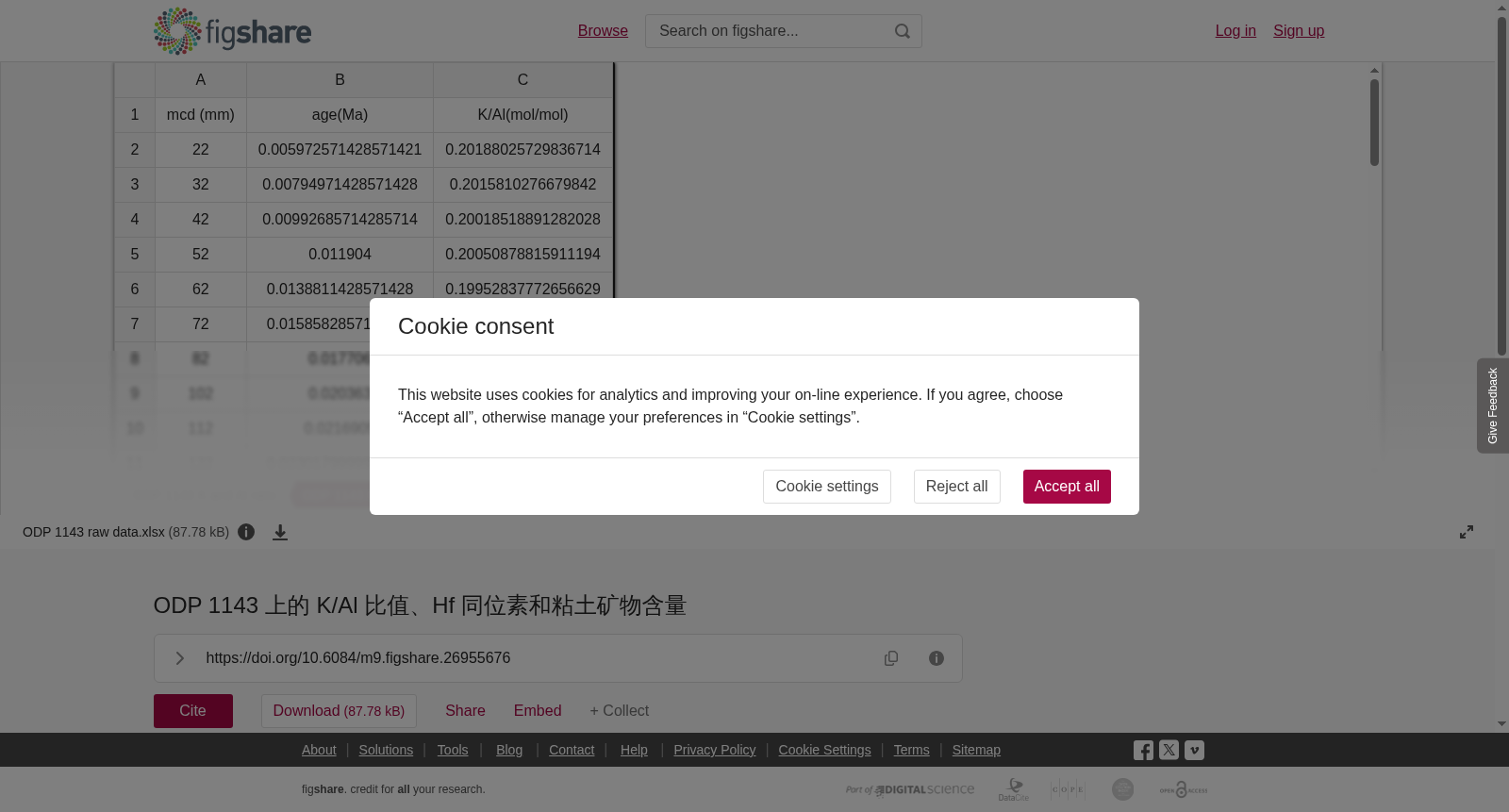
ODP 1143 上的 K/Al 比值、Hf 同位素和粘土矿物含量
收藏DataCite Commons2024-09-10 更新2024-11-06 收录
下载链接:
https://figshare.com/articles/dataset/ODP_1143_K_Al_Hf__/26955676
下载链接
链接失效反馈官方服务:
资源简介:
We collected splits from 1886 samples at 10 cm intervals for K and Al measurement. These samples were retrieved from ODP Site 1143, characterized by a core sediment composed of homogeneous hemipelagic fine-grained terrigenous materials and biogenic nannofossil carbonate ooze. Among these samples, 37 were earmarked for Hf isotope analysis, and 184 were allocated for clay mineral analysis. We determined the age of each sample through interpolation, utilizing an astronomically calibrated timescale from the same hole(Tian et al., 2002). All samples were dried at 60 ℃ in an oven and ~4 g samples were used and crushed into powder <200 mesh for K and Al measurements. The concentrations of K and Al were determined by X-ray fluorescence (XRF) using an Axios advanced PW4400. All analyses were conducted under the control of standards with relative standard deviation less than 5 %. To analyze Hf isotopes, the organic matter and carbonates from the sample were individually removed using excess hydrogen peroxide (30%) and 1 M acetic acid for 8 h. Then 100 mg of the sample was dissolved in a HF–HNO3 acid mixture at 120 °C for more than 72 h on a hot plate. Once dissolved, established ion exchange procedures were employed. The Hf isotopic compositions were determined using a Neptune plus (Thermo Finnigan) multicollector inductively-coupled plasma mass spectrometry (MC-ICP-MS). Clay minerals were identified by X-ray diffraction (XRD) on oriented mounts of decalcified clay-sized particles (<2 μm). The deflocculation of clays was performed by successive washing with distilled water after decarbonation with 1 M acetic acid. XRD spectra were obtained using a Rigaku D/max-rA diffractometer with Cu-Kα radiation, a voltage of 40 kV, and an intensity of 25 mA. Samples were scanned with the goniometer from 3° to 36° 2θ under air-dried conditions. Identification of clay minerals was made mainly according to the position of the (001) series of basal reflections on the XRD spectra.
本研究采集了1886件间隔为10厘米的岩芯分样,用于钾(K)和铝(Al)元素含量测定。这些样品取自大洋钻探计划(Ocean Drilling Program, ODP)1143站位,其岩芯沉积物由均一的半远洋细粒陆源物质与生物颗石藻碳酸盐软泥组成。其中37件样品预留用于铪(Hf)同位素分析,184件样品分配用于黏土矿物分析。本研究通过内插法,结合该钻孔的天文校准年代标尺(Tian等,2002),确定了每件样品的沉积年代。所有样品均置于60℃烘箱中烘干,称取约4克样品粉碎至200目以下粉末,用于钾、铝元素含量测定。钾、铝元素浓度采用Axios advanced PW4400型X射线荧光光谱仪(X-ray fluorescence, XRF)进行测定。所有分析均采用标准物质进行质控,相对标准偏差小于5%。针对铪同位素分析,先分别用过量30%过氧化氢和1 mol/L乙酸处理样品8小时,以去除有机质和碳酸盐组分。随后称取100毫克样品,置于电热板上,用氢氟酸-硝酸混合溶剂在120℃下溶样72小时以上。溶样完成后,采用成熟的离子交换分离流程进行铪元素提纯。铪同位素组成采用Neptune plus(赛默飞世尔Finnigan)型多接收杯电感耦合等离子体质谱仪(multicollector inductively-coupled plasma mass spectrometry, MC-ICP-MS)进行测定。黏土矿物分析采用X射线衍射法(X-ray diffraction, XRD),对脱钙后的<2μm粒级黏土颗粒制备定向片进行测试。黏土的分散处理采用1 mol/L乙酸脱碳后,依次用蒸馏水洗涤完成。X射线衍射谱采用Rigaku D/max-rA型衍射仪获取,测试条件为Cu-Kα辐射、管电压40kV、管电流25mA。样品在风干条件下,以测角仪扫描3°~36° 2θ区间。黏土矿物的定性识别主要依据X射线衍射谱中(001)系列基面反射峰的位置完成。
提供机构:
figshare
创建时间:
2024-09-06
搜集汇总
数据集介绍
背景与挑战
背景概述
该数据集包含ODP 1143站位的K/Al比值、Hf同位素和粘土矿物含量数据,样本来自以半远洋沉积为主的1886个样品,采用XRF、MC-ICP-MS和XRD等多种分析方法获得。数据可用于研究亚洲夏季风等气候过程。
以上内容由遇见数据集搜集并总结生成


