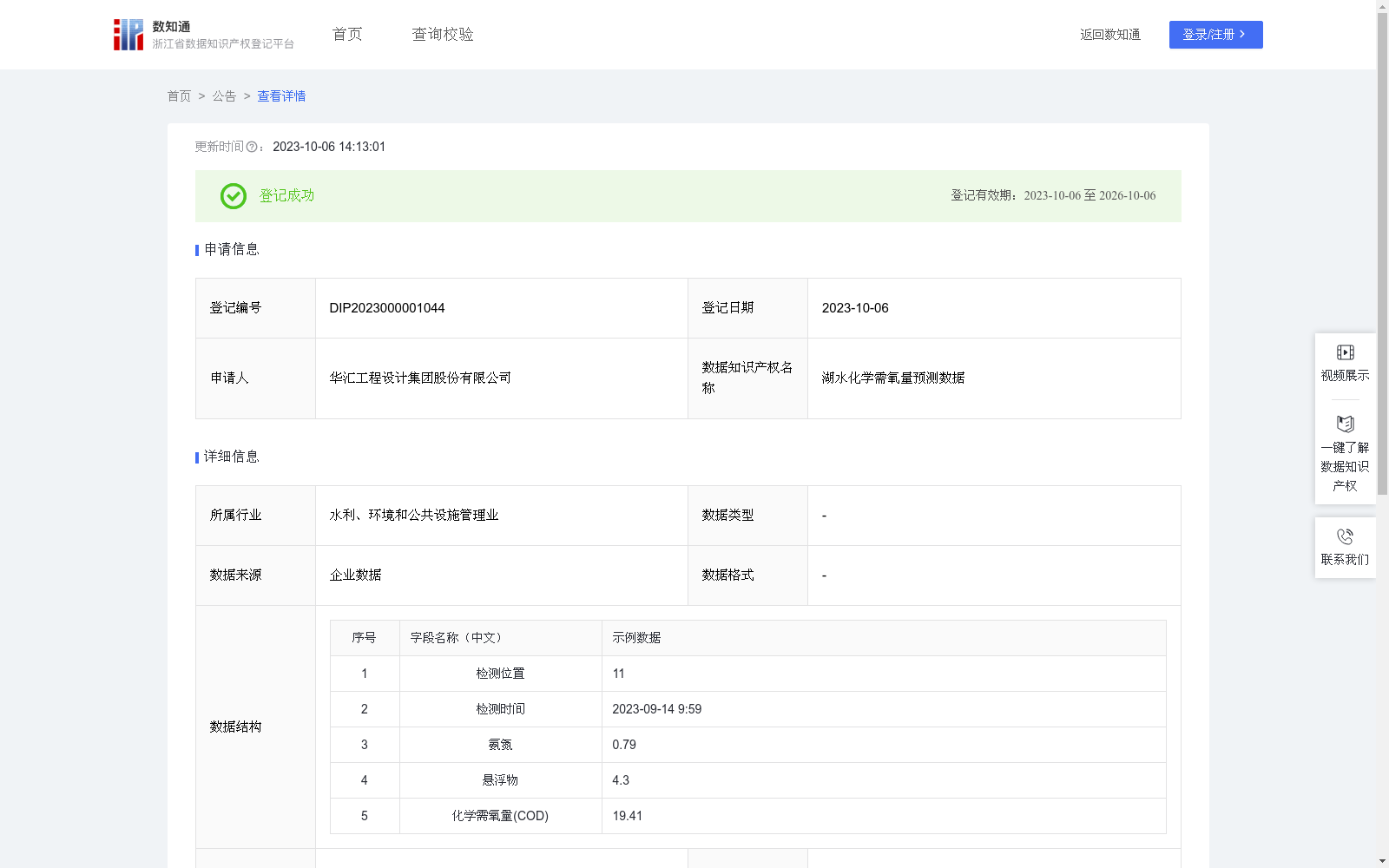
湖水化学需氧量预测数据
收藏资源简介:
通过物联网传感器实时监控观测点的数据,了解湖水中的化学需氧量(COD)变化趋势和异常情况,并对湖水污染进行监测,为海绵城市服务平台提供强有力的数据支持。这将为海绵城市的管理和规划提供重要支持,有助于保护湖泊生态,预防环境污染,并促进城市的可持续发展。1. 数据收集与整理:利用物联网传感器实时收集湖水COD数据以及相关变量数据,包括悬浮物、氨氮等,并对所获数据进行清洗、处理和整理。 2. 数据探索:对COD数据进行初步的数据探索性分析,了解数据的分布、特征间关系以及可能存在的模式。 3. 特征选择与变换:从初始数据中选择对有用的特征,并进行适当的变换和处理。 4. 建立线性回归模型:基于特征选择的结果,选定合适的线性回归模型结构,COD=a+b*氨氮+c*悬浮物,其中,b>0,表示湖水中的氨氮含量每上升1(mg/l),COD就会上升b(mg/l);c>0,表示湖水中的悬浮物每上升1(mg/l),COD就会上升c(mg/l)。 5. 模型训练:利用已有数据对选定的线性回归模型进行训练。 6. 模型评估:采用交叉验证等方法,对模型的准确性进行评估。 7. 模型优化:基于训练和评估结果,对模型的参数和结构进行调整,以提升模型的预测能力和稳定性。 8. 数据应用:运用所建立的COD回归模型,预测和分析未来一段时间内湖水的COD变化。 综上所述,我们能够建立可靠的统计学模型,用于预测湖水COD数据。这将为海绵城市服务平台提供强有力的数据支持。
Real-time monitoring of observation point data via IoT sensors to track the changing trends and anomalies of Chemical Oxygen Demand (COD) in lake water, monitor water pollution, and provide robust data support for the sponge city service platform. This will offer critical support for the management and planning of sponge cities, contribute to lake ecosystem conservation, prevent environmental pollution, and promote urban sustainable development. 1. Data Collection and Organization: Collect real-time COD data of lake water and related variable data including suspended solids, ammonia nitrogen, etc. via IoT sensors, and clean, process and organize the acquired data. 2. Data Exploration: Conduct preliminary exploratory data analysis on the COD data to understand the data distribution, relationships between features, and potential existing patterns. 3. Feature Selection and Transformation: Select useful features from the initial dataset and perform appropriate transformations and processing. 4. Establishment of Linear Regression Model: Based on the results of feature selection, select an appropriate linear regression model structure: COD = a + b*ammonia nitrogen + c*suspended solids, where b>0 indicates that for every 1 (mg/l) increase in ammonia nitrogen content in lake water, COD will increase by b (mg/l); c>0 indicates that for every 1 (mg/l) increase in suspended solids in lake water, COD will increase by c (mg/l). 5. Model Training: Train the selected linear regression model using existing datasets. 6. Model Evaluation: Evaluate the accuracy of the model using methods such as cross-validation. 7. Model Optimization: Adjust the model's parameters and structure based on training and evaluation results to improve its predictive ability and stability. 8. Data Application: Use the established COD regression model to predict and analyze the changes in lake water COD over a future period of time. In summary, we can establish a reliable statistical model for predicting lake water COD data, which will provide robust data support for the sponge city service platform.