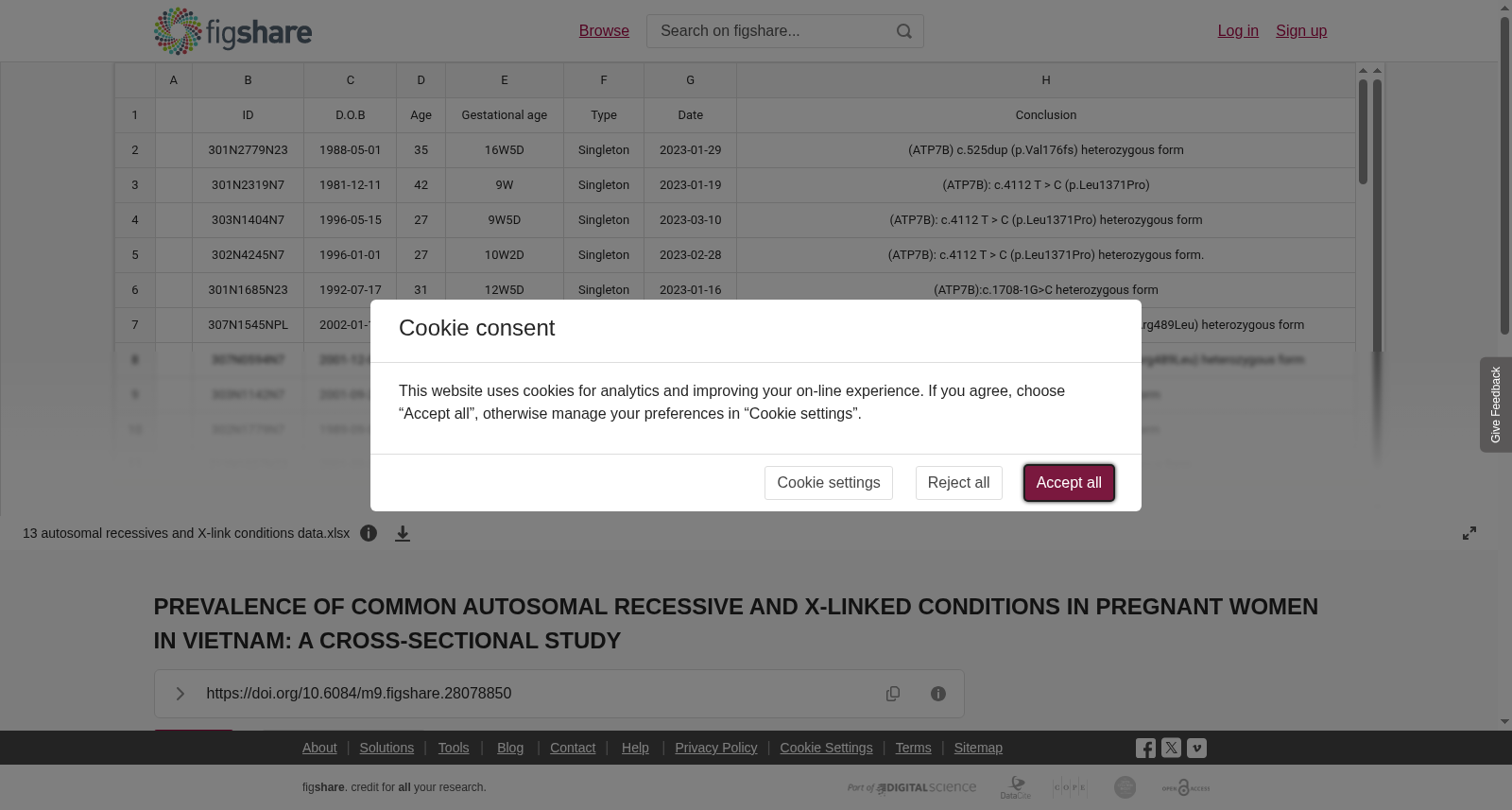
<b>PREVALENCE OF COMMON AUTOSOMAL RECESSIVE AND X-LINKED CONDITIONS IN PREGNANT WOMEN IN VIETNAM: A CROSS-SECTIONAL STUDY</b>
收藏资源简介:
<b>Abstract (max 250 words)</b>Background: The prevalence of recessive disorder carriers among Vietnamese women is still indistinct. This study aims to assess the prevalence of recessive disorder carriers and depict some common mutations of these genes.Method: A cross-sectional study was conducted with 8464 Vietnamese pregnant women with indications for carrier screening tests for recessive disorders from November 2022 to August 2023 at the Institute of DNA Technology and Genetic Analysis. The survey includes demographic information and the recessive carrier screening results.Results: 8.464 Vietnamese pregnant women’s records were involved in this study. 1.928 of them carried at least one genetic recessive condition, representing the frequency of a recessive disorder was 22.8%. The highest recessive disorders rate among pregnant women was found for the G6PD gene mutation (G6PD deficiency) at a rate of about 1 in 20 individuals, followed by the HBA1 and HBA2 gene mutations (Alpha Thalassemia) at a rate of about 1 in 25. Other common recessive carrier genes included SRD5A2 (5-alpha reductase deficiency) at a rate of about 1 in 27, HBB (Beta Thalassemia) at a rate of about 1 in 28, ATP7B (Wilson's disease) at a rate of about 1 in 40, PAH (Phenylketonuria) at a rate of about 1 in 40, and SLC25A13 (Citrin deficiency) at a rate of about 1 in 45.Conclusions: The prevalence of recessive carriers among Vietnamese pregnant women is high, and at least 1 in 5 pregnant women carries one recessive gene. It is essential to encourage Vietnamese pregnant women to conduct recessive carrier screening tests to reduce mortality rates among children and to implement effective pregnancy planning and childbirth.
<b>摘要(限250字以内)</b>背景:越南女性隐性遗传病携带者的患病率尚不明确。本研究旨在评估隐性遗传病携带者的患病率,并阐明此类基因的常见突变类型。方法:本研究为横断面研究,于2022年11月至2023年8月期间,在DNA技术与遗传分析研究所纳入8464名需接受隐性遗传病携带者筛查的越南孕妇作为研究对象。研究收集了受试者的人口统计学信息及隐性遗传病携带者筛查结果。结果:本研究共纳入8464名越南孕妇的病例资料。其中1928名至少携带1种遗传性隐性致病突变,隐性遗传病携带者的检出率为22.8%。孕妇群体中检出率最高的隐性遗传病为葡萄糖-6-磷酸脱氢酶(G6PD)基因突变所致的G6PD缺乏症,约每20名个体即有1名携带相关突变;其次为血红蛋白α1(HBA1)与血红蛋白α2(HBA2)基因突变所致的α地中海贫血,约每25名个体即有1名携带。其余常见隐性致病基因包括:类固醇5α-还原酶2(SRD5A2)基因突变所致的5α-还原酶缺乏症(约每27名个体1名携带)、血红蛋白β(HBB)基因突变所致的β地中海贫血(约每28名个体1名携带)、ATP7B基因突变所致的肝豆状核变性(Wilson病,约每40名个体1名携带)、苯丙氨酸羟化酶(PAH)基因突变所致的苯丙酮尿症(约每40名个体1名携带)以及溶质载体家族25成员13(SLC25A13)基因突变所致的Citrin缺乏症(约每45名个体1名携带)。结论:越南孕妇群体中隐性遗传病携带者的患病率较高,每5名孕妇中即至少有1名携带1种隐性致病基因。应鼓励越南孕妇接受隐性遗传病携带者筛查,以降低儿童死亡率,并为科学妊娠规划与分娩提供有效依据。