
2046-2065年SSP1-2.5、SSP2-4.5和SSP5-8.5情景下三极多年冻土活动层厚度
收藏地球大数据科学工程2024-03-04 收录
下载链接:
https://data.casearth.cn/sdo/detail/65389a42819aec0f2610b139
下载链接
链接失效反馈官方服务:
资源简介:
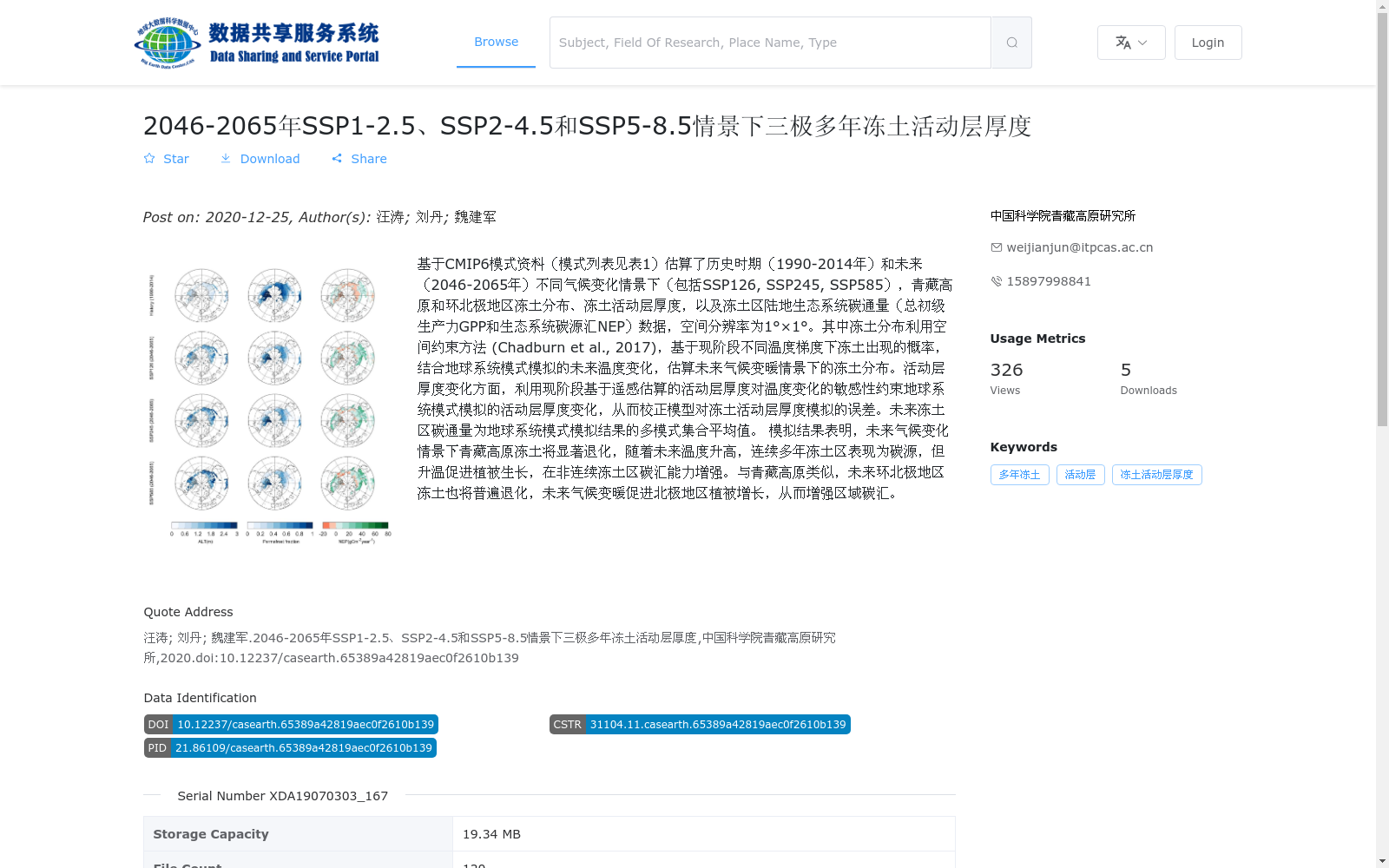
基于CMIP6模式资料(模式列表见表1)估算了历史时期(1990-2014年)和未来(2046-2065年)不同气候变化情景下(包括SSP126, SSP245, SSP585),青藏高原和环北极地区冻土分布、冻土活动层厚度,以及冻土区陆地生态系统碳通量(总初级生产力GPP和生态系统碳源汇NEP)数据,空间分辨率为1°×1°。其中冻土分布利用空间约束方法 (Chadburn et al., 2017),基于现阶段不同温度梯度下冻土出现的概率,结合地球系统模式模拟的未来温度变化,估算未来气候变暖情景下的冻土分布。活动层厚度变化方面,利用现阶段基于遥感估算的活动层厚度对温度变化的敏感性约束地球系统模式模拟的活动层厚度变化,从而校正模型对冻土活动层厚度模拟的误差。未来冻土区碳通量为地球系统模式模拟结果的多模式集合平均值。 模拟结果表明,未来气候变化情景下青藏高原冻土将显著退化,随着未来温度升高,连续多年冻土区表现为碳源,但升温促进植被生长,在非连续冻土区碳汇能力增强。与青藏高原类似,未来环北极地区冻土也将普遍退化,未来气候变暖促进北极地区植被增长,从而增强区域碳汇。
Using CMIP6 model data (model list is shown in Table 1), this study estimates permafrost distribution, active layer thickness, and terrestrial ecosystem carbon fluxes (including Gross Primary Productivity [GPP] and Net Ecosystem Production [NEP]) in permafrost regions over the Qinghai-Tibet Plateau and Circum-Arctic Region during the historical period (1990–2014) and future periods (2046–2065) under different climate change scenarios (SSP1-2.6, SSP2-4.5, SSP5-8.5), with a spatial resolution of 1° × 1°.
For permafrost distribution, a spatial constraint approach (Chadburn et al., 2017) is adopted, which estimates permafrost distribution under future warming scenarios based on the probability of permafrost occurrence under different temperature gradients at the present stage, combined with future temperature changes simulated by Earth System Models (ESMs). Regarding active layer thickness changes, the sensitivity of remotely sensed present-stage active layer thickness to temperature changes is used to constrain the active layer thickness variations simulated by ESMs, thereby correcting the simulation errors of permafrost active layer thickness in the models.
Future carbon fluxes in permafrost regions are calculated as the multi-model ensemble mean of ESM simulation results.
Simulation results show that permafrost on the Qinghai-Tibet Plateau will degrade significantly under future climate change scenarios. With increasing future temperatures, continuous permafrost regions will act as carbon sources, while vegetation growth is promoted, enhancing the carbon sink capacity in discontinuous permafrost regions. Similar to the Qinghai-Tibet Plateau, permafrost in the Circum-Arctic Region will also degrade universally in the future, and future climate warming will promote vegetation growth in the Arctic, thereby enhancing the regional carbon sink.
提供机构:
中国科学院青藏高原研究所
搜集汇总
数据集介绍
背景与挑战
背景概述
该数据集基于CMIP6模式资料,提供了2046-2065年在SSP1-2.5、SSP2-4.5和SSP5-8.5三种气候变化情景下,青藏高原和环北极地区的多年冻土活动层厚度、冻土分布及碳通量数据,空间分辨率为1°×1°,时间覆盖历史时期(1990-2014年)和未来。模拟结果表明,未来气候变暖将导致冻土普遍退化,连续多年冻土区可能转为碳源,而非连续冻土区因植被生长增强碳汇能力。
以上内容由遇见数据集搜集并总结生成


