
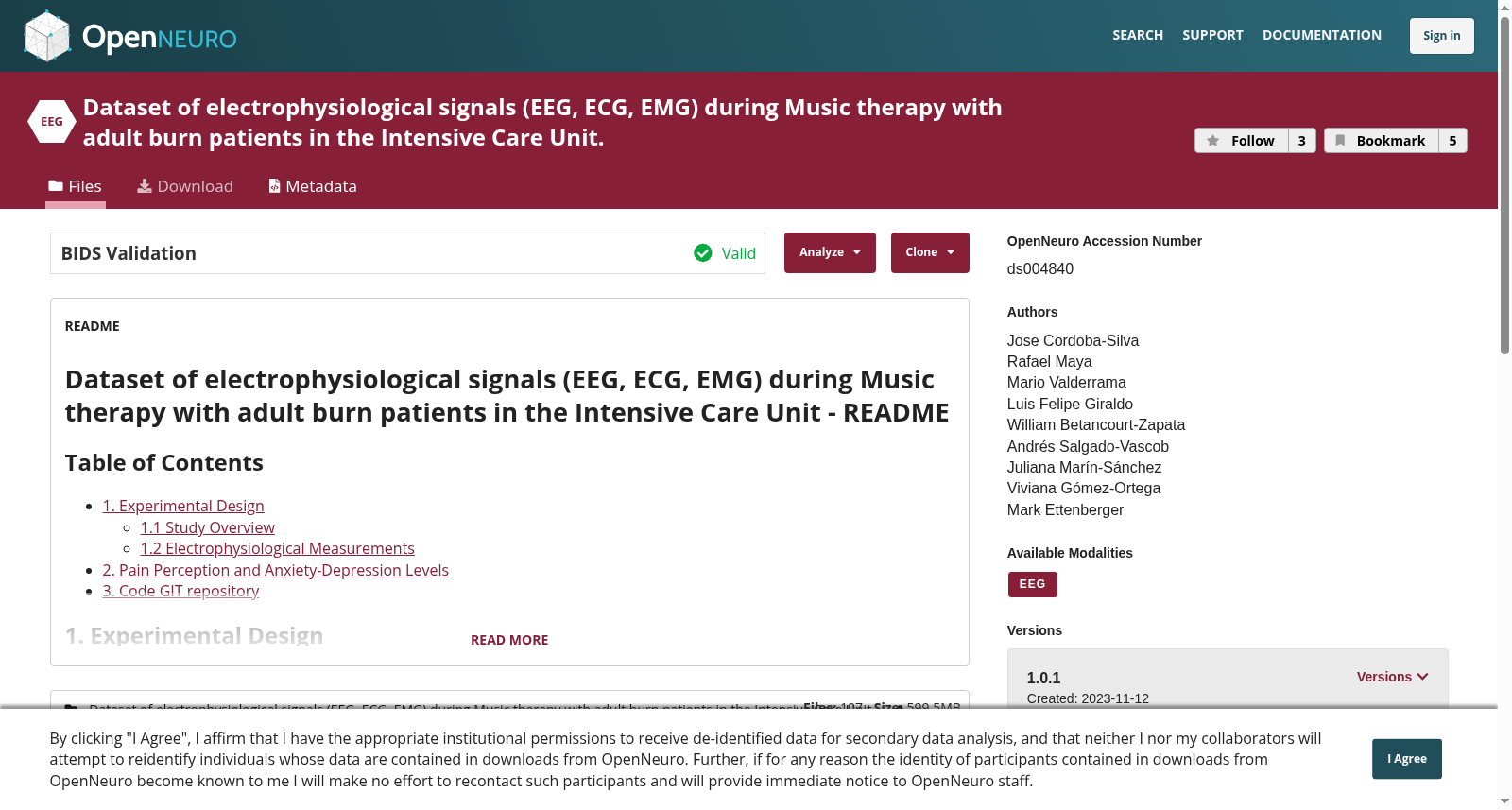
Dataset of electrophysiological signals (EEG, ECG, EMG) during Music therapy with adult burn patients in the Intensive Care Unit.
收藏OpenNeuro2023-11-12 更新2026-03-14 收录
下载链接:
https://openneuro.org/datasets/ds004840
下载链接
链接失效反馈官方服务:
资源简介:
# Dataset of electrophysiological signals (EEG, ECG, EMG) during Music therapy with adult burn patients in the Intensive Care Unit - README
## Table of Contents
- [1. Experimental Design](#1-experimental-design)
- [1.1 Study Overview](#11-study-overview)
- [1.2 Electrophysiological Measurements](#12-electrophysiological-measurements)
- [2. Pain Perception and Anxiety-Depression Levels](#2-pain-perception-and-anxiety-depression-levels)
- [3. Code GIT repository](#3-code-GIT-repository)
## 1. Experimental Design
### 1.1 Study Overview
This dataset forms part of an ongoing single-site Randomized Clinical Trial (RCT) involving adult burn patients admitted to the Intensive Care Unit (ICU). The key details of the study include:
- **Participants**: The study encompasses 82 adult burn patients admitted to the ICU.
- **Randomization**: Participants were randomly assigned to either an intervention group or a control group in a 1:1 ratio. The intervention group received standard care in addition to a maximum of six Music therapy sessions provided by a certified music therapist over a 2-week period.
- **Electrophysiological Measures**: Electrophysiological measures were taken from a subset of 9 participants in the intervention group (11%).
- **Ethics and Registration**: The study was approved by the ethics committee of the Fundación Santa Fe de Bogotá (FSFB) with approval IDs CCEI-11234-2019 and CCEI-11971-2020. It is registered on Clinicaltrials.gov under the identifier NCT04571255.
- **Informed Consent**: All participants provided informed consent to participate in the study.
### 1.2 Electrophysiological Measurements
- **Participants**: The electrophysiological measurements were conducted with nine adult burn patients hospitalized in the ICU of the University Hospital Fundación Santa Fe de Bogotá (FSFB).
- **Inclusion Criteria**: Inclusion criteria involved individuals of legal adult age with an expected hospitalization period of more than 7 days. Patients with known psychiatric disorders, cognitive disabilities, sedation, or mechanical ventilation were excluded. Patients with burns in regions above the neck were also excluded.
- **Measurement Sessions**: Electrophysiological measurements were performed with each patient during two Music-Assisted Relaxation (MAR) sessions on two different days.
- **Recording Phases**: Each recording session included three phases:
- Pre-Intervention (PRE): The resting state was measured as a baseline with the patient's eyes closed or fixed at a point.
- MAR MTI: The specialist performed the MAR MTI.
- Post-Intervention (POST): Measurements were taken during the patient's reincorporation after MAR.
- **Equipment**: Recordings were made with the Micromed LTM64 equipment with a sampling frequency of at least 256Hz. The Micromed LTM64 is of clinical quality and has approval from the Colombian National Institute for Drug and Food Safety (approval ID: 20090486-2015).
- **Electrode Setup**:
- EEG: The electrode montage followed the international System 10-20. Due to time limitations, the number of electrodes was reduced to eight: FP1, FP2, T3, T4, C3, C4, O1, and O2. The reference electrode was set to Cz, and the ground electrode was placed on the mastoids.
- ECG: ECG was acquired by a bipolar assembly of lead II with two electrodes located bilaterally in the upper part of the thorax or both arms, depending on each patient's possibilities or limitations.
- EMG: For EMG, a bipolar electrode configuration was positioned on the left eyebrow to assess the motor activity of the corrugator supercilii muscle. The electrodes were placed with a 20 mm distance between them, following the natural alignment of the muscle fibers.
## 2. Pain Perception and Anxiety-Depression Levels
- **Measures**: To correlate pain, anxiety, and depression levels with electrophysiological signals, two complementary measures were obtained.
- **Pain Assessment**: A Visual Analog Scale (VAS) was administered before the PRE and after the POST. The VAS ranged from 0 (indicating no pain) to 10 (representing the maximum pain possible).
- **Anxiety and Depression**: The Colombian version of the Hospital Anxiety and Depression Scale (HADS) was used. HADS consists of two sub-scales for anxiety and depression, each containing seven items. Items are rated on a four-point Likert scale (0 to 3), with higher scores indicating increased anxiety or depression levels (maximum score of 21 for each subscale). HADS was administered after obtaining informed consent, both as a baseline and after the last music therapy sessions.
## 3. Code GIT repository
- All the analysis and graphics in this project were conducted using Python 3.7. We utilized custom scripts in combination with various libraries, such as NumPy, Pandas, SciPy, MNE, Biopsy, neurokit2, and Visbrain. After generating the graphics, we enhanced them in PowerPoint by adding titles, symbols, and any necessary supplementary information.
- Code is Open by MIT license at: https://github.com/jgcordoba/BurnICU_MusicTherapy_Signals.git
For more detailed information about the study, please refer to the associated article titled "Article not submitted", DOI: '-Insert Link-'
---
**Last Update**: 23/10/2023
**Author**: Jose Gabriel Cordoba Silva
# 成人重症监护病房(Intensive Care Unit, ICU)烧伤患者音乐治疗期间电生理信号(脑电图Electroencephalogram, EEG、心电图Electrocardiogram, ECG、肌电图Electromyogram, EMG)数据集 - 说明文档
## 目录
- [1. 实验设计](#1-experimental-design)
- [1.1 研究概况](#11-study-overview)
- [1.2 电生理测量](#12-electrophysiological-measurements)
- [2. 疼痛感知与焦虑抑郁水平](#2-pain-perception-and-anxiety-depression-levels)
- [3. 代码Git仓库](#3-code-GIT-repository)
## 1. 实验设计
### 1.1 研究概况
本数据集是一项正在进行的单中心随机临床试验(Randomized Clinical Trial, RCT)的一部分,研究对象为入住重症监护病房(Intensive Care Unit, ICU)的成人烧伤患者。研究核心细节如下:
- **研究对象**:本研究共纳入82名入住ICU的成人烧伤患者。
- **随机分组**:受试者以1:1的比例被随机分配至干预组与对照组。干预组在标准治疗基础上,接受由认证音乐治疗师提供的最多6次音乐治疗,疗程为期2周。
- **电生理测量**:仅对干预组中11%(共9名)的受试者开展了电生理测量。
- **伦理与注册**:本研究已获得波哥大圣达菲基金会(Fundación Santa Fe de Bogotá, FSFB)伦理委员会批准,批准编号为CCEI-11234-2019与CCEI-11971-2020,并在Clinicaltrials.gov注册,注册编号为NCT04571255。
- **知情同意**:所有受试者均已签署知情同意书参与本研究。
### 1.2 电生理测量
- **研究对象**:本次电生理测量的受试者为9名入住波哥大圣达菲基金会(Fundación Santa Fe de Bogotá, FSFB)ICU的成人烧伤患者。
- **纳入排除标准**:纳入标准为年满法定成年年龄且预计住院时长超过7天的患者。排除标准包括已知精神疾病、认知障碍、接受镇静治疗或机械通气的患者,以及颈部以上区域存在烧伤的患者。
- **测量疗程**:每位受试者在两个不同日期分别接受两次音乐辅助放松(Music-Assisted Relaxation, MAR)疗程期间的电生理测量。
- **记录阶段**:每次记录疗程包含三个阶段:
- 干预前(PRE):测量患者闭眼或注视固定点时的静息状态作为基线。
- MAR MTI:由专业人员实施音乐辅助放松治疗(MAR MTI)。
- 干预后(POST):在患者完成音乐辅助放松后的恢复阶段进行测量。
- **设备**:采用Micromed LTM64设备进行记录,采样频率不低于256Hz。该设备为临床级设备,已获得哥伦比亚国家药品与食品安全局批准,批准编号为20090486-2015。
- **电极配置**:
- 脑电图(EEG):电极布局遵循国际10-20系统。受时间限制,电极数量缩减为8个:FP1、FP2、T3、T4、C3、C4、O1及O2。参考电极设置为Cz,接地电极置于乳突部位。
- 心电图(ECG):采用双极导联II配置,两个电极分别放置于双侧胸部上部或双臂(根据患者具体情况调整)。
- 肌电图(EMG):采用双极电极配置,放置于左侧眉弓处,用于评估皱眉肌的运动活动。电极间距为20mm,与肌纤维自然走向对齐。
## 2. 疼痛感知与焦虑抑郁水平
- **测量指标**:为关联疼痛、焦虑与抑郁水平与电生理信号,本研究采集了两项互补性测量数据。
- **疼痛评估**:在干预前(PRE)与干预后(POST)阶段分别采用视觉模拟评分法(Visual Analog Scale, VAS)进行疼痛评估。VAS评分范围为0(无疼痛)至10(最剧烈疼痛)。
- **焦虑与抑郁评估**:采用哥伦比亚版医院焦虑抑郁量表(Hospital Anxiety and Depression Scale, HADS)。该量表包含焦虑与抑郁两个子量表,每个子量表含7个条目。条目采用4级李克特量表(0~3分)评分,得分越高代表焦虑或抑郁程度越严重(每个子量表最高得分为21分)。HADS量表在获取知情同意后作为基线测量,以及在最后一次音乐治疗疗程结束后再次施测。
## 3. 代码Git仓库
- **分析与可视化实现**:本项目所有分析与图表制作均基于Python 3.7完成,我们结合自定义脚本与NumPy、Pandas、SciPy、MNE、Biopsy、neurokit2及Visbrain等各类库开展工作。生成图表后,我们通过PowerPoint添加标题、符号及其他必要补充信息进行优化。
- **开源代码**:代码采用MIT开源许可,托管于:https://github.com/jgcordoba/BurnICU_MusicTherapy_Signals.git
如需了解本研究的更多详细信息,请参阅已投稿论文"Article not submitted",DOI: '-Insert Link-'
---
**最后更新时间**:2023年10月23日
**作者**:何塞·加夫列尔·科尔多瓦·席尔瓦(Jose Gabriel Cordoba Silva)
创建时间:
2023-11-12
搜集汇总
数据集介绍
背景与挑战
背景概述
该数据集收集了成年烧伤ICU患者在音乐治疗期间的EEG、ECG和EMG电生理信号,旨在研究音乐干预对生理指标的影响。数据集包含9名患者的信号记录,覆盖干预前、干预中和干预后三个阶段,并整合了疼痛、焦虑和抑郁的临床评估数据,为探索音乐治疗在重症监护环境中的效果提供了多模态研究资源。
以上内容由遇见数据集搜集并总结生成


