
日喀则弧前盆地晚古新世加拉孜组古地磁数据
收藏国家青藏高原科学数据中心2025-05-14 更新2025-05-24 收录
下载链接:
https://data.tpdc.ac.cn/zh-hans/data/a09ddd60-e1d6-4c9b-b6ba-8f7b24de9ee4
下载链接
链接失效反馈官方服务:
资源简介:
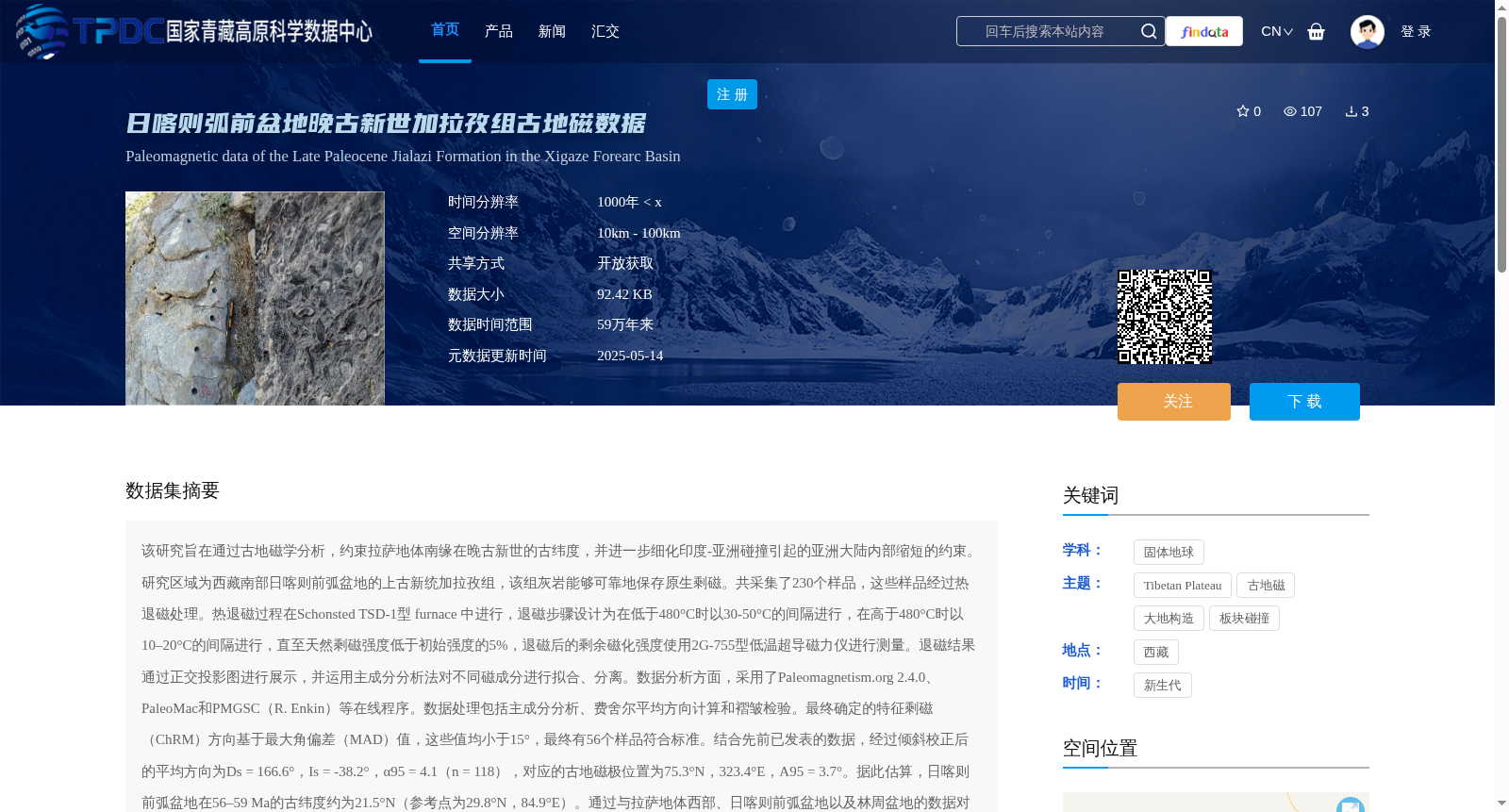
该研究旨在通过古地磁学分析,约束拉萨地体南缘在晚古新世的古纬度,并进一步细化印度-亚洲碰撞引起的亚洲大陆内部缩短的约束。研究区域为西藏南部日喀则前弧盆地的上古新统加拉孜组,该组灰岩能够可靠地保存原生剩磁。共采集了230个样品,这些样品经过热退磁处理。热退磁过程在Schonsted TSD-1型 furnace 中进行,退磁步骤设计为在低于480°C时以30-50°C的间隔进行,在高于480°C时以10–20°C的间隔进行,直至天然剩磁强度低于初始强度的5%,退磁后的剩余磁化强度使用2G-755型低温超导磁力仪进行测量。退磁结果通过正交投影图进行展示,并运用主成分分析法对不同磁成分进行拟合、分离。数据分析方面,采用了Paleomagnetism.org 2.4.0、PaleoMac和PMGSC(R. Enkin)等在线程序。数据处理包括主成分分析、费舍尔平均方向计算和褶皱检验。最终确定的特征剩磁(ChRM)方向基于最大角偏差(MAD)值,这些值均小于15°,最终有56个样品符合标准。结合先前已发表的数据,经过倾斜校正后的平均方向为Ds = 166.6°,Is = -38.2°,α95 = 4.1(n = 118),对应的古地磁极位置为75.3°N,323.4°E,A95 = 3.7°。据此估算,日喀则前弧盆地在56–59 Ma的古纬度约为21.5°N(参考点为29.8°N,84.9°E)。通过与拉萨地体西部、日喀则前弧盆地以及林周盆地的数据对比,研究结果表明拉萨地体南缘在晚白垩世至早始新世期间呈现东西走向。与亚洲视极移曲线的对比分析显示,自晚古新世以来,拉萨地体与稳定亚洲内部之间的大陆内缩短量约为890 ± 470公里。这些发现为理解印度-亚洲碰撞的过程提供了重要的古地磁约束。
This study aims to constrain the paleolatitude of the southern margin of the Lhasa Terrane during the Late Paleocene via paleomagnetic analysis, and to further refine the constraints on intracontinental shortening of the Asian continent caused by the India-Asia collision. The study area is the Upper Paleocene Galazi Formation in the Xigaze Forearc Basin, southern Tibet, whose limestones can reliably preserve primary remanent magnetization. A total of 230 samples were collected and subjected to thermal demagnetization. Thermal demagnetization was conducted in a Schonsted TSD-1 furnace, with demagnetization steps set at 30–50°C intervals below 480°C and 10–20°C intervals above 480°C, until the natural remanent magnetization (NRM) intensity dropped below 5% of its initial value. The remaining magnetization after demagnetization was measured using a 2G-755 cryogenic superconducting magnetometer. Demagnetization results were presented via orthogonal projection diagrams, and principal component analysis was applied to fit and separate different magnetic components. Data analysis was performed using online programs including Paleomagnetism.org 2.4.0, PaleoMac, and PMGSC (R. Enkin). Data processing included principal component analysis, calculation of Fisherian mean directions, and fold tests. The final identified characteristic remanent magnetization (ChRM) directions were based on maximum angular deviation (MAD) values all less than 15°, and 56 samples met the criteria. Combined with previously published data, the tilt-corrected mean direction was determined as Ds = 166.6°, Is = -38.2°, α95 = 4.1 (n = 118), corresponding to a paleomagnetic pole position of 75.3°N, 323.4°E, with A95 = 3.7°. Accordingly, the paleolatitude of the Xigaze Forearc Basin at 56–59 Ma was estimated to be approximately 21.5°N (with the reference point at 29.8°N, 84.9°E). By comparing with data from the western Lhasa Terrane, the Xigaze Forearc Basin, and the Linzhou Basin, the results indicate that the southern margin of the Lhasa Terrane exhibited an east-west strike during the Late Cretaceous to Early Eocene. Comparative analysis with the Asian apparent polar wander path shows that the intracontinental shortening magnitude between the Lhasa Terrane and stable intra-Asia since the Late Paleocene is approximately 890 ± 470 km. These findings provide important paleomagnetic constraints for understanding the process of the India-Asia collision.
提供机构:
马星铎,李亚林
创建时间:
2025-01-13
搜集汇总
数据集介绍
背景与挑战
背景概述
该数据集包含西藏南部日喀则前弧盆地晚古新世加拉孜组的古地磁数据,旨在通过分析230个样品的古地磁特性,研究拉萨地体南缘的古纬度和印度-亚洲碰撞引起的大陆内部缩短。数据以word格式存储,包含样品编号、实验方法和具体数据,适用于地质学和地球物理学研究。
以上内容由遇见数据集搜集并总结生成


