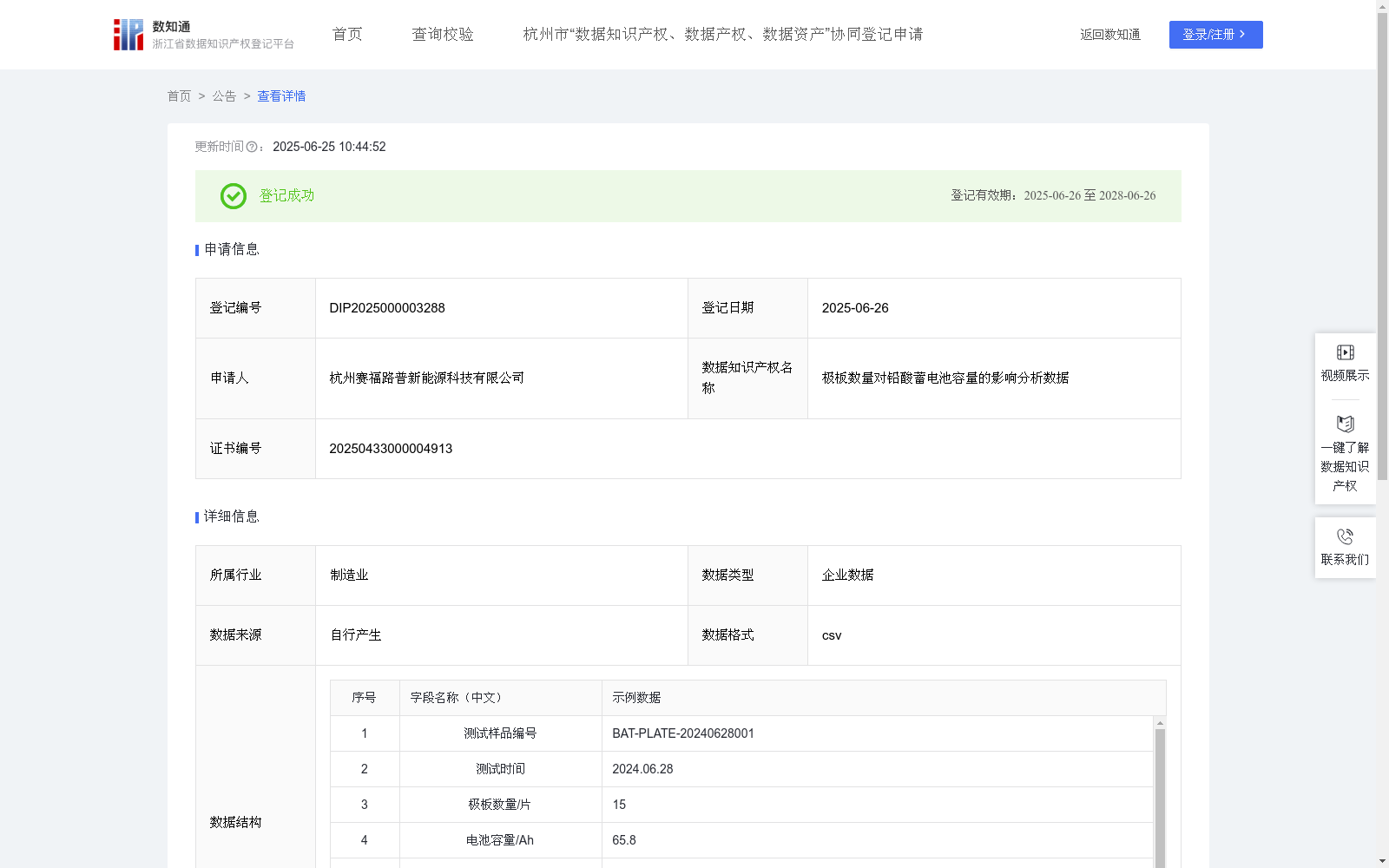
极板数量对铅酸蓄电池容量的影响分析数据
收藏资源简介:
本数据聚焦于分析极板数量对铅酸蓄电池容量的影响,揭示了极板配置与电池能量密度之间的定量关系,为公司(作为电池制造商)及外部相关方提供了关键的结构设计依据,具有重要的应用价值。具体体现在以下方面: 1.优化电池结构设计方案:公司可通过分析极板数量对容量的影响,科学设计极板排列数量和间距配置,在保证电池体积效率的同时优化活性物质利用率,从而显著提升电池的比能量和功率密度。 2.指导差异化产品开发:本数据可为电池应用厂商、设备制造商及研发机构提供参考,支持其开展定制化电池设计、性能-成本平衡优化、新型结构创新等工作,促进铅酸蓄电池产品系列向多元化、专业化方向发展。1.数据采集: 实时记录不同极板数量下的铅酸蓄电池容量测试数据,包括测试样品编号、测试时间、极板数量/片、电池容量/Ah等字段。 2.数据预处理: (1)对采集的数据进行去噪处理,确保数据准确性。 (2)将历史采集的数据(包含本次采集)进行聚合,形成数据集X,并针对数据集X中的电池容量字段,计算出其平均值。 3.计算线性回归斜率a和截距b: (1)基于数据集X(以极板数量为自变量、电池容量为因变量),运用SLOPE函数,基于最小二乘法原理确定斜率a,运用INTERCEPT函数确定截距b。 (2)斜率a表示单位极板数量变化对电池容量的影响程度,截距b表示基准极板数量下铅酸蓄电池的容量值。 4.结果运用: (1)计算比例系数k:k=|a/电池容量平均值|×100%。 (2)若k≥8%,则判定为"高影响",若4%≤k<8%,则判定为"中影响",若k<4%,则判定为"低影响"。
This dataset focuses on analyzing the impact of the number of plates on the capacity of lead-acid batteries, revealing the quantitative relationship between plate configuration and battery energy density. It provides key structural design basis for the company (as a battery manufacturer) and external stakeholders, with important application value, which is reflected in the following aspects: 1. Optimizing battery structural design schemes: The company can scientifically design the number of plate arrangements and spacing configuration by analyzing the impact of the number of plates on capacity, optimize the utilization rate of active materials while ensuring battery volumetric efficiency, thereby significantly improving the specific energy and power density of the battery. 2. Guiding differentiated product development: This dataset can provide references for battery application manufacturers, equipment manufacturers and R&D institutions, supporting them to carry out customized battery design, performance-cost balance optimization, novel structure innovation and other work, promoting the lead-acid battery product series to develop towards diversification and specialization. 1. Data Collection: Real-time recording of capacity test data of lead-acid batteries under different numbers of plates, including fields such as test sample number, test time, number of plates / piece, battery capacity / Ah, etc. 2. Data Preprocessing: (1) Denoise the collected data to ensure data accuracy. (2) Aggregate the historically collected data (including this collection) to form dataset X, and calculate the average value of the battery capacity field in dataset X. 3. Calculating the linear regression slope a and intercept b: (1) Based on dataset X (taking the number of plates as the independent variable and battery capacity as the dependent variable), use the SLOPE function to determine the slope a based on the least squares method, and use the INTERCEPT function to determine the intercept b. (2) The slope a represents the degree of influence of the change in unit number of plates on the battery capacity, and the intercept b represents the capacity value of the lead-acid battery under the reference number of plates. 4. Result Application: (1) Calculate the proportional coefficient k: k = |a / average battery capacity| × 100%. (2) If k ≥ 8%, it is classified as "high impact"; if 4% ≤ k < 8%, it is classified as "moderate impact"; if k < 4%, it is classified as "low impact".