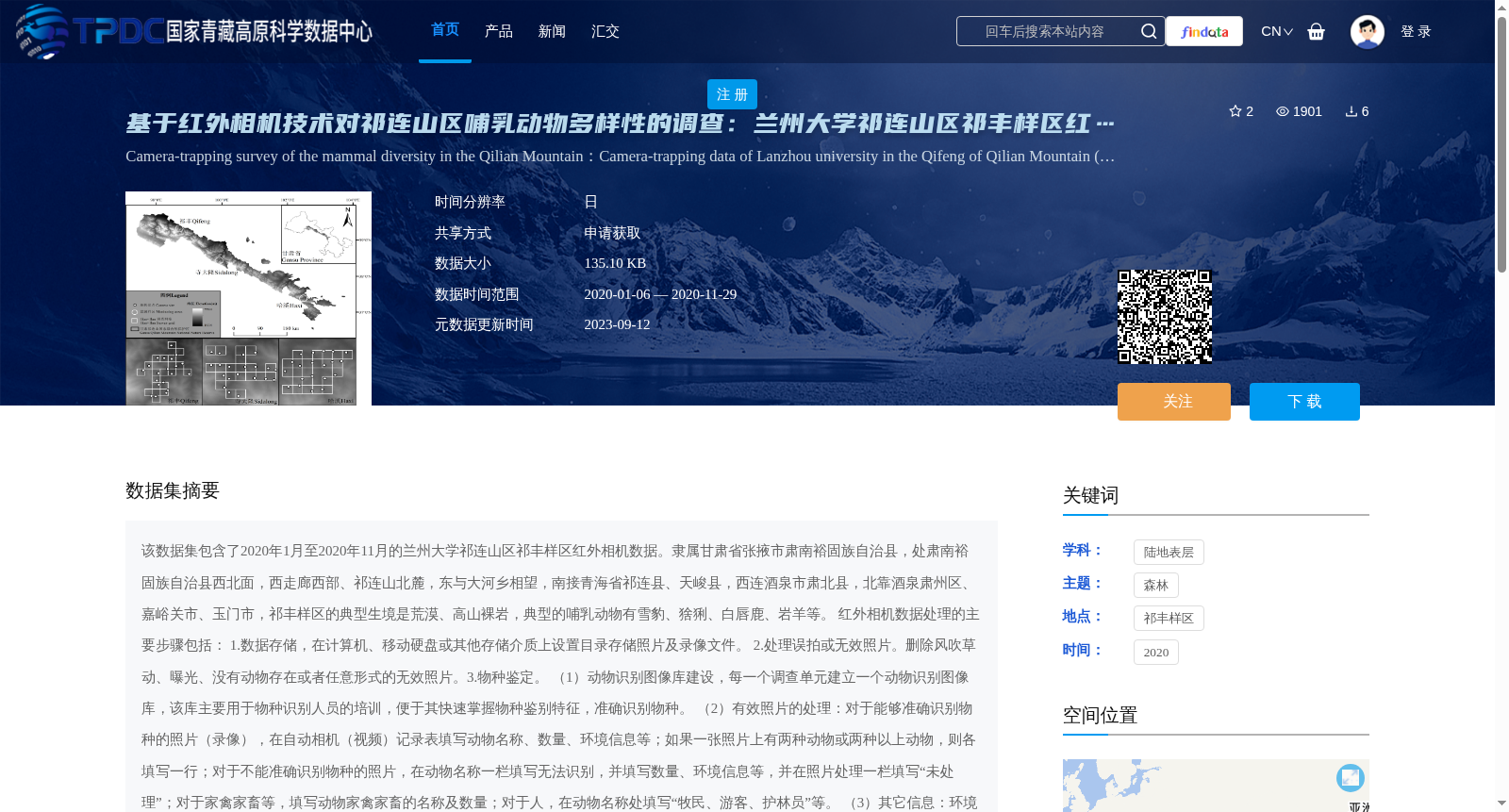
基于红外相机技术对祁连山区哺乳动物多样性的调查:兰州大学祁连山区祁丰样区红外相机数据(2019-2020)
收藏资源简介:
该数据集包含了2020年1月至2020年11月的兰州大学祁连山区祁丰样区红外相机数据。隶属甘肃省张掖市肃南裕固族自治县,处肃南裕固族自治县西北面,西走廊西部、祁连山北麓,东与大河乡相望,南接青海省祁连县、天峻县,西连酒泉市肃北县,北靠酒泉肃州区、嘉峪关市、玉门市,祁丰样区的典型生境是荒漠、高山裸岩,典型的哺乳动物有雪豹、猞猁、白唇鹿、岩羊等。 红外相机数据处理的主要步骤包括: 1.数据存储,在计算机、移动硬盘或其他存储介质上设置目录存储照片及录像文件。 2.处理误拍或无效照片。删除风吹草动、曝光、没有动物存在或者任意形式的无效照片。3.物种鉴定。 (1)动物识别图像库建设,每一个调查单元建立一个动物识别图像库,该库主要用于物种识别人员的培训,便于其快速掌握物种鉴别特征,准确识别物种。 (2)有效照片的处理:对于能够准确识别物种的照片(录像),在自动相机(视频)记录表填写动物名称、数量、环境信息等;如果一张照片上有两种动物或两种以上动物,则各填写一行;对于不能准确识别物种的照片,在动物名称一栏填写无法识别,并填写数量、环境信息等,并在照片处理一栏填写“未处理”;对于家禽家畜等,填写动物家禽家畜的名称及数量;对于人,在动物名称处填写“牧民、游客、护林员”等。 (3)其它信息:环境信息记录,应根据照片(录像),填写以下环境信息:温度:依照照片上显示的温度填写。天气:晴、阴、雨、雪。需要仔细判断。积雪:有或无。行为:觅食、饮水、捕食、交配、打斗、争食、驱赶、嬉戏、奔跑、休息、行走、警戒等。动物年龄:幼、亚、雌、雄、未知。 发布的观测数据包括:文件编号,文件格式,文件夹编号,相机编号,布设点位编号,拍摄日期,拍摄时间,工作天数(天),要素,物种名称,幼,亚,雌,雄,未知,总数,行为,温度(℃),天气,积雪。
This dataset contains infrared camera trap data collected from the Qifeng Sample Area in the Qilian Mountains of Lanzhou University, spanning from January 2020 to November 2020. The study area is located in the northwest of Sunan Yugur Autonomous County, Zhangye City, Gansu Province, at the western segment of the Hexi Corridor and the northern foothills of the Qilian Mountains. It borders Dahe Township to the east, Qilian County and Tianjun County of Qinghai Province to the south, Subei County of Jiuquan City to the west, and Suzhou District of Jiuquan, Jiayuguan City, and Yumen City to the north. The typical habitats of the Qifeng Sample Area are deserts and alpine bare rocks, with representative mammal species including snow leopard, Eurasian lynx, white-lipped deer, blue sheep, and others. The main steps for processing the infrared camera trap data are as follows: 1. Data storage: Establish dedicated directories on computers, external hard drives, or other storage media to store captured photos and video files. 2. Filtering invalid and misclassified photos: Delete photos caused by wind-blown vegetation, overexposure, absence of animals, or any other invalid content. 3. Species identification: (1) Construction of animal identification image libraries: Establish an animal identification image library for each survey unit. This library is designed to train species identifiers, enabling them to quickly master species identification traits and accurately recognize animal species. (2) Processing of valid photos and videos: - For photos/videos where the species can be accurately identified, fill in the animal name, quantity, environmental information, and other relevant details in the automatic camera (video) record sheet. If a single photo contains two or more animal species, record each species on a separate line. - For photos/videos where the species cannot be accurately identified, fill in "unidentifiable" in the animal name column, along with the quantity and environmental information, and mark "unprocessed" in the photo processing column. - For domestic poultry and livestock, record their respective names and quantities. - For human subjects, fill in terms such as "herdsman, tourist, forest ranger" in the animal name column. (3) Environmental and associated information recording: Record the following information based on the captured photos/videos: - Temperature: Fill in the temperature value displayed on the photo. - Weather: Clear, cloudy, rainy, or snowy (judge carefully based on visual content). - Snow cover: Present or absent. - Behavior: Foraging, drinking, predating, mating, fighting, competing for food, chasing, playing, running, resting, walking, alertness, etc. - Animal age: Juvenile, sub-adult, female, male, or unknown. The released observational dataset includes the following fields: file ID, file format, folder ID, camera ID, deployment point ID, shooting date, shooting time, working days (unit: day), element, species name, juvenile count, sub-adult count, female count, male count, unknown age count, total count, behavior, temperature (℃), weather, and snow cover.