
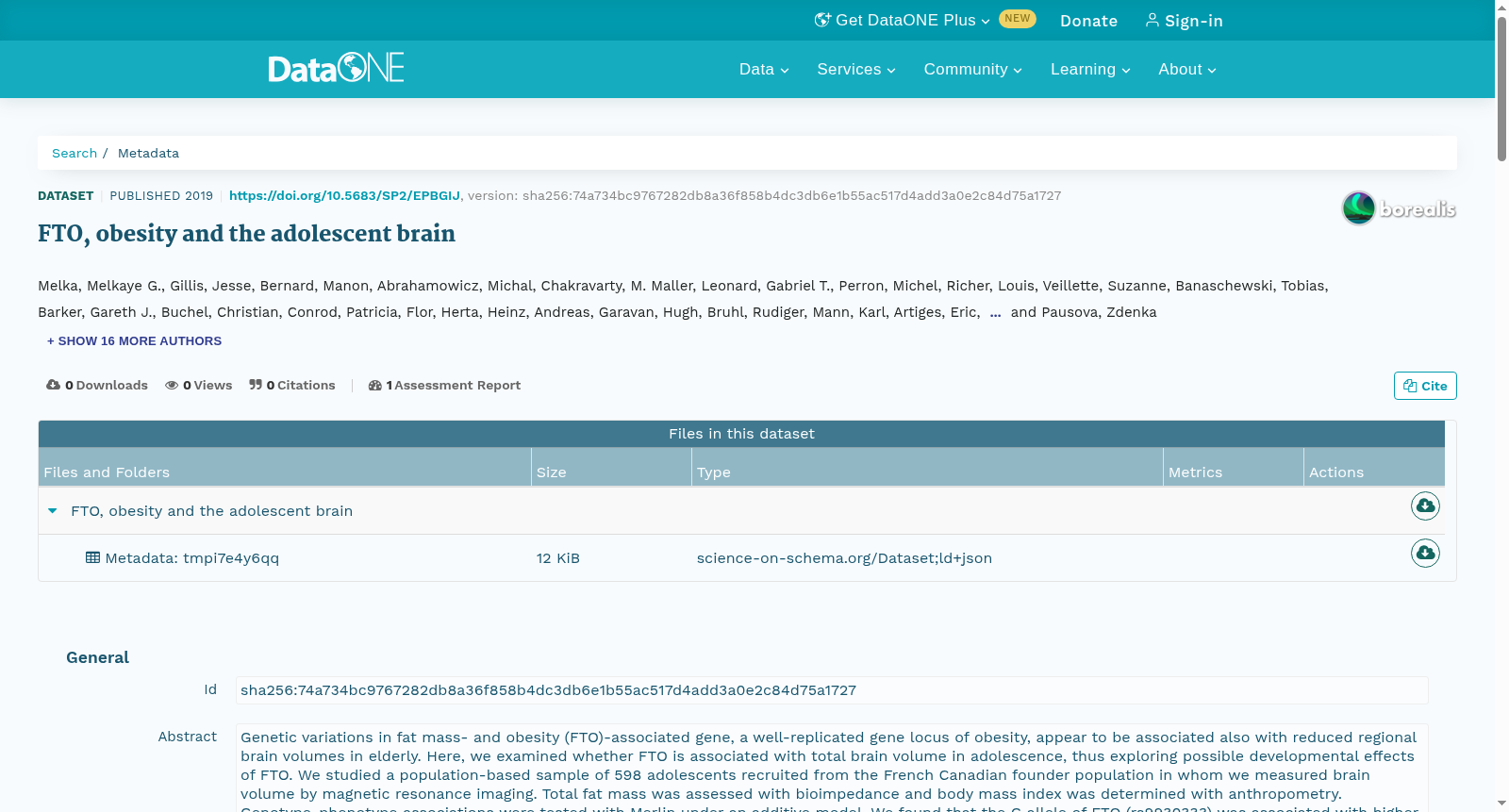
FTO, obesity and the adolescent brain
收藏DataONE2019-03-05 更新2024-06-08 收录
下载链接:
https://search.dataone.org/view/sha256:74a734bc9767282db8a36f858b4dc3db6e1b55ac517d4add3a0e2c84d75a1727
下载链接
链接失效反馈官方服务:
资源简介:
Genetic variations in fat mass- and obesity (FTO)-associated gene, a well-replicated gene locus of obesity, appear to be associated also with reduced regional brain volumes in elderly. Here, we examined whether FTO is associated with total brain volume in adolescence, thus exploring possible developmental effects of FTO. We studied a population-based sample of 598 adolescents recruited from the French Canadian founder population in whom we measured brain volume by magnetic resonance imaging. Total fat mass was assessed with bioimpedance and body mass index was determined with anthropometry. Genotype-phenotype associations were tested with Merlin under an additive model. We found that the G allele of FTO (rs9930333) was associated with higher total body fat [TBF (P = 0.002) and lower brain volume (P = 0.005)]. The same allele was also associated with higher lean body mass (P = 0.03) and no difference in height (P = 0.99). Principal component analysis identified a shared inverse variance between the brain volume and TBF, which was associated with FTO at P = 5.5 × 10(-6). These results were replicated in two independent samples of 413 and 718 adolescents, and in a meta-analysis of all three samples (n = 1729 adolescents), FTO was associated with this shared inverse variance at P = 1.3 × 10(-9). Co-expression networks analysis supported the possibility that the underlying FTO effects may occur during embryogenesis. In conclusion, FTO is associated with shared inverse variance between body adiposity and brain volume, suggesting that this gene may exert inverse effects on adipose and brain tissues. Given the completion of the overall brain growth in early childhood, these effects may have their origins during early development.
脂肪量与肥胖相关基因(fat mass- and obesity-associated gene, FTO)是已被多次重复验证的肥胖易感基因座,其遗传变异不仅与肥胖发生相关,此前研究还发现该变异与老年人群的区域性脑体积缩小存在关联。本研究旨在探讨FTO基因是否与青少年期总脑体积相关,以揭示该基因可能存在的发育层面效应。我们以法裔加拿大奠基人群为基础,招募了598名青少年作为研究队列,通过磁共振成像(magnetic resonance imaging, MRI)技术测量其总脑体积。采用生物电阻抗法评估总体脂质量(total body fat, TBF),通过人体测量学方法测定体质量指数。采用Merlin软件在加性遗传模型下检验基因型-表型关联。研究发现,FTO基因rs9930333位点的G等位基因与更高的TBF(P=0.002)以及更低的脑体积(P=0.005)相关。该等位基因同时与更高的去脂体重相关(P=0.03),而与身高无显著关联(P=0.99)。主成分分析显示,脑体积与TBF之间存在共同的负向变异,该变异与FTO基因显著相关(P=5.5×10⁻⁶)。上述结果在两个独立的青少年队列(分别包含413名和718名受试者)中得到了重复验证;对全部3个队列(共1729名青少年)进行的荟萃分析显示,FTO基因与该共同负向变异显著相关(P=1.3×10⁻⁹)。共表达网络分析结果支持,FTO基因的潜在调控效应可能发生于胚胎发育阶段。综上,FTO基因与体脂量和脑体积之间的共同负向变异显著相关,提示该基因可能对脂肪组织与脑组织产生反向调控效应。鉴于整体脑发育在幼儿早期即已完成,该基因的上述效应可能起源于早期发育阶段。
创建时间:
2023-12-28
搜集汇总
数据集介绍
以上内容由遇见数据集搜集并总结生成


