
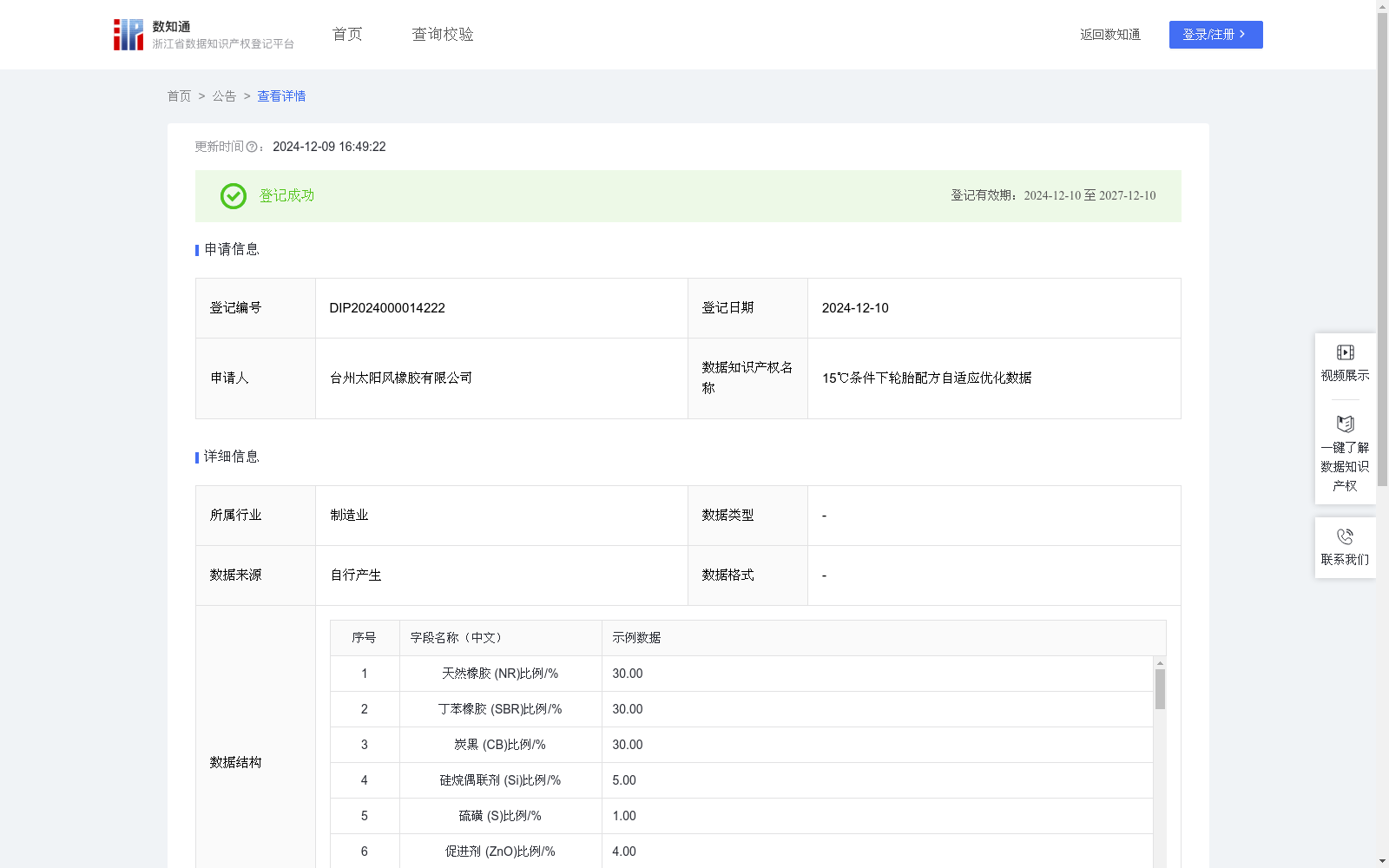
15℃条件下轮胎配方自适应优化数据
收藏浙江省数据知识产权登记平台2024-12-09 更新2024-12-10 收录
下载链接:
https://www.zjip.org.cn/home/announce/trends/98766
下载链接
链接失效反馈官方服务:
资源简介:
公司希望开发出一种高性能轮胎,以满足不同气候条件下的使用需求,使得该轮胎需要在耐磨性、抓地力和滚动阻力方面达到最优平衡,同时还要考虑温度对这些性能的影响。通过科学的方法来优化轮胎配方,确保产品在各种环境条件下都能保持优异的性能。最大化耐磨性(W):使轮胎在长时间使用后仍能保持良好的性能。最大化抓地力(G):保证轮胎在湿滑路面上的安全性能。最小化滚动阻力(RR):减少燃油消耗,提高车辆的燃油效率。考虑温度影响:确保轮胎在不同温度下都能保持稳定的性能。该项数据对本行业所有企业的轮胎配方优化方法有重要参考价值,通过分析不同配方的成本和性能,制定改进措施,减少缺陷率,找到性价比最高的方案。1、数据来源:已经通过实验数据训练得到了线性回归模型的系数,用于预测每个性能指标。约束条件为各成分的比例之和必须为100%,且每种成分的比例应在合理的范围内,各成分比例及当前温度参数来源于质量检测实验室。
2、算法规则:
耐磨性(W):W=a0+a1·NR+a2·SBR+a3·CB+a4·Si+a5·S+a6·ZnO+a7·T
抓地力(G):G=b0+b1·NR+b2·SBR+b3·CB+b4·Si+b5·S+b6·ZnO+b7·T
滚动阻力(RR):RR=c0+c1·NR+c2·SBR+c3·CB+c4·Si+c5·S+c6·ZnO+c7·T
为了综合考虑多个性能指标,定义一个适应度函数F,该函数结合了耐磨性、抓地力和滚动阻力,并赋予不同的权重,权重分别为:耐磨性=0.4、抓地力=0.4、滚动阻力=-0.2(负号表示希望最小化滚动阻力)。适应度函数为:F=0.4·W+0.4·G−0.2·RR。
3、数据分析:适应度数值是一个综合指标,它结合了多个性能指标,通过加权求和的方式,适应度数值能够反映出配方在这些性能指标上的整体表现,数值越高耐磨性、抓地力越好,滚动阻力越差。
The company intends to develop high-performance tires applicable to diverse climatic conditions, which necessitates achieving an optimal balance among wear resistance, grip, and rolling resistance, while accounting for the influence of temperature on these performance indicators. Scientific formulation optimization methods are employed to ensure the product maintains exceptional performance across all environmental conditions. The optimization objectives are as follows:
1. Maximize wear resistance (W): Ensure the tire retains good performance after long-term use.
2. Maximize grip (G): Guarantee the tire's safety performance on wet roads.
3. Minimize rolling resistance (RR): Reduce fuel consumption and improve vehicle fuel efficiency.
4. Consider temperature effects: Ensure the tire maintains stable performance across different temperatures.
This dataset holds substantial reference value for tire formulation optimization practices across all enterprises in the tire industry. By analyzing the cost and performance of different formulations, enterprises can formulate improvement measures, reduce defect rates, and identify the most cost-effective solutions.
1. Data Source: The coefficients of a linear regression model trained using experimental data are provided for predicting each performance metric. The constraints are that the sum of the proportions of all components must equal 100%, the proportion of each component should fall within a reasonable range, and the component proportions and current temperature parameters are sourced from the quality inspection laboratory.
2. Algorithm Rules:
Wear resistance (W): $W = a_0 + a_1 cdot NR + a_2 cdot SBR + a_3 cdot CB + a_4 cdot Si + a_5 cdot S + a_6 cdot ZnO + a_7 cdot T$
Grip (G): $G = b_0 + b_1 cdot NR + b_2 cdot SBR + b_3 cdot CB + b_4 cdot Si + b_5 cdot S + b_6 cdot ZnO + b_7 cdot T$
Rolling resistance (RR): $RR = c_0 + c_1 cdot NR + c_2 cdot SBR + c_3 cdot CB + c_4 cdot Si + c_5 cdot S + c_6 cdot ZnO + c_7 cdot T$
To comprehensively consider multiple performance metrics, a fitness function F is defined, which combines wear resistance, grip, and rolling resistance with different weights: wear resistance weight = 0.4, grip weight = 0.4, rolling resistance weight = -0.2 (the negative sign indicates that rolling resistance should be minimized). The fitness function is: $F = 0.4 cdot W + 0.4 cdot G - 0.2 cdot RR$.
3. Data Analysis: The fitness value is a comprehensive indicator that combines multiple performance metrics through weighted summation. It reflects the overall performance of the formulation across these metrics. A higher fitness value indicates better wear resistance and grip, but poorer rolling resistance.
提供机构:
台州太阳风橡胶有限公司
创建时间:
2024-10-30
搜集汇总
数据集介绍
以上内容由遇见数据集搜集并总结生成


