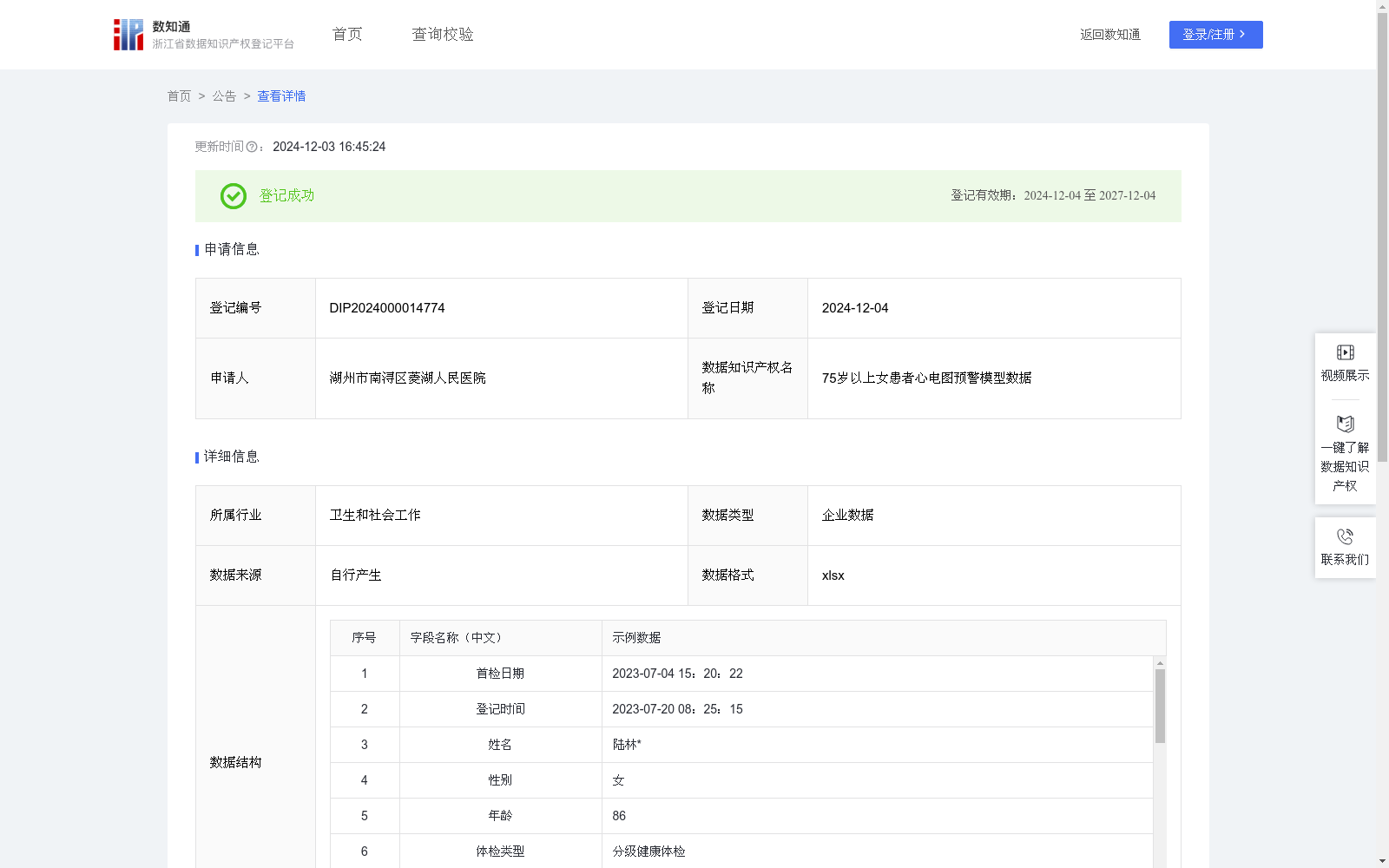
75岁以上女患者心电图预警模型数据
收藏资源简介:
参与分级健康体检项目的75岁以上女性患者群体,进行心电图健康检测结果划定分析,进行指标模型的构建,体检数据的收集整理分析,对体检主体的相应指标数据进行预警分级处理,针对相关健康问题进行预警,分析结果是患者后续医疗康养的重要依据,该模式对于行业内体检结果分析具有示范作用,引导医院调整体检项目数量,种类,安排义诊等。不同年龄段的人群,根据算法生成的预警特征模型应用不同,故将场景算法分年龄层处理。 一、统计参与【分级健康体检】的【75岁以上女性】体检患者资料导入数据库,包括:姓名、年龄、 体检诊断、体检类型、套餐名称、指标项目、检查医生、异常标记等。二、状态分级: 心率数值(HR),60次/min≤HR ≤ 100次/min为【正常】,标记为“/”;HR<60次/min为【过低】,标记为“-”,HR> 100次/min为【过高】,标记为“+”。三.生成模型数据:生成健康状态预警特征模型GLUW(HR)=α1×glu_60_min(HR)+ α2×glu60_100(HR)+α3×glu_100_plus(HR),其中α1-α3为模型权重,权重数值采取专家估测法,由相关领域专家依据经验知识,综合判断各指标的重要性,通过每次研究时的统计处理得到权重。综合分析GLUW(HR)数值,针对数据包所涉及对象,进行颈动脉内膜相关疾病的预警,从而对行业内体检结果分析进行示范,并为医院调整体检项目,体检频率,开展义诊以及政府主管部门了解该地区居民健康状况提供数据支撑,并制定相应的随访和管理策略。 GLUW是预警特征模型公式,HR为心率数值的代称,GLUW(HR)指不同心率数值区间的人员数,在每次体检后,将相关数据模型进行计算,归于另外的模型数据库,进行波动情况分析,出现大于50%的波动时,要针对数据内容进行复用研究,观察是否出现异常情况。
This study focuses on female patients aged 75 and above who participated in graded health physical examination programs, conducting delimitation and analysis of electrocardiogram (ECG) health test results, constructing indicator models, collecting, organizing and analyzing physical examination data, performing early warning and grading processing on the relevant indicator data of the physical examination subjects, and issuing early warnings for related health issues. The analysis results serve as an important basis for the subsequent medical care and health management of patients. This model has a demonstrative role in physical examination result analysis within the industry, guiding hospitals to adjust the quantity and types of physical examination items, arrange free medical clinics, etc. Since the application of early warning feature models generated by algorithms varies among different age groups, the scenario algorithms are processed by age layers. 1. Data Import and Statistics: The data of female physical examination participants aged 75 and above who participated in ["Graded Health Physical Examination"] were imported into the database, including name, age, physical examination diagnosis, physical examination type, package name, indicator items, examining physician, abnormality marker, and other related information. 2. Status Grading: For heart rate (HR): 60 beats/min ≤ HR ≤ 100 beats/min is defined as ["Normal"], marked with "/"; HR < 60 beats/min is defined as ["Too Low"], marked with "-"; HR > 100 beats/min is defined as ["Too High"], marked with "+". 3. Model Data Generation: The health status early warning feature model GLUW(HR) is constructed as: GLUW(HR) = α₁ × glu_60_min(HR) + α₂ × glu60_100(HR) + α₃ × glu_100_plus(HR) where α₁-α₃ are the model weights. The weight values are obtained via the expert estimation method: relevant experts comprehensively judge the importance of each indicator based on empirical knowledge, and the weights are derived through statistical processing in each study. By comprehensively analyzing the GLUW(HR) values, early warnings for carotid intima-related diseases are issued for the subjects covered in the dataset. This provides a demonstration for physical examination result analysis in the industry, offers data support for hospitals to adjust physical examination items and frequencies, carry out free medical clinics, and for government competent departments to understand the health status of residents in the region, and helps formulate corresponding follow-up and management strategies. GLUW is the formula of the early warning feature model, and HR is the alias of heart rate value. GLUW(HR) refers to the number of individuals in different heart rate intervals. After each physical examination, the relevant data model is calculated and imported into another dedicated model database for fluctuation analysis. When the fluctuation exceeds 50%, a reuse study of the data content shall be conducted to observe whether any abnormal conditions have occurred.