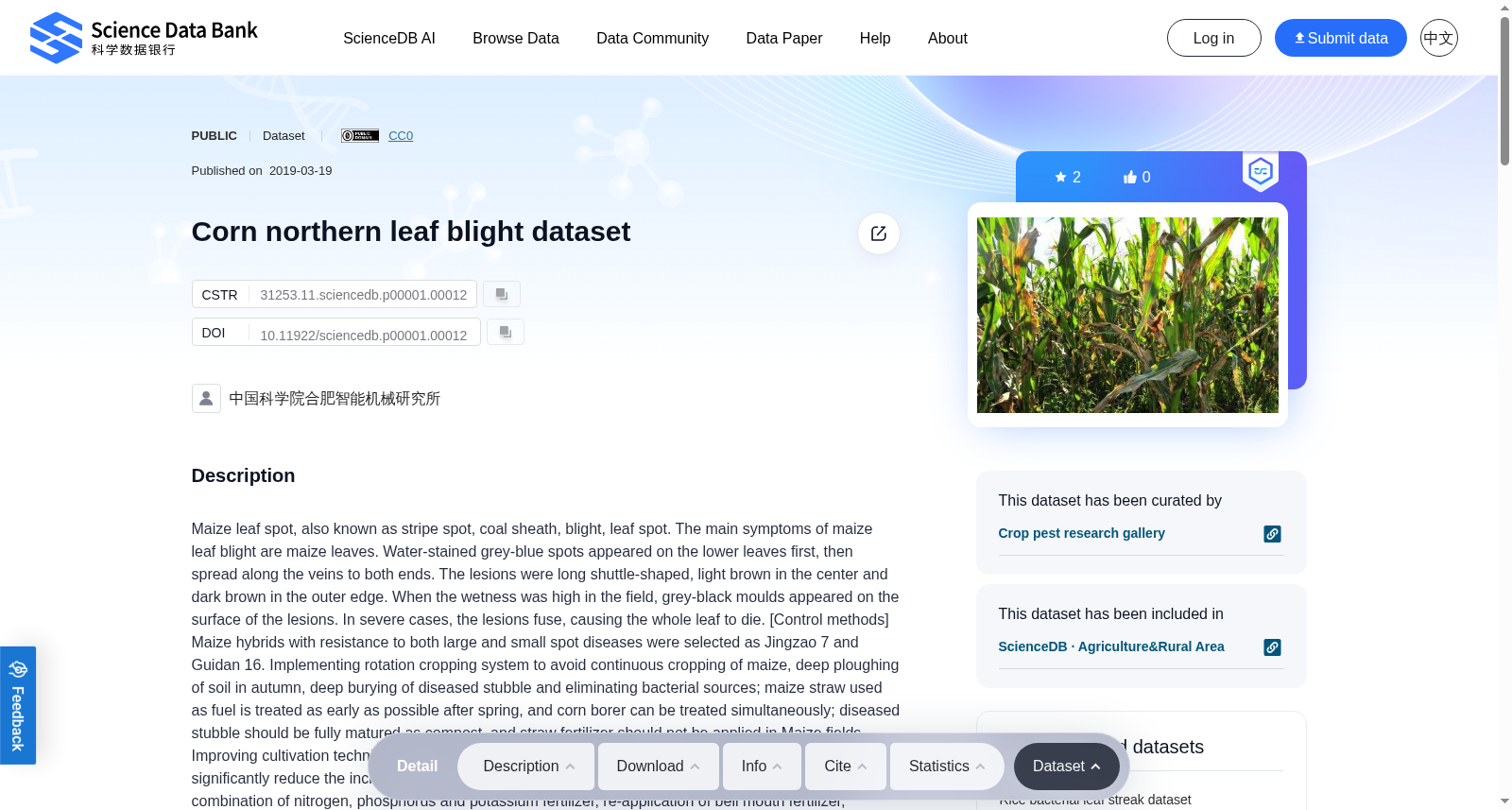
Corn northern leaf blight dataset
收藏资源简介:
Maize leaf spot, also known as stripe spot, coal sheath, blight, leaf spot. The main symptoms of maize leaf blight are maize leaves. Water-stained grey-blue spots appeared on the lower leaves first, then spread along the veins to both ends. The lesions were long shuttle-shaped, light brown in the center and dark brown in the outer edge. When the wetness was high in the field, grey-black moulds appeared on the surface of the lesions. In severe cases, the lesions fuse, causing the whole leaf to die. [Control methods] Maize hybrids with resistance to both large and small spot diseases were selected as Jingzao 7 and Guidan 16. Implementing rotation cropping system to avoid continuous cropping of maize, deep ploughing of soil in autumn, deep burying of diseased stubble and eliminating bacterial sources; maize straw used as fuel is treated as early as possible after spring, and corn borer can be treated simultaneously; diseased stubble should be fully matured as compost, and straw fertilizer should not be applied in Maize fields. Improving cultivation techniques and enhancing disease resistance of summer maize early sowing can significantly reduce the incidence of disease. Appropriate application of phosphorus fertilizer, proper combination of nitrogen, phosphorus and potassium fertilizer, re-application of bell mouth fertilizer, implementation of maize-soybean intercropping, or intercropping with wheat, peanuts, sweet potatoes and other crops, wide and narrow row planting; rational irrigation, attention to field drainage in low-lying areas. Due to the limitation of objective conditions such as plant height and density, spraying control can focus on the high-yielding experimental fields such as seed production and intercropping fields. Generally, before and after maize bolting, when the disease rate in the field is over 70% and the disease leaf rate is about 20%, spraying begins. The effective insecticides are: 50% carbendazim wettable powder, 50% carbendazim wettable powder or 90% mancozeb, adding 500 times water, or 40% grams of aerosol powder 800 times the spray. Each mu of medicinal liquid 50-75 kg, spraying once every 7-10 days, a total of 2-3 times of prevention and control.
玉米叶斑病,又称条斑病、煤纹病、枯叶病、叶斑病。玉米叶斑病主要为害玉米叶片:病害先于下部叶片出现水渍状灰蓝色病斑,随后沿叶脉向两端扩展。病斑呈长梭形,中央浅褐色,边缘深褐色。田间湿度较高时,病斑表面会产生灰黑色霉层。病情严重时病斑相互融合,导致整叶枯死。 【防治方法】选用兼抗大小斑病的玉米杂交品种,如京早7号、贵单16号。实行轮作制度,避免玉米连作;秋季深耕土壤,深翻病残体,消灭菌源;春季尽早处理用作燃料的玉米秸秆,可同时兼治玉米螟;病残体需充分腐熟后方可作为堆肥,切勿在玉米田施用秸秆肥料。 优化栽培技术以增强抗病性:提早播种夏玉米,可显著降低病害发生率。合理施用磷肥,配合氮、磷、钾肥料,重施喇叭口肥;采用玉米与大豆间作,或与小麦、花生、甘薯等作物间作的种植模式,推行宽窄行种植;合理灌溉,低洼地块需注重田间排水。 受株高、种植密度等客观条件限制,药剂防治可重点针对制种田、间作田等高产田块。一般可在玉米抽穗前后,田间病株率达70%以上、病叶率约20%时开始施药。有效药剂包括:50%多菌灵(carbendazim)可湿性粉剂、90%代森锰锌(mancozeb)可湿性粉剂,兑水500倍液,或40%气雾剂粉剂以800倍液喷雾。每亩喷施药液50~75千克,每隔7~10天施药一次,共防治2~3次。