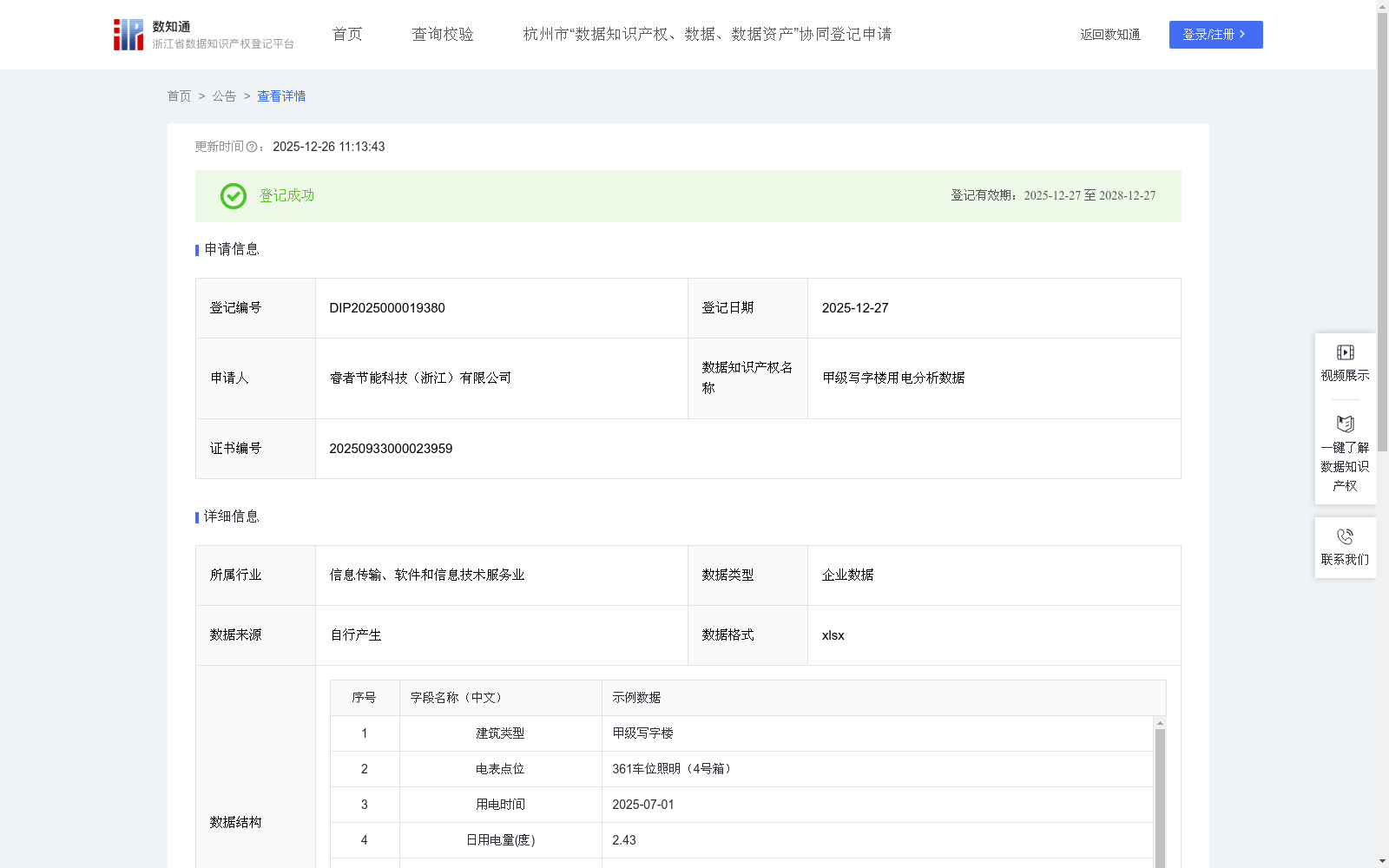
甲级写字楼用电分析数据
收藏资源简介:
甲级写字楼用电分析数据的应用场景是甲级写字楼用电智能监测与管理。通过分析甲级写字楼各个资源点位的用电数据,包括月用电量、月每日用电量均值、标准差、变异系数及当月增长率等,实现了对各处电量使用情况的精准把握,为甲级写字楼管理人员优化能源管理、排查异常能源消耗提供决策支持。此外,其他甲级写字楼可借鉴本分析数据完善自身对于电量使用的监测与管理,由“经验驱动”管理向“数据驱动”管理转变;还可将自身用电数据与本用电分析数据进行对标分析,定位自身电量使用及管理水平,为节能提升、运营优化及模式借鉴提供重要依据。1. 数据来源 通过甲级写字楼内部各个资源点位的电表获取各个资源点位的每日用电数据,包括建筑类型、电表点位、用电时间、日用电量等,并存储到对应数据库中。 2. 数据预处理 以甲级写字楼电表点位作为唯一标识,在数据库中筛选记录,提取出各个资源点位的日用电量等信息,并通过以下算法规则进行数据分析。 3. 数据分析 甲级写字楼用电分析数据算法规则: 对各个资源点位的日用电量按所属月份进行加和计算,得到月用电量。 对月用电量加以运算,得到月每日用电量均值,月每日用电量均值=月用电量/当月天数;再对当月每日用电量求取标准差和变异系数,月每日用电量标准差用于监测各个资源点位当月用电的波动情况,月每日用电量变异系数=月每日用电量标准差/月每日用电量均值,消除了量纲影响,便于对各个资源点位进行用电稳定性的横向比较。 在各月用电量数据的基础上,计算当月用电增长率,当月用电增长率=(月用电量-上月用电量)/上月用电量。 各个资源点位中,当月用电增长率大于100%为重点关注资源点位,说明该点位用电需求愈发旺盛,需要警惕异常用电消耗;增长率为负数,且绝对值大于50%以上,说明该点位用电明显减少,需要跟进深入了解情况。
The application scenario of Grade A office building electricity consumption analysis dataset is intelligent electricity consumption monitoring and management for Grade A office buildings. By analyzing the electricity consumption data of various resource points in Grade A office buildings — including monthly electricity consumption, average daily electricity consumption for the current month, standard deviation, coefficient of variation, and month-on-month electricity growth rate — the system accurately grasps the electricity usage status of each location, providing decision support for managers to optimize energy management and identify abnormal energy consumption. In addition, other Grade A office buildings can reference this analysis dataset to improve their own electricity monitoring and management practices, transitioning from "experience-driven" management to "data-driven" management; they can also conduct benchmarking analysis between their internal electricity consumption data and this dataset to evaluate their own electricity usage and management levels, providing a critical basis for energy conservation enhancement, operational optimization, and model reference. 1. Data Source Daily electricity consumption data of each resource point is collected via electricity meters installed at various locations within Grade A office buildings, covering building type, electricity meter location, electricity consumption timestamp, daily electricity consumption, and other relevant metrics, and then stored in the corresponding database. 2. Data Preprocessing Taking the electricity meter locations of Grade A office buildings as unique identifiers, records are filtered from the database, and information such as daily electricity consumption for each resource point is extracted. Data analysis is then conducted following the algorithm rules outlined below. 3. Data Analysis Algorithm Rules for Grade A office building electricity consumption analysis dataset: 1. Sum the daily electricity consumption of each resource point by their respective month to derive the monthly electricity consumption. 2. Calculate the average daily electricity consumption for the current month using the formula: average daily electricity consumption for the current month = monthly electricity consumption / number of days in the current month. Next, compute the standard deviation and coefficient of variation of the daily electricity consumption for the current month. The standard deviation of daily electricity consumption for the current month is used to monitor the electricity consumption fluctuation at each resource point. The coefficient of variation is calculated as: coefficient of variation = standard deviation of daily electricity consumption for the current month / average daily electricity consumption for the current month, which eliminates the impact of measurement units and enables horizontal comparison of electricity consumption stability across different resource points. 3. Based on the monthly electricity consumption data, calculate the month-on-month electricity growth rate using the formula: month-on-month electricity growth rate = (monthly electricity consumption - previous month's electricity consumption) / previous month's electricity consumption. 4. For each resource point, those with a month-on-month electricity growth rate exceeding 100% are classified as key monitoring points, as their electricity demand is growing rapidly and abnormal electricity consumption should be alerted. For points with a negative growth rate and an absolute value greater than 50%, it indicates a significant decrease in electricity consumption, requiring follow-up in-depth investigation.