
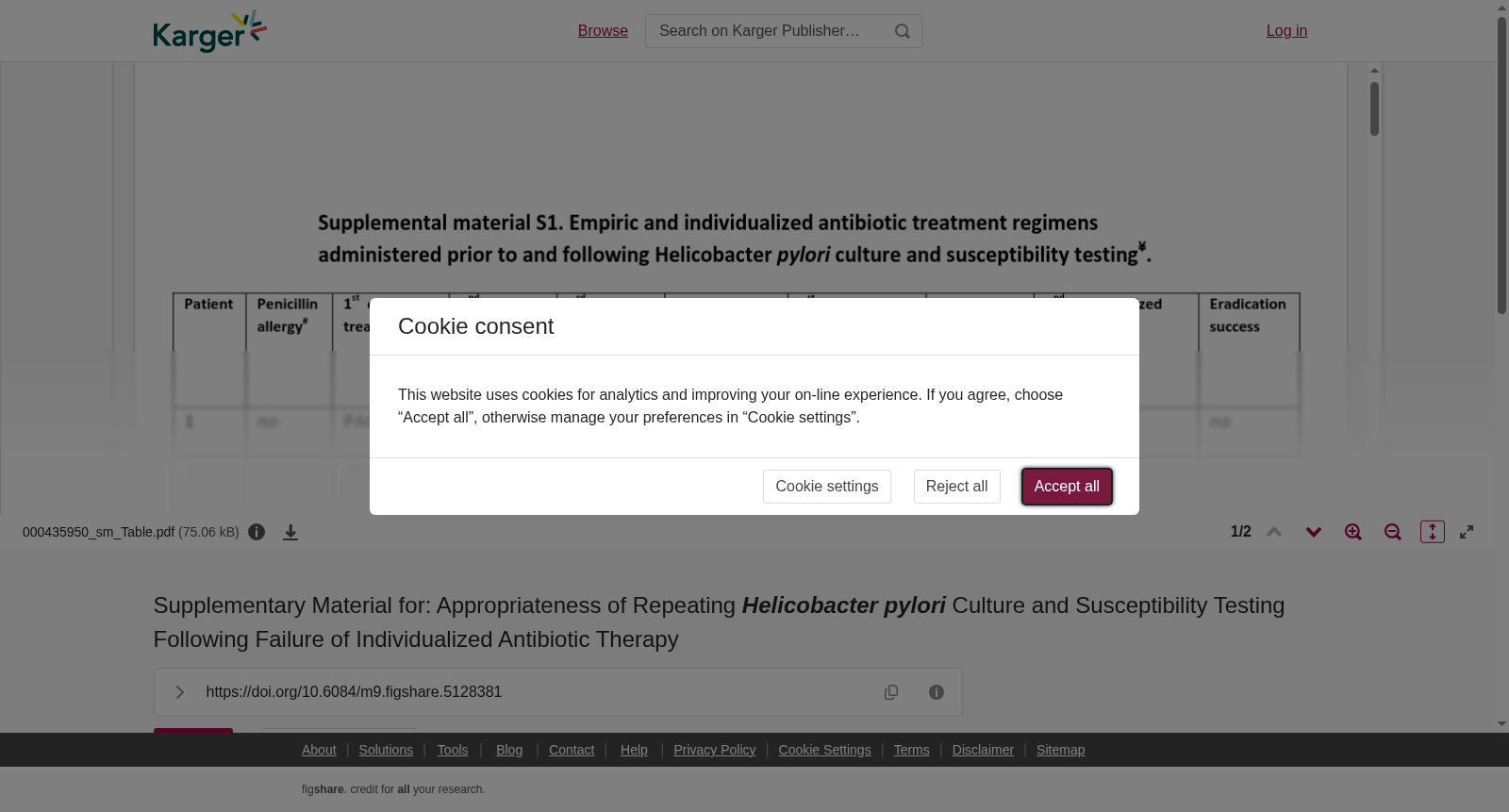
Supplementary Material for: Appropriateness of Repeating <b><i>Helicobacter pylori</i></b> Culture and Susceptibility Testing Following Failure of Individualized Antibiotic Therapy
收藏DataCite Commons2020-09-02 更新2024-07-25 收录
下载链接:
https://karger.figshare.com/articles/dataset/Supplementary_Material_for_Appropriateness_of_Repeating_b_i_Helicobacter_pylori_i_b_Culture_and_Susceptibility_Testing_Following_Failure_of_Individualized_Antibiotic_Therapy/5128381
下载链接
链接失效反馈官方服务:
资源简介:
<b><i>Background:</i></b> Current guidelines recommend direct <i>Helicobacter pylori</i> culture and antibiotic susceptibility testing following 2 failed eradication attempts. If this process is followed and yet subsequent treatment is unsuccessful, it is unclear whether susceptibility testing should be repeated. This is the first study to examine the appropriateness of repeated <i>H. pylori</i> culture and susceptibility testing following failure of individualized treatment. <b><i>Methods:</i></b> Between 2007 and 2014, consecutive patients who underwent at least 2 upper gastrointestinal endoscopies with <i>H. pylori</i> culture and susceptibility testing at our institution following several treatment failures were retrospectively identified. Antibiotic susceptibility was recorded and linked to demographic data. <b><i>Results:</i></b> A total of 68 cultures from 34 patients were included (12 (35.3%) men, 41.4 ± 16.6 years), and 20 (58.8%) cultures had a different antibiotic susceptibility profile on repeat testing (8 (23.5%) with new susceptibility and 13 (38.2%) with new resistance). Acquired resistance to clarithromycin, levofloxacin and metronidazole was observed in 9 (26.5%), 2 (5.9%) and 10 (29.4%) cultures, respectively. Subjects with resistance to ≤1 antibiotic at baseline were more likely to develop resistance to at least 1 antibiotic on subsequent culture, compared to subjects with resistance to ≥2 antibiotics at baseline (13 (100%) vs. 5 (23.8%), p < 0.01). <b><i>Conclusion:</i></b> Repeating <i>H. pylori</i> culture and susceptibility testing usually yields new antimicrobial susceptibility data. However, the clinical usefulness of this approach remains unclear.
<b><i>背景:</i></b> 当前指南推荐在根除治疗失败2次后直接开展幽门螺杆菌(Helicobacter pylori)培养与抗生素药敏试验。若遵循该流程后后续治疗仍未成功,则尚不明确是否应重复药敏试验。本研究为首项探讨个体化治疗失败后重复幽门螺杆菌培养及药敏试验合理性的研究。
<b><i>方法:</i></b> 2007年至2014年间,本机构回顾性纳入了因多次根除治疗失败后,接受至少2次上消化道内镜检查并行幽门螺杆菌培养及药敏试验的连续性患者。研究记录了抗生素药敏结果,并将其与人口学资料进行关联。
<b><i>结果:</i></b> 本研究共纳入34例患者的68份培养标本(其中男性12例,占35.3%,年龄41.4±16.6岁),20份(58.8%)重复检测标本呈现不同的抗生素药敏谱(8份(23.5%)出现新的药敏表型,13份(38.2%)出现新的耐药表型)。分别有9份(26.5%)、2份(5.9%)及10份(29.4%)的培养标本检出对克拉霉素、左氧氟沙星及甲硝唑的获得性耐药。与基线时对≥2种抗生素耐药的受试者相比,基线时对≤1种抗生素耐药的受试者在后续培养中更易出现至少1种抗生素耐药(13例(100%) vs. 5例(23.8%),p < 0.01)。
<b><i>结论:</i></b> 重复幽门螺杆菌培养及药敏试验通常可获得新的抗菌药物药敏数据,但该方法的临床应用价值仍不明确。
提供机构:
Karger Publishers创建时间:
2017-06-20
搜集汇总
数据集介绍
背景与挑战
背景概述
该数据集是一项关于幽门螺杆菌(Helicobacter pylori)的医学研究补充材料,发布于2015年,旨在评估在个体化抗生素治疗失败后重复进行幽门螺杆菌培养和药敏测试的适当性。研究基于34名患者的68次培养数据,发现58.8%的重复测试产生了新的抗生素敏感性谱,包括对克拉霉素、左氧氟沙星和甲硝唑的获得性耐药,但结论指出这种重复测试的临床实用性仍不明确。
以上内容由遇见数据集搜集并总结生成

暂无相关数据集


