具有层次潜在特征的SAR到光学图像的转换
收藏资源简介:
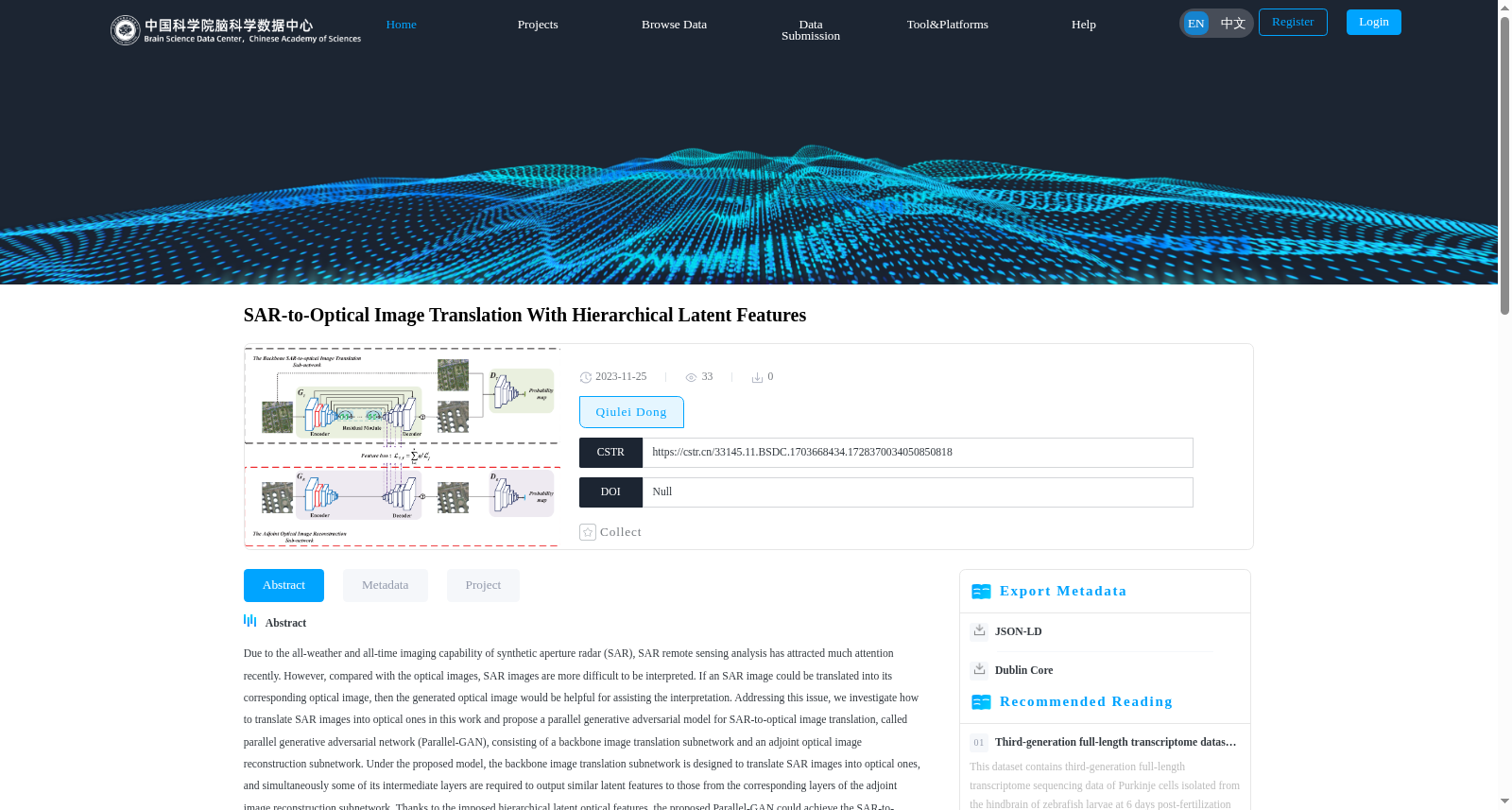
由于合成孔径雷达(SAR)具有全天候和全时段成像的能力,SAR遥感分析最近引起了广泛的关注。然而,与光学图像相比,SAR图像更难以解释。如果能将SAR图像转化为其对应的光学图像,那么生成的光学图像将有助于辅助解释。针对这个问题,我们研究了如何将SAR图像转换为光学图像,并提出了一种用于SAR到光学图像转换的并行生成对抗模型,称为并行生成对抗网络(Parallel-GAN),由主干图像转换子网络和伴随光学图像重建子网络组成。在提出的模型下,主干图像转换子网络设计用来将SAR图像转换为光学图像,同时,其部分中间层需要输出与伴随图像重建子网络的相应层相似的潜在特征。由于施加的分层潜在光学特征,提出的Parallel-GAN能够有效地实现SAR到光学图像的转换。在三个公开数据集上的广泛实验结果表明,所提出的方法在SAR到光学图像转换上超越了十种最先进的方法。
Synthetic Aperture Radar (SAR) has garnered extensive attention in remote sensing research recently, owing to its all-weather and all-time imaging capabilities. However, interpreting SAR images is more challenging than optical image interpretation. Converting SAR images into their corresponding optical images can greatly facilitate the interpretation of SAR data. To tackle this issue, we investigate the task of SAR-to-optical image translation and propose a parallel generative adversarial network termed Parallel-GAN, which consists of a backbone image translation sub-network and an auxiliary optical image reconstruction sub-network. In the proposed model, the backbone image translation sub-network is designed to convert SAR images into optical images, while some of its intermediate layers are required to output latent features similar to those of the corresponding layers in the auxiliary optical image reconstruction sub-network. By leveraging the introduced hierarchical latent optical features, the proposed Parallel-GAN can effectively accomplish SAR-to-optical image translation. Extensive experimental results on three public datasets demonstrate that the proposed method outperforms ten state-of-the-art methods in SAR-to-optical image translation.