
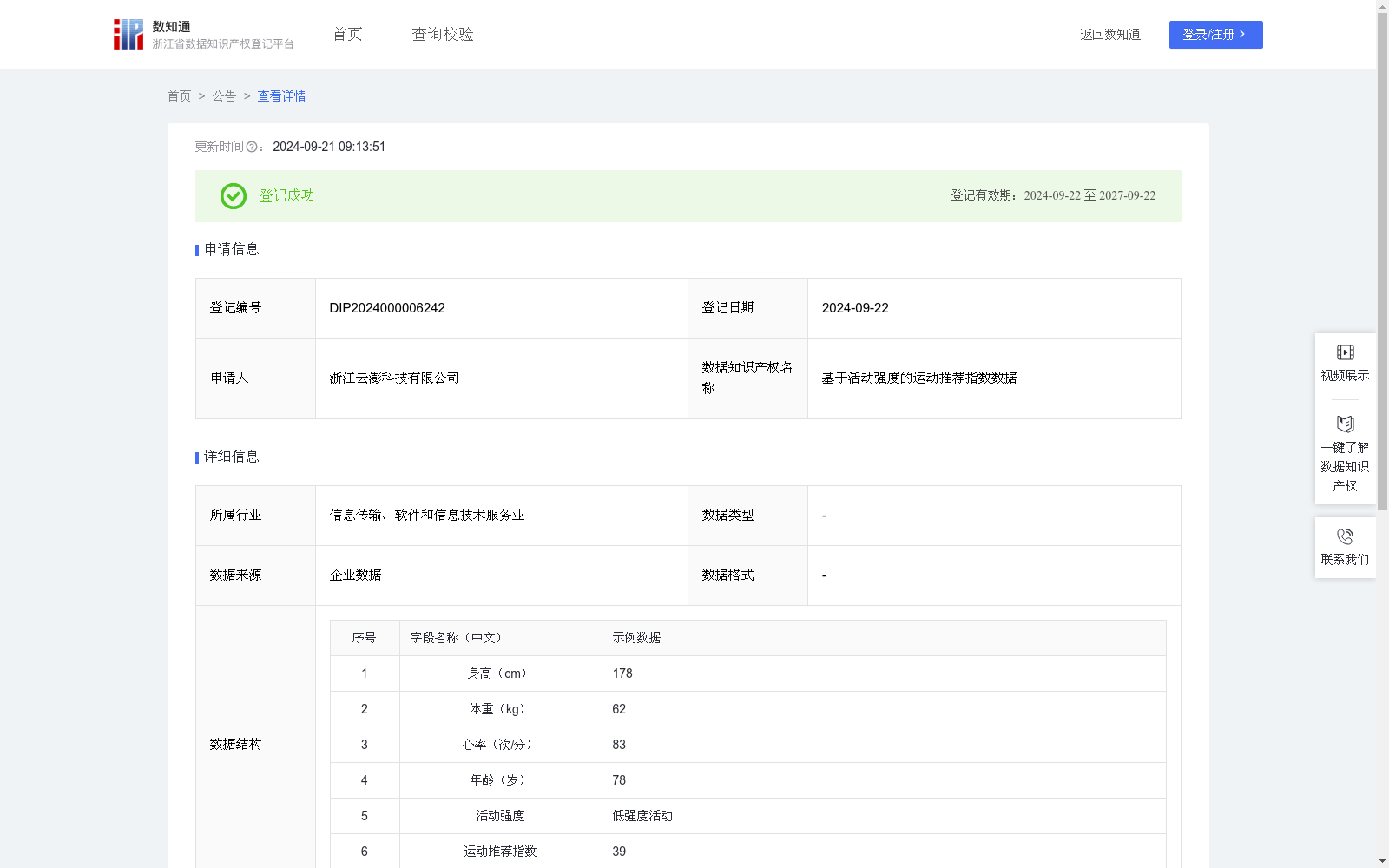
基于活动强度的运动推荐指数数据
收藏浙江省数据知识产权登记平台2024-09-21 更新2024-09-22 收录
下载链接:
https://www.zjip.org.cn/home/announce/trends/63577
下载链接
链接失效反馈官方服务:
资源简介:
通过综合分析个人的基础数据,以及持续监测的日、周、月的活动强度,利用专有算法计算出个性化的运动推荐指数,为用户提供科学的运动建议。
自我管理:可以根据该指数了解用户的运动需求,为用户推荐合适的日常活动。
长期跟踪与调整:通过长期监测活动强度指数,根据指数变化调整运动强度和类型,为用户提供具指导意义的运动建议。
本数据适用于:
智能健康管理系统:智能健康管理系统可以根据用户的个人健康数据结合实时监测的健康状况,推荐合适的运动类型和强度。
健身中心与体育俱乐部:为会员提供科学的运动指导,根据客户的活动强度调整训练计划,确保运动的安全性。通过本公司健康监测产品,对日常活动活动持续的监测;将检测数据预处理后,输入到随机森林模型中,得出运动推荐指数。
随机森林模型是通过构建多棵决策树并综合其预测结果。每棵决策树会根据身体指标特征重要性和分裂规则,对数据进行逐步的节点分裂,直至达到叶节点。
1.节点分裂:在每个内部节点,决策树根据某个身体指标特征向量及其阈值对数据进行分裂,选择信息增益最大的身体指标特征点和阈值。计算公式为:
Information Gain = H(S) - Σ (v ∈ Values(A)) |S_v| / |S| * H(S_v)
其中,H(S)是样本集 S 的熵,A 是特征,是特征 A 取值为时的样本子集。
2.综合多棵决策树的预测结果,最终的运动推荐指数公式为:
(1/T) * ∑(从 t=1 到 T) y_t^(X)
其中,T是决策树的数量,y是第t棵决策树的预测值。X是输入的身体指标特征向量(身高、体重、年龄、劳动强度、心率、活动强度)。
By comprehensively analyzing an individual's basic data and continuously monitored daily, weekly, and monthly activity intensity, a personalized exercise recommendation index is calculated using a proprietary algorithm to provide users with scientific exercise advice.
Self-management: Users can understand their exercise needs based on this index and receive recommendations for appropriate daily activities.
Long-term tracking and adjustment: By long-term monitoring of activity intensity indices, exercise intensity and type can be adjusted according to index changes, providing users with instructive exercise guidance.
This dataset is applicable to:
1. Smart health management systems: Such systems can recommend appropriate exercise types and intensities based on users' personal health data combined with real-time monitored health conditions.
2. Fitness centers and sports clubs: Provide members with scientific exercise guidance, adjust training plans according to customers' activity intensity to ensure exercise safety.
Through the company's health monitoring products, daily activities are continuously monitored; the detected data is preprocessed and then input into a random forest model to derive the exercise recommendation index.
The random forest model is constructed by building multiple decision trees and integrating their prediction results. Each decision tree performs gradual node splitting on the data based on the feature importance of physical indicators and splitting rules until reaching leaf nodes.
1. Node splitting: At each internal node, the decision tree splits the data based on a physical indicator feature vector and its threshold, selecting the physical indicator feature and threshold that maximize the information gain. The calculation formula is:
$$Information Gain = H(S) - sum_{v in Values(A)} frac{|S_v|}{|S|} imes H(S_v)$$
Where H(S) is the entropy of the sample set S, A is the feature, and S_v is the sample subset when feature A takes value v.
2. Integrate the prediction results of multiple decision trees, and the final formula for the exercise recommendation index is:
$$ ext{Exercise Recommendation Index} = frac{1}{T} sum_{t=1}^{T} y_t^{(X)}$$
Where T is the number of decision trees, $y_t^{(X)}$ is the predicted value of the t-th decision tree, and X is the input physical indicator feature vector (height, weight, age, labor intensity, heart rate, activity intensity).
提供机构:
浙江云澎科技有限公司
创建时间:
2024-08-20
搜集汇总
数据集介绍
特点
该数据集是一个包含1001条记录的运动推荐指数数据,每日更新,用于智能健康管理系统和健身中心,通过随机森林模型为用户提供个性化的运动建议。
以上内容由遇见数据集搜集并总结生成


