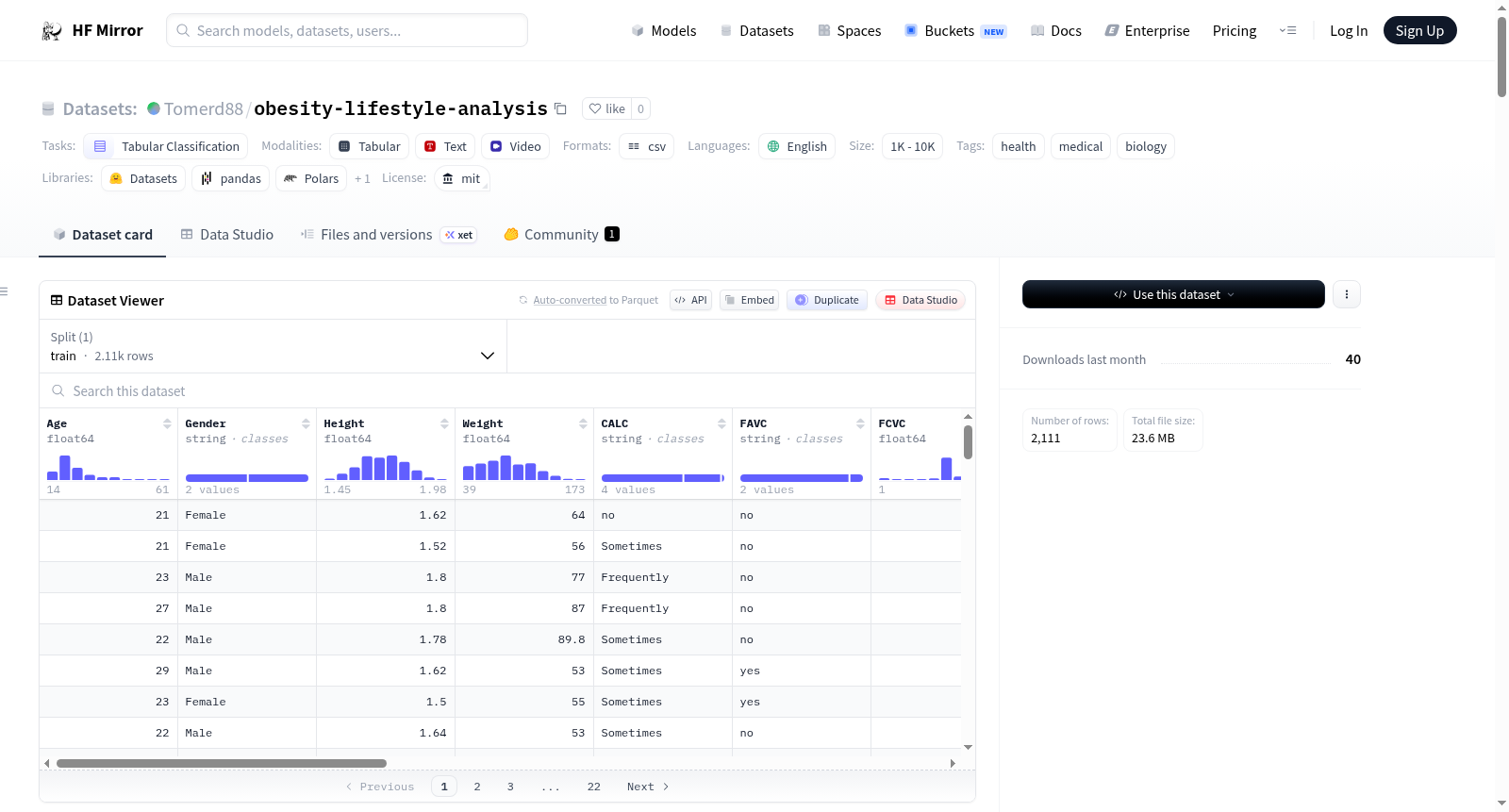
Tomerd88/obesity-lifestyle-analysis
收藏资源简介:
--- license: mit task_categories: - tabular-classification language: - en tags: - health - medical - biology pretty_name: Obesity Levels & Lifestyle Analysis size_categories: - 1K<n<10K --- <video src="https://cdn-uploads.huggingface.co/production/uploads/69d98e416f24734dd0943c55/eKTE3OIHtHQfCqqNsmtm8.mp4" controls="controls" style="max-width: 720px;"></video> # Obesity Levels & Lifestyle Dynamics: A Predictive Research Study **Student:** Tomer Dariel **Academic Institution:** Reichman University (IDC Herzliya) **Course:** Introduction to Data Science --- ## 1. Project Overview This research explores the critical relationship between lifestyle habits, physical attributes, and genetic predispositions in determining obesity levels. By analyzing multimodal data, the study aims to identify which factors—biological or behavioral—should be prioritized in public health assessments. The research moves beyond the common assumption that weight is purely a result of exercise, seeking to uncover the hidden "anchors" of body mass. --- ## 2. Research Questions & Dataset Selection **Source:** The dataset is sourced from Kaggle (Estimation of Obesity Levels based on eating habits and physical condition), containing pre-processed multimodal data for health classification. **Size:** The dataset consists of 2,111 rows and 17 features, providing a substantial foundation for non-basic statistical analysis. **Features:** * **Biological and Genetic (3 features):** Age, Height, and Family History of Overweight. * **Behavioral Habits (7 features):** Physical Activity Frequency (FAF), Water Consumption (CH2O), Time using Technology (TUE), and Vegetable Consumption (FCVC). **Target Variable:** `NObeyesdad`, which classifies each sample into 7 categories: Insufficient Weight, Normal Weight, Overweight I/II, and Obesity I/II/III. **Primary Research Question:** Which factor serves as the strongest predictor of clinical obesity: physical stature (Height), behavioral habits (Activity), or genetic background (Family History)? --- ## 3. Data Cleaning & Preprocessing **Integrity Check:** The dataset was found to be complete with no missing values (0 nulls). Duplicate rows were identified and removed to ensure statistical purity and prevent over-representation of specific profiles. **Label Mapping:** I manually mapped the categorical target variable (`NObeyesdad`) into an ordinal scale ranging from 0 to 6. This allowed the analysis to treat obesity as a progression rather than independent labels. **Feature Encoding:** Categorical variables such as `Family History` and `Gender` were converted into binary numerical values (0 and 1). This critical step enabled these features to be processed in the Advanced Correlation Matrix, measuring the "signal" of genetics against numeric behavioral habits. --- ## 4. Key Research Decision: Outlier Handling **Identification:** Outliers were detected using Box Plots analyzing the distribution of Weight across Obesity Levels.  **Handling and Justification:** While standard practice often suggests removing outliers, I made the strategic decision to **keep all extreme values**. **Reasoning:** In obesity research, outliers represent the most clinically significant cases—individuals at the extreme ends of the weight spectrum. Removing them would create a "sterile" dataset incapable of detecting the very conditions (Obesity Type III) that this research aims to predict. These outliers are not errors; they are the core of the study. --- ## 5. Height vs. Weight: The Physical Anchor **Visualization:**  **Analysis:** The scatter plot revealed a positive correlation of **0.46**. **Insight:** While height provides the physical frame for weight, the 0.46 correlation indicates that it only explains less than half of the variance. This finding led to the next stage of the study: investigating what fills the gap between stature and actual body mass. --- ## 6. Physical Activity vs. Weight: Challenging the Intuition **Visualization:**  **Analysis:** I investigated the frequency of physical activity (FAF) as a predictor. **Finding:** Surprisingly, the correlation was significantly lower than height or genetics. **Insight:** This challenges the common intuition that exercise is the primary driver of weight. In this specific population, activity frequency is a supportive factor but lacks the predictive power of biological anchors, suggesting that lifestyle choices are often secondary to a genetic baseline. --- ## 7. Cross-Analysis: Family History & Gender **Visualization:**  **Methodology:** I utilized a Pivot Table to calculate the mean weight across gender and genetic lines. **Key Finding:** Individuals with a family history of overweight have a drastically higher weight floor. **Insight:** The data reveals that males with a family history reached the highest average weights in the sample. This identifies a specific high-risk demographic where genetic predisposition and gender-specific biology intersect. --- ## 8. Advanced Correlation Map **Visualization:**  **Analysis:** By including the newly encoded Family History variable in the correlation matrix, the true hierarchy of predictors emerged. **Finding:** A remarkable **0.50 correlation** was found between Family History and the Obesity Level. **Insight:** This was the strongest link in the entire study. It proves that a patient's genetic and environmental background is a more reliable primary differentiator for obesity than their physical height or their self-reported exercise habits. --- ## 9. Final Conclusions **Genetics as a Proxy for Risk:** The study identifies Family History (0.50) as the most powerful predictor. Predictive models must prioritize genetic background to accurately identify at-risk individuals before they reach extreme obesity levels. **Physical-Habit Dissonance:** The gap between the 0.46 (Height) and 0.50 (Genetics) correlations indicates that while we are anchored to our stature, our genetic environment sets our biological limit. **Final Summary:** The research concludes that obesity is a multi-modal challenge. The findings suggest that public health interventions should be tailored to individuals with specific genetic risk factors, as behavioral habits alone show a lower direct correlation with clinical weight outcomes in this dataset. ---