
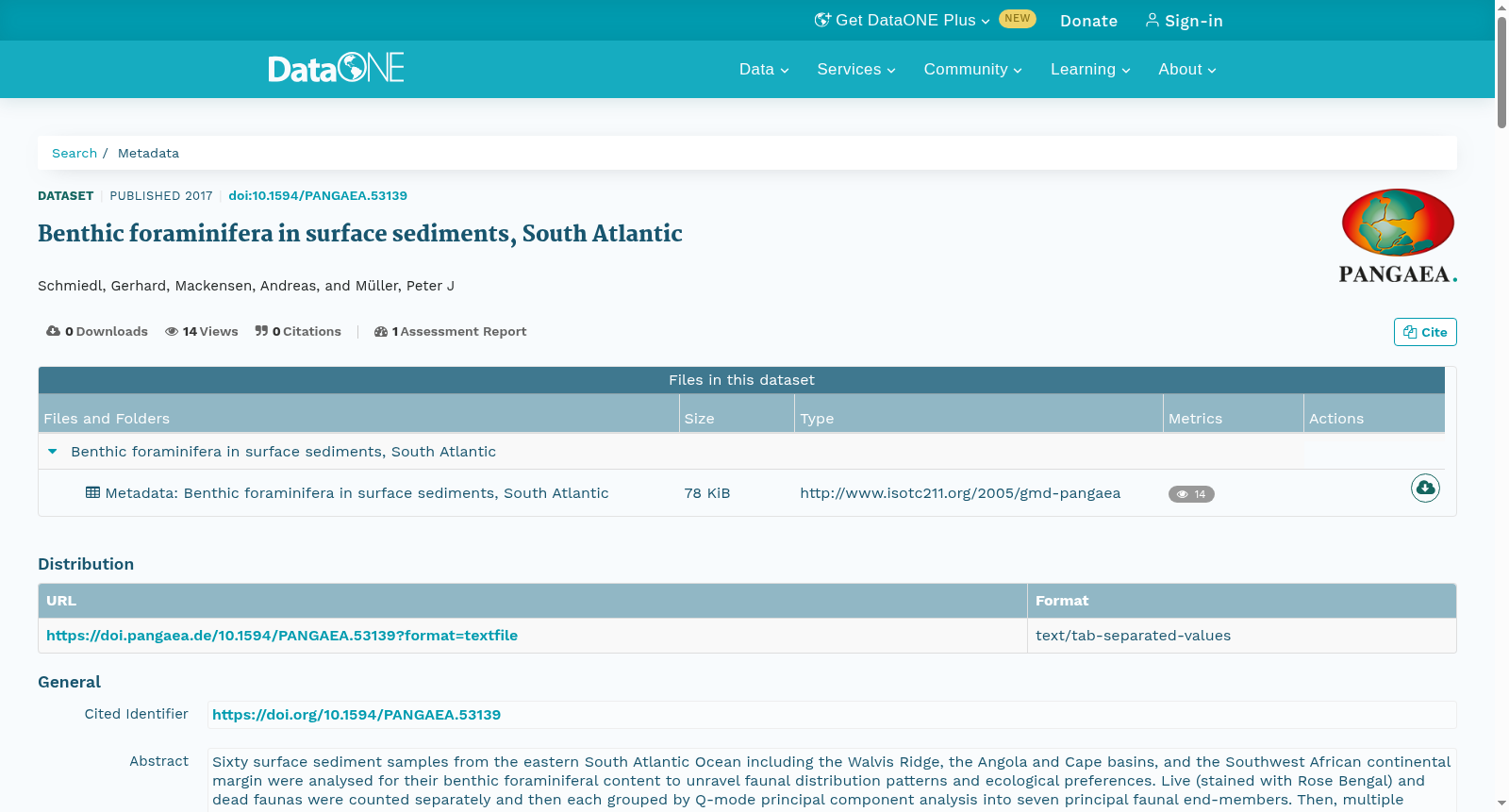
Benthic foraminifera in surface sediments, South Atlantic
收藏DataONE2017-08-04 更新2024-06-26 收录
下载链接:
https://search.dataone.org/view/bc985a8f69080824262456c4ddbb3412
下载链接
链接失效反馈官方服务:
资源简介:
Sixty surface sediment samples from the eastern South Atlantic Ocean including the Walvis Ridge, the Angola and Cape basins, and the Southwest African continental margin were analysed for their benthic foraminiferal content to unravel faunal distribution patterns and ecological preferences.
Live (stained with Rose Bengal) and dead faunas were counted separately and then each grouped by Q-mode principal component analysis into seven principal faunal end-members. Then, multiple regression technique was used to correlate Recent assemblages with available environmental variables and to finally differentiate between four principal groups of environmental agents acting upon the generation of benthic foraminiferal assemblages: (1) seasonality of food supply and organic carbon flux rates, together with oxygen content in the pore and bottom waters; (2) lateral advection of deep-water masses; (3) bottom water carbonate corrosiveness; and (4) energetic state at the benthic boundary layer and grain size composition of the substrate.
Food supply and corresponding dissolved oxygen contents in the pore and bottom waters turned out to be the most important factors which control the distribution pattern of the Recent benthic foraminifera. At the continental margin, in the zone of coastal upwelling and its mixing area, benthic foraminiferal assemblages are dominated by stenobathic high-productivity faunas, characterized by elevated standing stocks, low diversities and a large number of endobenthic living species. At the continental shelf and upper continental slope the live assemblages are characterized by Rectuvigerina cylindrica, Uvigerina peregrina s.1., Uvigerina auberiana and Rhizammina spp. while the dead assemblages are characterized by Cassidulina laevigata, Bolivina dilatata, Bulimina costata and B. mexicana. At the lower continental slope strong influence of high organic matter fluxes on the species composition is restricted to the area off the Cunene river mouth, where the live assemblage is dominated by Uvigerina peregrina s.1., the corresponding dead assemblage by Melonis barleeanum and M. zaandamae. In the adjacent areas of the lower continental slope the biocoenosis is characterized by Reophax bilocularis, and Epistominella exigua which becomes dominant in the corresponding dead assemblage.
At the Walvis Ridge and in the abyssal Angola and Cape basins, where organic matter fluxes are low and highly seasonal, benthic foraminiferal assemblages reflect both the oligotrophic situation and the deep and bottom water mass configuration. The top and flanks of the Walvis Ridge are inhabited by the Rhizammina, Psammosphaera and R. bilocularis live assemblages, the corresponding dead assemblages are dominated by G. subglobosa on the ridge top and E. exigua on the flanks. Within the highly diverse E. exigua dead assemblage several associated epibenthic species coincide with the core of NADW between about 1600 and 3700 m water depth. These species include Osangularia culter, Cibicidoides kullenbergi, Melonis pompilioides, Bolivinita pseudothalmanni and Bulimina alazanensis. The assemblages of the abyssal Cape and Angola basins are characterized by Nuttallides umbonifer and a high proportion of agglutinated species. These species are adapted to very low organic matter fluxes and a carbonate corrosive environment.
本研究对南大西洋东部海域(包含沃尔维斯海岭(Walvis Ridge)、安哥拉盆地与开普盆地,以及西南非洲大陆边缘)的60份表层沉积物样品开展底栖有孔虫(benthic foraminifera)组分分析,以揭示其动物群分布模式与生态偏好。
经玫瑰红(Rose Bengal)染色的现生有孔虫与死有孔虫动物群分别计数,随后通过Q模式主成分分析(Q-mode principal component analysis)将其划分为7个主要动物群端元。本研究采用多元回归技术,将现代底栖有孔虫组合与已获取的环境变量进行关联,最终区分出调控底栖有孔虫组合形成的4类主要环境因子:(1) 食物供给的季节性与有机碳通量速率,以及孔隙水与底层水的含氧量;(2) 深水团块的侧向平流输送;(3) 底层水的碳酸盐溶蚀性;(4) 底栖边界层的水动力状态与沉积物基质的粒度组成。
研究结果显示,食物供给与对应的孔隙水、底层水溶解氧含量是调控现代底栖有孔虫分布模式的最关键因素。在大陆边缘的海岸上升流区及其混合区域,底栖有孔虫组合以狭栖性高生产力动物群为主,其特征为现存量较高、多样性较低且包含大量内栖生活物种。在大陆架与上陆坡区域,现生组合以圆筒直室虫(Rectuvigerina cylindrica)、广义远游乌格虫(Uvigerina peregrina s.l.)、奥氏乌格虫(Uvigerina auberiana)以及根足虫属(Rhizammina)物种为特征;死组合则以光盖虫(Cassidulina laevigata)、膨凸玻切虫(Bolivina dilatata)、肋饰布利米那虫(Bulimina costata)以及墨西哥布利米那虫(B. mexicana)为特征。在下陆坡区域,高有机碳通量对物种组成的强烈影响仅局限于库内河口附近海域,该区域的现生组合以广义远游乌格虫为主,对应的死组合则以巴利美隆虫(Melonis barleeanum)与扎安达美隆虫(M. zaandamae)为主。在下陆坡的邻近海域,生物群落以双室串珠虫(Reophax bilocularis)与细缝小泡虫(Epistominella exigua)为特征,后者在对应的死组合中占据优势。
在沃尔维斯海岭以及深渊域的安哥拉盆地与开普盆地,有机碳通量较低且季节性极强,底栖有孔虫组合同时反映了贫营养环境与深水-底层水团的结构特征。沃尔维斯海岭的顶部与侧翼的现生组合以根足虫属(Rhizammina)、沙球虫属(Psammosphaera)以及双室根足虫(R. bilocularis)为特征;对应的死组合中,海岭顶部以G. subglobosa为主,侧翼则以细缝小泡虫(E. exigua)为主。在水深1600~3700 m的北大西洋深层水(North Atlantic Deep Water,NADW)核心区域,多样性极高的细缝小泡虫死组合中伴随有多种外栖物种,这些物种包括刀形角口虫(Osangularia culter)、库氏拟圆辐虫(Cibicidoides kullenbergi)、膨凸美隆虫(Melonis pompilioides)、假塔氏玻切小体虫(Bolivinita pseudothalmanni)以及阿拉萨布利米那虫(Bulimina alazanensis)。深渊域开普盆地与安哥拉盆地的有孔虫组合以脐盖小纺锤虫(Nuttallides umbonifer)以及高比例的胶结质壳物种为特征,这些物种适应极低的有机碳通量与碳酸盐溶蚀性较强的环境。
创建时间:
2018-01-05
搜集汇总
数据集介绍
以上内容由遇见数据集搜集并总结生成

暂无相关数据集


