未来不同气候变化情景下青藏高原冻土碳储量变化图集
收藏资源简介:
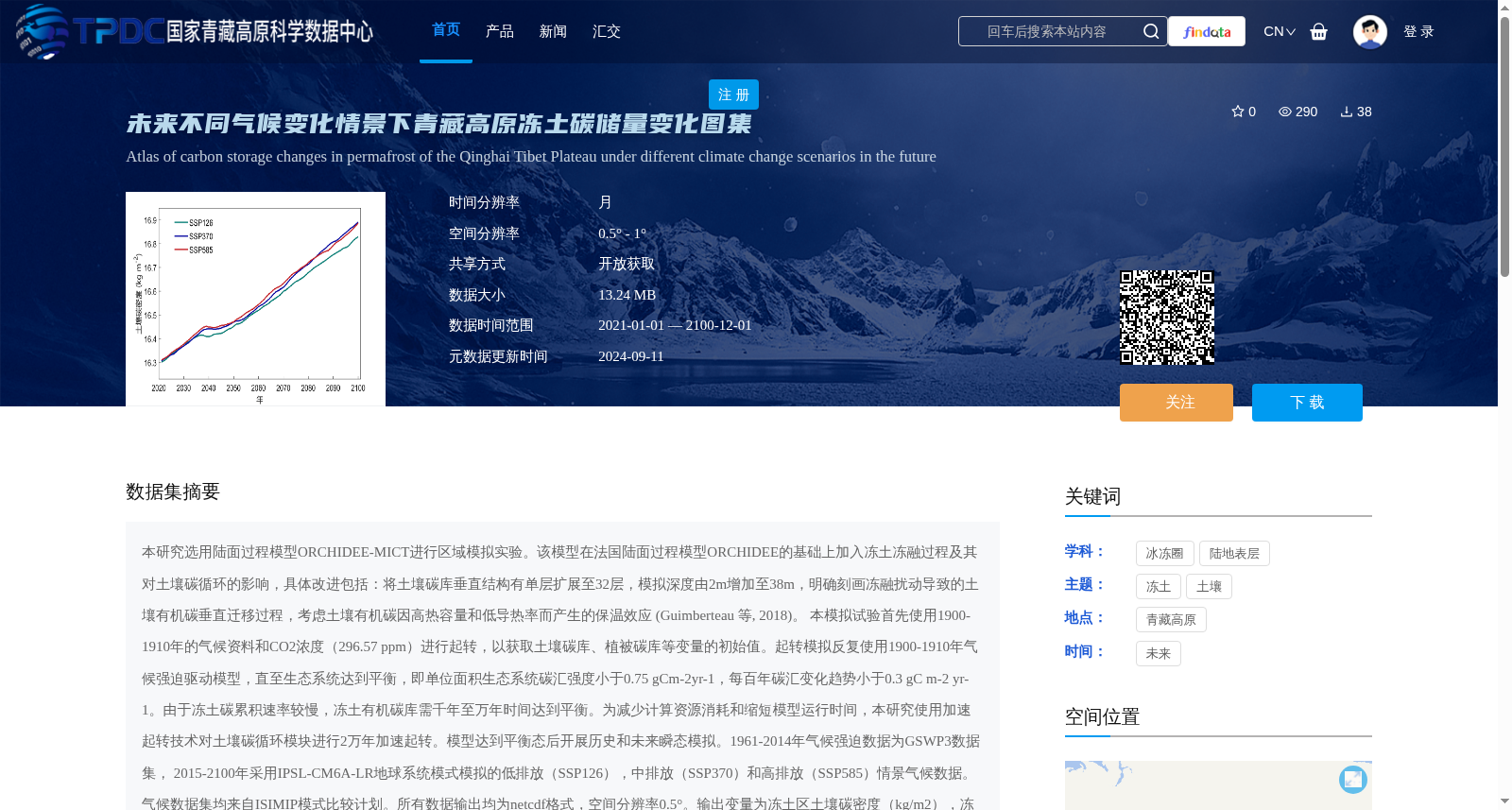
本研究选用陆面过程模型ORCHIDEE-MICT进行区域模拟实验。该模型在法国陆面过程模型ORCHIDEE的基础上加入冻土冻融过程及其对土壤碳循环的影响,具体改进包括:将土壤碳库垂直结构有单层扩展至32层,模拟深度由2m增加至38m,明确刻画冻融扰动导致的土壤有机碳垂直迁移过程,考虑土壤有机碳因高热容量和低导热率而产生的保温效应 (Guimberteau 等, 2018)。 本模拟试验首先使用1900-1910年的气候资料和CO2浓度(296.57 ppm)进行起转,以获取土壤碳库、植被碳库等变量的初始值。起转模拟反复使用1900-1910年气候强迫驱动模型,直至生态系统达到平衡,即单位面积生态系统碳汇强度小于0.75 gCm-2yr-1,每百年碳汇变化趋势小于0.3 gC m-2 yr-1。由于冻土碳累积速率较慢,冻土有机碳库需千年至万年时间达到平衡。为减少计算资源消耗和缩短模型运行时间,本研究使用加速起转技术对土壤碳循环模块进行2万年加速起转。模型达到平衡态后开展历史和未来瞬态模拟。1961-2014年气候强迫数据为GSWP3数据集, 2015-2100年采用IPSL-CM6A-LR地球系统模式模拟的低排放(SSP126),中排放(SSP370)和高排放(SSP585)情景气候数据。气候数据集均来自ISIMIP模式比较计划。所有数据输出均为netcdf格式,空间分辨率0.5°。输出变量为冻土区土壤碳密度(kg/m2),冻土区的范围使用Zou D.F. 等(2017)数据。模拟结果显示,未来高原气候暖湿化趋势持续增强背景下,高原冻土退化引起的冻土碳排放并未抵消植被变绿驱动的土壤碳积累,即便在高排放情景下冻土区土壤有机碳储量仍然呈现稳步增长趋势。
In this study, the land surface model ORCHIDEE-MICT was selected for regional simulation experiments. This model is developed based on the French land surface model ORCHIDEE, with the addition of permafrost freeze-thaw processes and their impacts on soil carbon cycling. Specific improvements include: expanding the vertical structure of the soil carbon pool from a single layer to 32 layers, increasing the simulation depth from 2 m to 38 m, explicitly characterizing the vertical migration of soil organic carbon induced by freeze-thaw disturbances, and considering the thermal insulation effect of soil organic carbon due to its high heat capacity and low thermal conductivity (Guimberteau et al., 2018). This simulation experiment first used climate data and CO₂ concentration (296.57 ppm) from 1900–1910 for spin-up to obtain initial values of variables such as soil carbon pool and vegetation carbon pool. The spin-up simulation repeatedly drove the model with climate forcing from 1900–1910 until the ecosystem reached equilibrium, defined as the ecosystem carbon sink intensity per unit area being less than 0.75 gC m⁻² yr⁻¹ and the centennial trend of carbon sink change being less than 0.3 gC m⁻² yr⁻¹. Due to the slow accumulation rate of permafrost carbon, the permafrost organic carbon pool requires thousands to tens of thousands of years to reach equilibrium. To reduce computational resource consumption and shorten model runtime, this study used accelerated spin-up technology to perform a 20,000-year accelerated spin-up for the soil carbon cycling module. After the model reached equilibrium, historical and future transient simulations were conducted. Climate forcing data from 1961–2014 were taken from the GSWP3 dataset, while data for 2015–2100 were from the low-emission (SSP126), medium-emission (SSP370), and high-emission (SSP585) scenarios simulated by the IPSL-CM6A-LR Earth System Model. All climate datasets were sourced from the ISIMIP Model Intercomparison Project. All model outputs are in netCDF format with a spatial resolution of 0.5°. The output variables include soil carbon density in permafrost regions (kg/m²), and the permafrost extent was derived from the data of Zou D.F. et al. (2017). Simulation results show that under the background of the continuously intensifying warming and humidification trend of the plateau climate in the future, permafrost carbon emissions caused by permafrost degradation on the plateau do not offset the soil carbon accumulation driven by vegetation greening. Even under the high-emission scenario, soil organic carbon stocks in permafrost regions still show a steady increasing trend.