
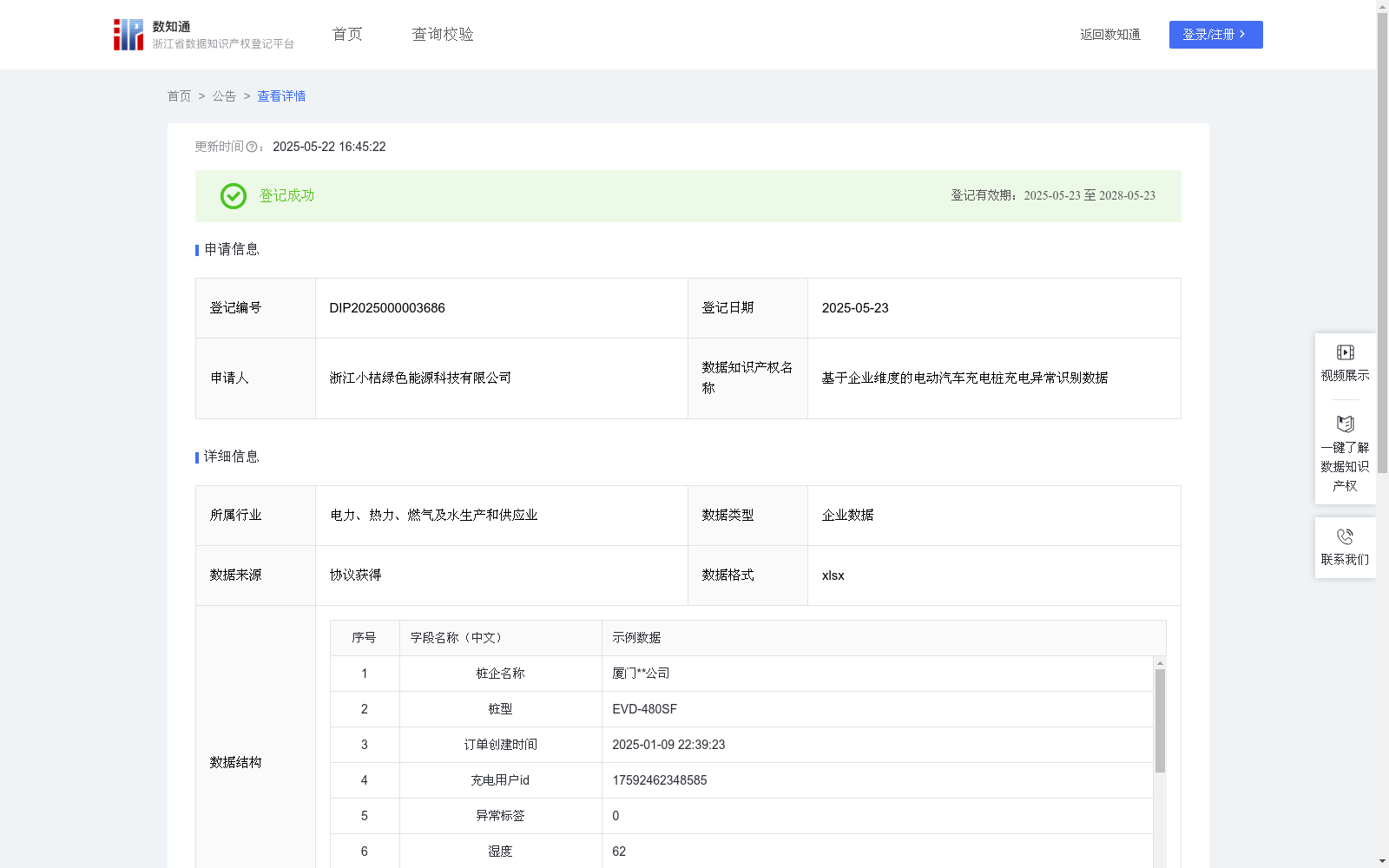
基于企业维度的电动汽车充电桩充电异常识别数据
收藏浙江省数据知识产权登记平台2025-05-22 更新2025-05-23 收录
下载链接:
https://www.zjip.org.cn/home/announce/trends/131910
下载链接
链接失效反馈官方服务:
资源简介:
本数据在充电桩智能运维领域具备精准故障定位能力,具体应用场景如下:
1. 对平台的价值(运维效率提升):可通过多订单特征分析识别机械部件故障,自动拦截天气、用户行为等临时干扰,推荐维修优先级。当同一桩企同型号设备连续多次判定为故障时,自动触发维修工单,减少人工排查成本。
2. 对桩企的价值(精准售后服务):快速定位批次性设计缺陷(如某型号桩高温环境接触不良),指导针对性零件更换,降低售后响应时长与维修成本。
3. 对场站商家的价值(运营稳定性保障):通过支撑故障预警降低桩群异常停机风险,减少用户投诉,提升场站服务评分与用户留存率。
4. 对城市管理的价值(设施安全监管):识别高频故障桩型分布,辅助制定充电桩强制检修政策,规避公共安全隐患。1.数据采集:原始数据经授权合法获取并使用,采集字段包括桩企名称、桩型、订单创建时间、充电用户id、异常标签、湿度、订单id、降水量、温度、订单充电时长。
2.特征加工:基于采集数据进行近30天滚动窗口计算。加工字段包含:用户历史充电订单数(统计用户30天内总订单量)、用户历史充电枪数(累计充电枪使用次数)、用户历史充电失败订单数(过滤异常标签≥1的订单计数)、用户历史充电失败枪数(统计失败订单对应枪数)。
3.样本构建:按桩企-桩型维度抽取异常订单(异常标签≥1)与正常订单(异常标签=0)按1:3比例采样。将订单创建时间前推30天内的特征加工字段与当前订单的采集字段拼接,形成训练样本,每个样本对应唯一订单id。
4.模型训练:采用XGBoost算法构建二分类模型,以异常结论(0/1)为输出目标,使用训练样本进行模型训练,并通过桩企维度交叉验证,优化模型对同一桩型故障模式的敏感性,利用SHAP值剔除用户行为、天气等非设备因素的干扰。
5.异常诊断:部署时实时采集近20笔异常订单数据,输入模型后输出异常结论(0-正常或1-异常)。
This dataset boasts precise fault localization capabilities in the field of intelligent operation and maintenance of charging piles, with specific application scenarios as follows:
1. Value for the platform (improved O&M efficiency): It can identify mechanical component faults through multi-order feature analysis, automatically filter out temporary interferences such as weather and user behavior, and recommend maintenance priorities. When devices of the same model under the same pile enterprise are consecutively determined to be faulty multiple times, it automatically triggers a maintenance work order, reducing manual troubleshooting costs.
2. Value for charging pile enterprises (precision after-sales service): It can quickly locate batch design defects (e.g., poor contact of a certain type of pile in high-temperature environments), guide targeted part replacement, and reduce after-sales response time and maintenance costs.
3. Value for station merchants (operational stability guarantee): It reduces the risk of abnormal shutdowns of pile groups by supporting fault early warning, minimizes user complaints, and improves station service scores and user retention rates.
4. Value for urban management (facility safety supervision): It identifies the distribution of high-frequency fault pile types, assists in formulating mandatory maintenance policies for charging piles, and avoids public safety hazards.
1. Data Collection: The original data is legally obtained and used with authorization. The collected fields include: pile enterprise name, pile type, order creation time, charging user ID, exception tag, humidity, order ID, precipitation, temperature, and order charging duration.
2. Feature Engineering: Calculations are conducted using a rolling 30-day window based on the collected data. The processed fields include: user's historical charging order count (total number of orders placed by the user within 30 days), user's historical charging gun usage count (cumulative number of charging gun uses), user's historical failed charging order count (number of orders with exception tag ≥1), and user's historical failed charging gun count (number of charging guns corresponding to failed orders).
3. Sample Construction: Abnormal orders (with exception tag ≥1) and normal orders (with exception tag = 0) are extracted at the pile enterprise-pile type dimension, with a sampling ratio of 1:3. The feature engineering fields within the 30 days prior to the order creation time are concatenated with the collected fields of the current order to form training samples, where each sample corresponds to a unique order ID.
4. Model Training: The XGBoost algorithm is adopted to build a binary classification model, with the anomaly conclusion (0 for normal, 1 for abnormal) as the output target. The model is trained using the training samples, and its sensitivity to fault patterns of the same pile type is optimized through pile enterprise-level cross-validation. SHAP values are used to eliminate interferences from non-device factors such as user behavior and weather.
5. Anomaly Diagnosis: During deployment, the most recent 20 abnormal order records are collected in real time, input into the model, and the anomaly conclusion (0 - normal or 1 - abnormal) is output.
提供机构:
浙江小桔绿色能源科技有限公司
创建时间:
2025-04-27
搜集汇总
数据集介绍
背景与挑战
背景概述
该数据集包含2861条电动汽车充电桩的充电异常识别数据,数据格式为xlsx,实时更新。应用场景包括充电桩智能运维、精准售后服务、运营稳定性保障和城市管理安全监管。数据集通过XGBoost算法构建二分类模型,识别充电异常,并已在浙江省知识产权区块链公共存证平台存证。
以上内容由遇见数据集搜集并总结生成


