
物流仓库拣货路径优化数据
收藏浙江省数据知识产权登记平台2025-07-14 更新2025-07-15 收录
下载链接:
https://www.zjip.org.cn/home/announce/trends/148684
下载链接
链接失效反馈官方服务:
资源简介:
该数据在仓库拣货路径优化中具有重要的应用价值。能够提供最短路径规划策略,更精确地预测拣货时间与路径效率,帮助仓库操作员或机器人系统进行高效的拣货路径调度。在仓储拣货场景中具有广泛的应用,特别是在大规模订单拣选、高频次SKU集中区域调度和多机器人协同拣货任务中,能够提高路径执行效率,降低拣货过程中的重复移动距离,提供智能动态调整能力。数据收集:
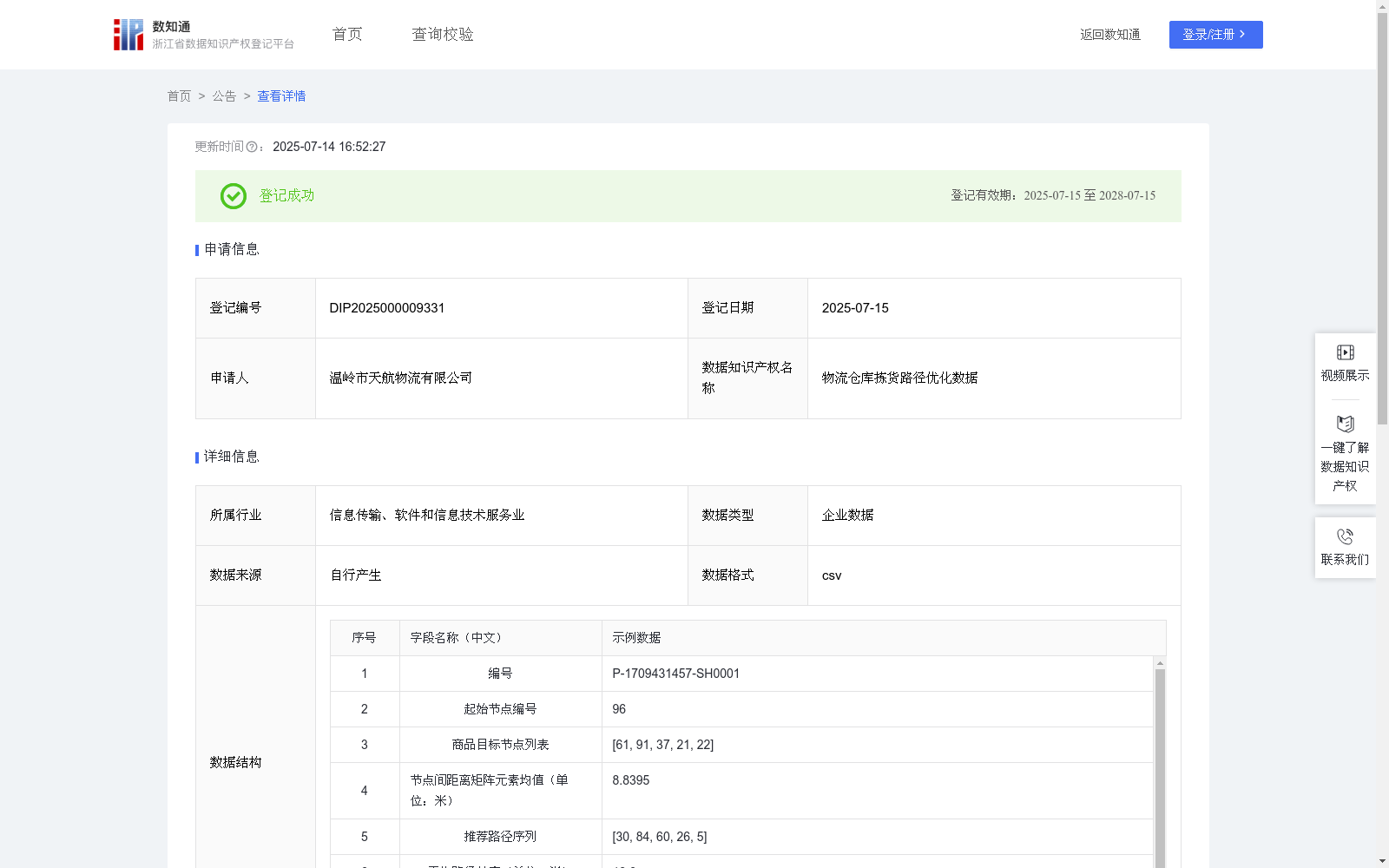
本算法所需数据来自仓库内部数字化地图系统、订单系统和传感器数据采集系统。每条样本记录包含拣货任务编号、起始节点编号(拣货员或机器人可实际到达的货架节点)、商品目标节点列表(表示商品物理存储的货架节点集合)和节点间距离矩阵元素均值(统计平均距离,用于路径建模)。推荐路径序列为模型输出的最优连接通道集合(即节点之间连接的通道),平均路径长度和平均拣货时间作为性能评估指标。
数据预处理:
将仓库的货架节点和连接通道分别抽象为图的节点(V)和边(E),并构建邻接矩阵与距离矩阵。目标节点列表根据订单进行提取。节点间距离归一化处理以防止数值波动影响模型训练,并在图中加入启发式标签,如通道拥堵程度、历史拣货时长等特征信息,丰富图结构的语义表达。
模型构建:
构建基于图神经网络(Graph Neural Network, GNN)的拣货路径优化模型。该模型将仓库结构表示为图G=(V,E),其中V为货架节点集合,E为连接通道边集合。模型输入为图结构信息、起始节点编号与目标节点列表,输出为推荐的访问顺序路径。
核心公式如下:
节点表示更新:Hᵢ = σ ( ∑(j∈N(i)) W × Hⱼ + b )。其中,Hᵢ表示节点i的表示向量,N(i)表示节点i的邻居集合,W为权重矩阵,b为偏置,σ为激活函数。
路径选择策略:S = argmin( ∑(k=1 to n-1) D(Pₖ, Pₖ₊₁) )。其中,S表示推荐路径序列,Pₖ为路径中的第k个节点,D(Pₖ, Pₖ₊₁)表示节点间距离矩阵中的值。路径优化目标是使节点序列的总距离最小。
最终模型通过学习图结构中的节点特征与边权信息,预测最短路径顺序并输出推荐路径序列。使用“平均路径长度”与“平均拣货时间”两个指标对模型进行评估,确保其在真实拣货场景中的可用性与效率。
This dataset holds significant application value in warehouse picking path optimization. It can provide shortest path planning strategies, more accurately predict picking time and path efficiency, and assist warehouse operators or robotic systems in efficient picking path scheduling. It has wide applications in warehouse picking scenarios, especially in large-scale order picking, high-frequency SKU concentrated area scheduling, and multi-robot collaborative picking tasks, where it can improve path execution efficiency, reduce redundant moving distance during picking, and enable intelligent dynamic adjustment capabilities.
Data Collection:
The data required by this algorithm is sourced from the warehouse's internal digital map system, order system, and sensor data acquisition system. Each sample record includes the picking task ID, starting node ID (the shelf node that pickers or robots can actually reach), the list of target commodity nodes (representing the set of shelf nodes where commodities are physically stored), and the mean value of elements in the inter-node distance matrix (statistical average distance for path modeling). The recommended path sequence is the optimal connection channel set output by the model (i.e., the connecting channels between nodes), with average path length and average picking time serving as performance evaluation metrics.
Data Preprocessing:
The warehouse's shelf nodes and connecting channels are respectively abstracted as graph nodes (V) and edges (E), and an adjacency matrix and distance matrix are constructed. The target node list is extracted based on orders. The inter-node distances are normalized to prevent numerical fluctuations from affecting model training, and heuristic labels such as channel congestion level and historical picking duration are added to the graph to enrich the semantic expression of the graph structure.
Model Construction:
A picking path optimization model based on Graph Neural Network (GNN) is constructed. This model represents the warehouse structure as a graph G=(V,E), where V is the set of shelf nodes and E is the set of connecting channel edges. The model inputs include graph structure information, starting node ID, and target node list, and outputs the recommended access order path.
Core Formulas:
1. Node Representation Update: $H_i = sigmaleft( sum_{j in N(i)} W imes H_j + b
ight)$
Where $H_i$ represents the representation vector of node $i$, $N(i)$ represents the neighbor set of node $i$, $W$ is the weight matrix, $b$ is the bias term, and $sigma$ is the activation function.
2. Path Selection Strategy: $S = argminleft( sum_{k=1}^{n-1} D(P_k, P_{k+1})
ight)$
Where $S$ represents the recommended path sequence, $P_k$ is the $k$-th node in the path, and $D(P_k, P_{k+1})$ is the value in the inter-node distance matrix. The goal of path optimization is to minimize the total distance of the node sequence.
The final model predicts the shortest path order and outputs the recommended path sequence by learning node features and edge weight information in the graph structure. The model is evaluated using two metrics: "average path length" and "average picking time", to ensure its availability and efficiency in real-world picking scenarios.
提供机构:
温岭市天航物流有限公司
创建时间:
2025-06-25
搜集汇总
数据集介绍
背景与挑战
背景概述
该数据集为物流仓库拣货路径优化数据,包含4640条CSV格式的企业数据,涵盖编号、起始节点编号、商品目标节点列表等关键字段,用于优化仓库拣货路径规划,提高拣货效率和降低移动距离。数据通过图神经网络模型处理,输出推荐路径序列和性能评估指标。
以上内容由遇见数据集搜集并总结生成


