
Seq-to-Final Benchmark
收藏arXiv2024-07-13 更新2024-07-17 收录
下载链接:
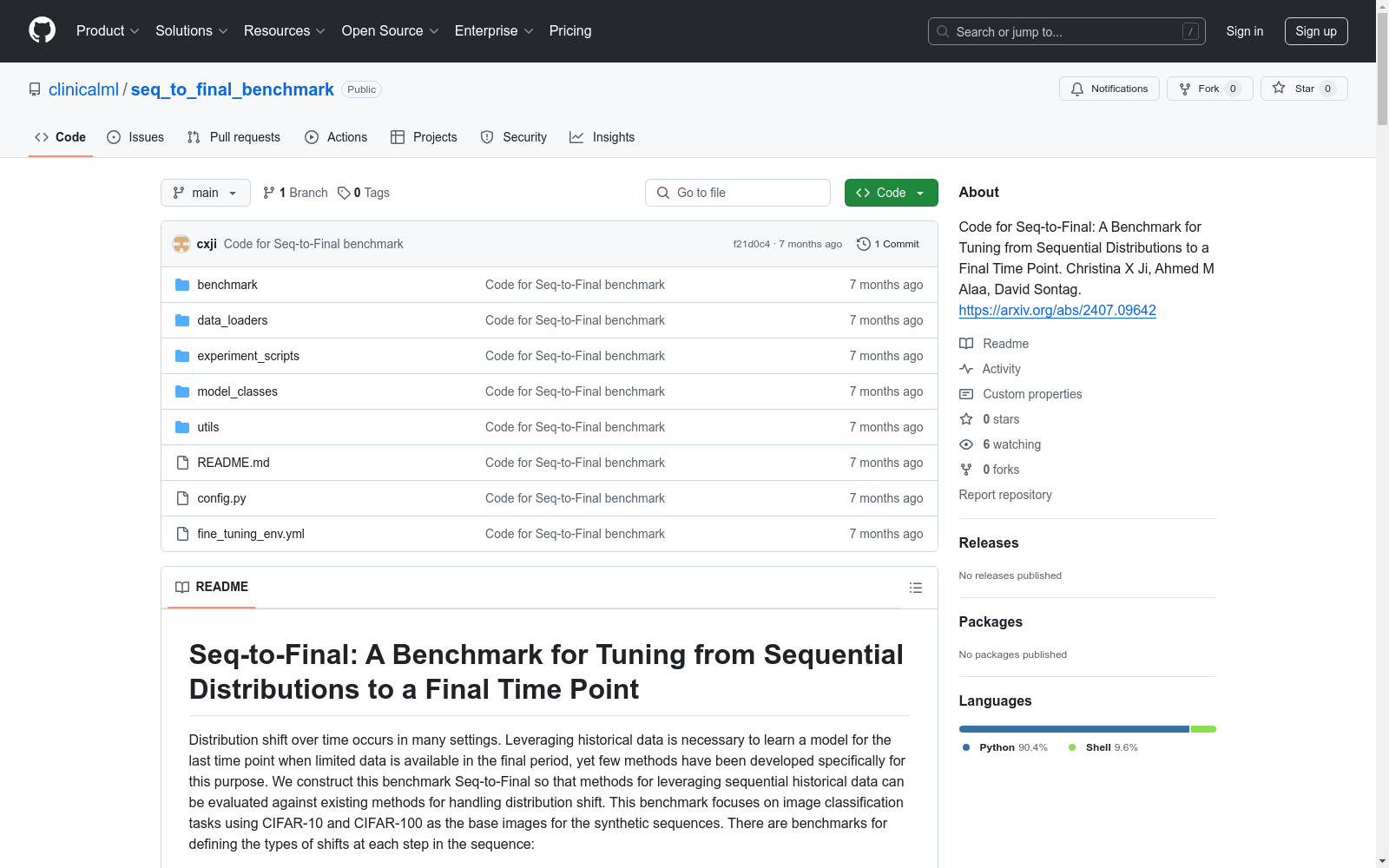
https://github.com/clinicalml/seq_to_final_benchmark
下载链接
链接失效反馈官方服务:
资源简介:
Seq-to-Final Benchmark是由麻省理工学院计算机科学与人工智能实验室和剑桥IMES创建的,专注于从时间序列分布到最终时间点的模型学习。该数据集包含12个合成序列,模拟了时间上的分布变化,主要用于图像分类任务。数据集的创建过程涉及使用CIFAR-10和CIFAR-100作为基础图像,通过不同的变换构建序列。该数据集的应用领域主要是机器学习中的时间序列数据处理,旨在解决由于时间分布变化导致的模型性能下降问题。
The Seq-to-Final Benchmark was co-developed by the MIT Computer Science and Artificial Intelligence Laboratory (CSAIL) and Cambridge’s IMES, focusing on model learning tasks that leverage time-series distributions up to their final time steps. This dataset comprises 12 synthetic sequences that simulate temporal distribution shifts, and is primarily designed for image classification tasks. The dataset was constructed using CIFAR-10 and CIFAR-100 as foundational images, with sequences generated via diverse transformation operations. Its core application domain is time-series data processing within machine learning, aiming to address the problem of degraded model performance induced by temporal distribution shifts.
提供机构:
麻省理工学院计算机科学与人工智能实验室和剑桥IMES
创建时间:
2024-07-13
原始信息汇总
Seq-to-Final 数据集概述
数据集描述
Seq-to-Final 是一个用于评估从时间序列分布到最终时间点的模型调优的基准数据集。该数据集关注图像分类任务,使用 CIFAR-10 和 CIFAR-100 作为合成序列的基础图像。数据集包括以下类型的分布偏移:
- 输入级偏移:损坏、旋转、重新着色
- 中间级偏移:条件旋转、子群体偏移
- 输出级偏移:标签翻转
用户可以定义其他构建块或添加其他数据集作为基础数据集。序列可以通过指定每个时间步的偏移和样本大小来构建。在最终步骤创建一个测试集用于评估。
数据集组成
数据集包括以下几类方法进行比较:
- 不适应最终时期的方法:从所有数据学习,不适应最终时期
- 不考虑序列性质的方法:从历史数据学习,然后适应最终时期
- 利用序列性质的方法:利用历史数据的序列性质,针对最终时期进行模型调优
数据集可视化
数据集包括以下几种可视化方法:
- 线性插值路径图:展示模型权重从初始到最后一步的线性插值路径的测试准确率
- 权重投影图:将权重投影到反映历史偏移和有限最终样本大小的方向
- CCA 系数图:展示每个模型与 oracle 模型之间的 SVCCA 系数
数据集设置
CIFAR-10 和 CIFAR-100 数据集将在运行基准时自动下载。Portraits 数据集需要手动下载并处理。
数据集使用
用户可以通过指定参数运行不同的方法,包括:
- 单模型学习方法
- 历史数据学习并适应最终步骤的方法
- 利用序列性质的历史数据学习方法
具体运行方法和参数设置详见数据集文档。
搜集汇总
数据集介绍
构建方式
Seq-to-Final Benchmark is designed to evaluate the effectiveness of different machine learning methods in adapting to a final time point when faced with distribution shift over time. The benchmark is constructed using synthetic sequences of datasets with various types of shifts, such as corruptions, rotations, and label flips. These sequences are built using building blocks that simulate practical shifts in input, output, and intermediate levels. The benchmark also includes a real-world sequence based on the Portraits dataset to validate the relevance of synthetic sequences to real-world scenarios. The benchmark allows users to compare different methods by evaluating their performance on the final time point.
使用方法
To use the Seq-to-Final Benchmark, users can specify the dataset, types of shifts, sample sizes, and the size of the test set at the final time point. Users can select from a variety of methods to learn from historical data and adapt to the final distribution. The benchmark provides modular components for constructing sequences, combining methods, and selecting different flavors of fine-tuning or joint models. Users can also control which layers are fine-tuned at each step, and apply different types of regularization. The benchmark is available on GitHub, and users can run experiments on their own datasets or use the provided datasets.
背景与挑战
背景概述
Seq-to-Final Benchmark是一个用于评估在时间序列数据分布变化的情况下,如何利用历史数据来学习一个在最后一个时间点表现良好的模型的数据集。该数据集由MIT CSAIL和IMES的Christina X Ji、UC Berkeley和UCSF的Ahmed M Alaa以及MIT CSAIL和IMES的David Sontag创建。该数据集旨在解决现实世界中由于时间序列数据分布变化而导致的机器学习模型性能下降的问题。Seq-to-Final Benchmark构建了一系列合成数据分布的变化序列,用于评估三种不同类型的方法在时间序列数据上的有效性。这些方法包括从所有数据中学习而不针对最后一个时间点进行适应、从历史数据中学习然后适应最后一个时间点以及利用历史数据的序列性质来调整模型以适应最后一个时间点。Seq-to-Final Benchmark的创建为评估和比较不同方法在处理时间序列数据分布变化方面的性能提供了一个标准化的平台。
当前挑战
Seq-to-Final Benchmark面临的挑战包括:1) 如何有效地利用历史数据来学习一个在最后一个时间点表现良好的模型,特别是在最后一个时间点数据量有限的情况下;2) 如何构建一个能够模拟现实世界中不同类型时间序列数据分布变化的数据集,以便更准确地评估和比较不同方法的有效性;3) 如何解释为什么一些方法在不利用历史数据的序列性质的情况下仍然能够表现良好,以及如何改进这些方法以更好地利用历史数据。
常用场景
经典使用场景
Seq-to-Final Benchmark is a synthetic benchmark designed to evaluate the effectiveness of various methods in leveraging historical data to learn a model for the final time point when faced with distribution shift over time. This benchmark is particularly useful for image classification tasks, utilizing CIFAR-10 and CIFAR100 as base images for synthetic sequences. It also assesses methods on the Portraits dataset to explore real-world relevance.
解决学术问题
The benchmark addresses the challenge of training machine learning models on limited recent data by utilizing historical data. It evaluates methods that 1) learn from all data without adapting to the final period, 2) learn from historical data and then adapt to the final period, and 3) leverage the sequential nature of historical data. The benchmark helps in understanding how different methods perform under various types of distribution shifts and provides insights into the initialization and parameter updates at the final time point.
实际应用
The Seq-to-Final Benchmark can be applied in scenarios where models need to be trained on limited recent data, such as in healthcare for predicting health events with limited recent patient data. It can also be used in fashion trend prediction where models need to adapt to changing trends over time. The benchmark provides a modular environment for constructing sequences of image datasets with different types of shifts, making it adaptable to various practical applications.
数据集最近研究
最新研究方向
Seq-to-Final Benchmark数据集的最新研究方向是评估和比较不同算法在处理时间序列数据分布变化时,如何利用历史数据来学习一个在最终时间点表现良好的模型。该数据集通过构建具有不同类型转换的合成序列来评估三类方法的有效性:1)从所有数据中学习而不针对最终时期进行调整,2)从历史数据中学习,不考虑序列性质,然后适应最终时期,3)在调整模型以适应最终时期时利用历史数据的序列性质。研究结果表明,对于那些忽视序列结构并适应最终时间点的方法,其性能往往较好。而那些利用序列性质的方法并没有提供任何改进。该研究希望这一基准能够激发新算法的开发,这些算法能够更好地利用序列历史数据,或者更深入地理解为什么忽视序列性质的方法能够表现良好。
相关研究论文
- 1Seq-to-Final: A Benchmark for Tuning from Sequential Distributions to a Final Time Point麻省理工学院计算机科学与人工智能实验室和剑桥IMES · 2024年
以上内容由遇见数据集搜集并总结生成



