
<b>EBV</b><b> </b><b>Infection</b><b> </b><b>as</b><b> </b><b>a</b><b> </b><b>Risk</b><b> </b><b>Factor</b><b> </b><b>for</b><b> </b><b>SLE</b><b> </b><b>Development</b><b> </b><b>in</b><b> </b><b>Adult</b><b> </b><b>Sudanese</b><b> </b><b>Patients</b> study questionnaire dataset
收藏DataCite Commons2023-12-26 更新2024-08-18 收录
下载链接:
https://figshare.com/articles/dataset/_b_EBV_b_b_b_b_Infection_b_b_b_b_as_b_b_b_b_a_b_b_b_b_Risk_b_b_b_b_Factor_b_b_b_b_for_b_b_b_b_SLE_b_b_b_b_Development_b_b_b_b_in_b_b_b_b_Adult_b_b_b_b_Sudanese_b_b_b_b_Patients_b_study_questionnaire_dataset/24903312/2
下载链接
链接失效反馈官方服务:
资源简介:
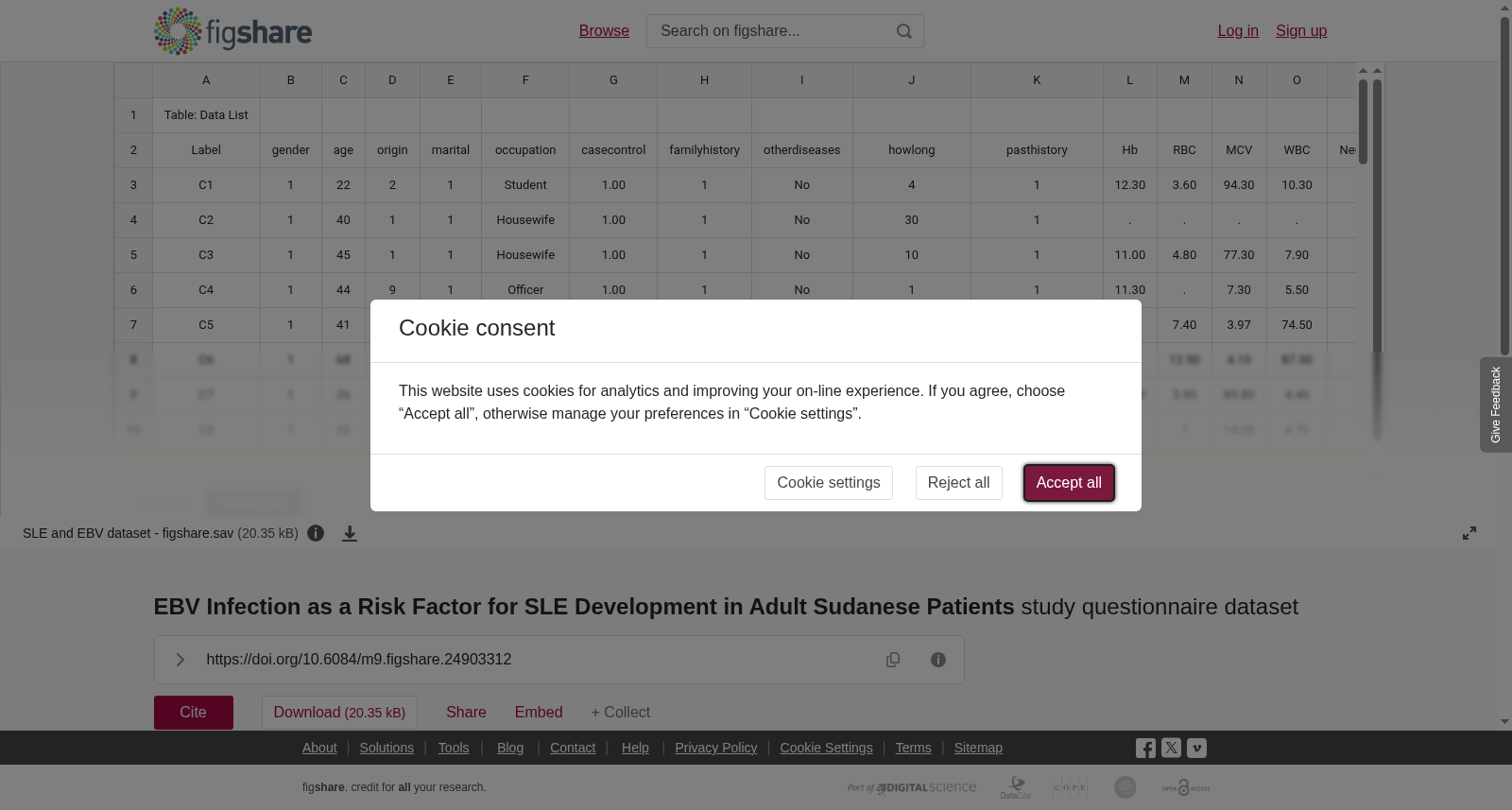
Background: To evaluate EBV (Epstein Barr VirusEpstein–Barr virus (EBV) infection as a risk factor for the development of SLE (Systemic Lupus Erythematosussystemic lupus erythematosus (SLE) in Sudanese patients. This iswas a case controlcase‒control study. Forty-two SLE patients and forty-one age- and sex -matched controls were included. Demographic, clinical and laboratory data were collected. Venous blood samples were drawn, and EBV- viral capsid antigen (EBV-VCA) IgGsIgG titreer levels were quantitively measured. quantified. Demographic, clinical and laboratory data were compared between the two groups by either Student’s t- test or Man- Whitneythe Mann‒Whitney U test for continuous data, or by χ² analysis for categorical data. P values < 0.05 were considered statistically significantto indicate statistical significance. Results: The SLE patients’ group hadpatients in the present study had a low mean Hb levelsconcentration (11.5 ± 1.7gm7 gm/dL) and a low RBCsRBC count (4.1 ± 0.73). Almost all patients (41, 97.6%) and controlcontrols (40, 97.6%) groups were positive for the VCA-IgG, (P=0.99). The titreer levels of the VCA-IgG between the two groups were similar (153.8± 58.2 RU/ml for patients, 156.6± 64.1 RU/ml for control groups,; p = 0.83). The mean EBV-VCA-IgG levels were similar inbetween the positive and negative anti-dsDNA patients, with a p value of 0.98. The mean VCA-IgG titreer means werewas also similar between anti-Sm -positive and anti-Sm-negative patients, (p= 0.22). Conclusions: No association was found between EBV infection and SLE development in adult Sudanese patients. LargerA larger sample size and younger population isare recommended to elucidate any association associations between EBV and SLE.
背景:本研究旨在评估EB病毒(Epstein-Barr Virus, EBV)感染作为苏丹人群系统性红斑狼疮(Systemic Lupus Erythematosus, SLE)发病风险因子的相关性。本研究为病例对照(case-control)研究,共纳入42例SLE患者与41例年龄、性别匹配的对照者。研究收集了受试者的人口学、临床及实验室数据,采集静脉血样本并定量检测EB病毒衣壳抗原(EBV-VCA)IgG抗体滴度。两组间连续型资料采用Student t检验或Mann-Whitney U检验进行比较,分类资料采用χ²检验进行比较,以P<0.05作为差异具有统计学意义的判定标准。结果:本研究中的SLE患者组平均血红蛋白浓度为11.5±1.7g/dL,红细胞计数为4.1±0.73。几乎所有患者(41例,97.6%)与对照者(40例,97.6%)的VCA-IgG检测均为阳性(P=0.99)。两组的VCA-IgG滴度水平无显著差异:患者组为153.8±58.2 RU/ml,对照组为156.6±64.1 RU/ml(p=0.83)。抗双链DNA(anti-dsDNA)阳性与阴性患者的平均EBV-VCA-IgG水平相似(p=0.98)。抗Sm抗体阳性与阴性患者的平均VCA-IgG滴度亦无显著差异(p=0.22)。结论:在苏丹成年患者中未发现EB病毒感染与SLE发病存在关联。建议扩大样本量并纳入更年轻的研究人群,以进一步阐明EB病毒与SLE之间的潜在关联。
提供机构:
figshare创建时间:
2023-12-26
搜集汇总
数据集介绍
以上内容由遇见数据集搜集并总结生成


