tantraloka-pipeline
收藏资源简介:
Tantraloka Processing Pipeline数据集是一个从Mark Dyczkowski的11卷本《Tantraloka》翻译与注释中构建的多层结构化数据集。《Tantraloka》是克什米尔湿婆教密续哲学的核心文本。该数据集旨在通过系统化的处理流程(包括PDF下载、OCR识别、文本解析、实体识别和层次化构建)将原始资料转化为可计算的研究资源。数据内容围绕经文(verse)组织,每节经文包含七个层次的信息:1) 天城体原文(devanagari);2) IAST音译(iast);3) 主要译文(main_meaning);4) 扩展注释(commentary);5) 学术脚注(footnotes);6) 讲座转录文本(audio_commentary,涵盖第1-3章共119讲);7) 命名实体识别结果(entities),包括文本引用、人物、神祇、哲学概念、原理(tattvas)和IAST术语六类实体。数据处理采用先进的技术基础设施:使用Chandra OCR-2模型进行梵语文字识别,在8xH100 GPU上并行处理;使用Whisper large-v3和Claude Haiku进行音频转录;整个流程通过MLflow进行实验跟踪。该数据集适用于梵语计算语言学、密续哲学数字人文研究、跨语言信息抽取、命名实体识别和宗教文本结构化分析等任务。
The Tantraloka Processing Pipeline dataset is a multi-layered structured dataset constructed from Mark Dyczkowskis 11-volume translation and commentary of the Tantraloka, a core text of Kashmiri Shaiva Tantric philosophy. This dataset aims to transform raw materials into a computable research resource through a systematic processing pipeline, including PDF downloading, OCR recognition, text parsing, entity recognition, and hierarchical construction. The data is organized around verses, with each verse containing seven layers of information: 1) Devanagari original text (devanagari); 2) IAST transliteration (iast); 3) main translation (main_meaning); 4) extended commentary (commentary); 5) scholarly footnotes (footnotes); 6) lecture transcriptions (audio_commentary, covering 119 lectures from chapters 1-3); and 7) named entity recognition results (entities), including six types of entities: textual references, persons, deities, philosophical concepts, principles (tattvas), and IAST terms. The data processing employs advanced technical infrastructure: using the Chandra OCR-2 model for Sanskrit text recognition, processed in parallel on 8xH100 GPUs; using Whisper large-v3 and Claude Haiku for audio transcription; and the entire workflow is tracked through MLflow. This dataset is suitable for tasks such as Sanskrit computational linguistics, digital humanities research in Tantric philosophy, cross-lingual information extraction, named entity recognition, and structured analysis of religious texts.
数据集概述
- 数据集名称:Tantraloka Processing Pipeline
- 许可协议:Apache-2.0
- 语言:梵语 (sa)、英语 (en)
- 标签:sanskrit, kashmir-shaivism, tantraloka, ocr, ner
- 配置:默认配置包含
scripts/*.py文件(split: scripts)
数据集描述
该数据集是一个从 Mark Dyczkowski 的11卷《Tantraloka》翻译/评注中构建多层数据集的脚本集合。核心内容包括:
- 每节诗的多层数据:
- devanagari:原始梵文诗句
- iast:IAST 转写
- main_meaning:主要翻译(粗体文本)
- commentary:扩展学术讨论
- footnotes:学术参考文献
- audio_commentary:Dyczkowski 讲座转录(第1-3章,119场讲座)
- entities:命名实体识别
命名实体识别 (NER) 类型
| 实体类型 | 匹配模式 | 示例 |
|---|---|---|
| text_refs | 基于缩写+经文编号的正则 | MVV 1/15-17ab, IP 2/1/5 |
| persons | 约30位学者/评注者词典 | Jayaratha, Abhinavagupta, Sanderson |
| deities | 约25个神祇名称词典 | Siva, Para, Bhairava, Kali |
| concepts | 约50个哲学术语词典 | anuttara, vimarsa, svatantrya |
| tattvas | 正则 *tattva 模式 |
ragatattva, mayatattva |
| iast_terms | 所有带IAST变音符号的斜体标签术语 | dharana, pramana, samavesa |
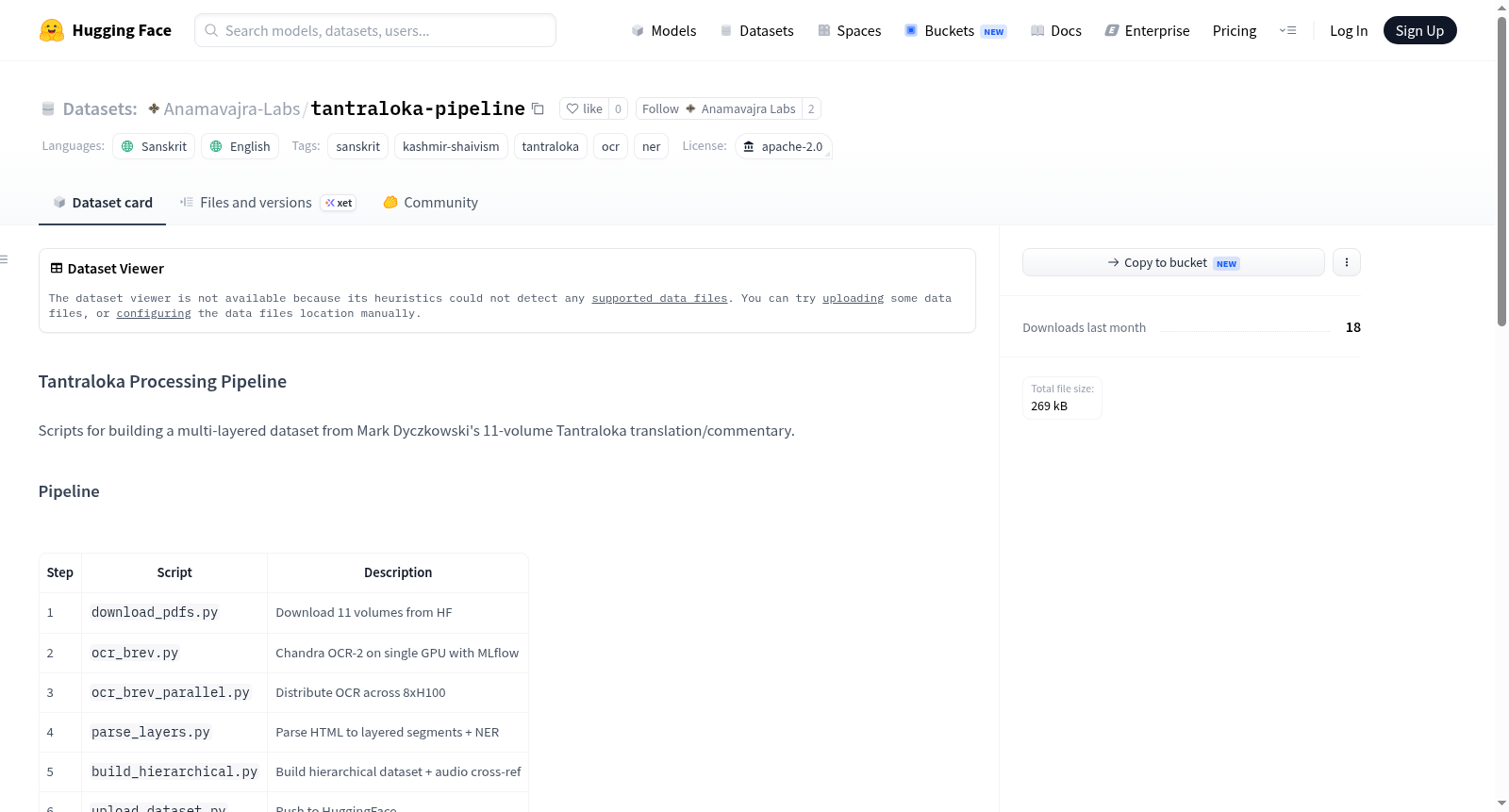
处理流程
由6个步骤组成的流水线:
| 步骤 | 脚本 | 描述 |
|---|---|---|
| 1 | download_pdfs.py |
从 HuggingFace 下载11卷PDF |
| 2 | ocr_brev.py |
在单GPU上运行 Chandra OCR-2,集成MLflow |
| 3 | ocr_brev_parallel.py |
跨8块H100 GPU分布式OCR |
| 4 | parse_layers.py |
将HTML解析为分层片段 + NER |
| 5 | build_hierarchical.py |
构建分层数据集 + 音频交叉引用 |
| 6 | upload_dataset.py |
上传至 HuggingFace |
基础设施
- OCR:Chandra OCR-2(datalab-to/chandra-ocr-2,5.3B 参数),运行于 Brev 8xH100
- ASR:Whisper large-v3 + Bedrock Claude Haiku(143场讲座)
- 追踪:MLflow
相关数据集
- Anamavajra-Labs/tantraloka-dyczkowski-raw — 源PDF、音频及转录