
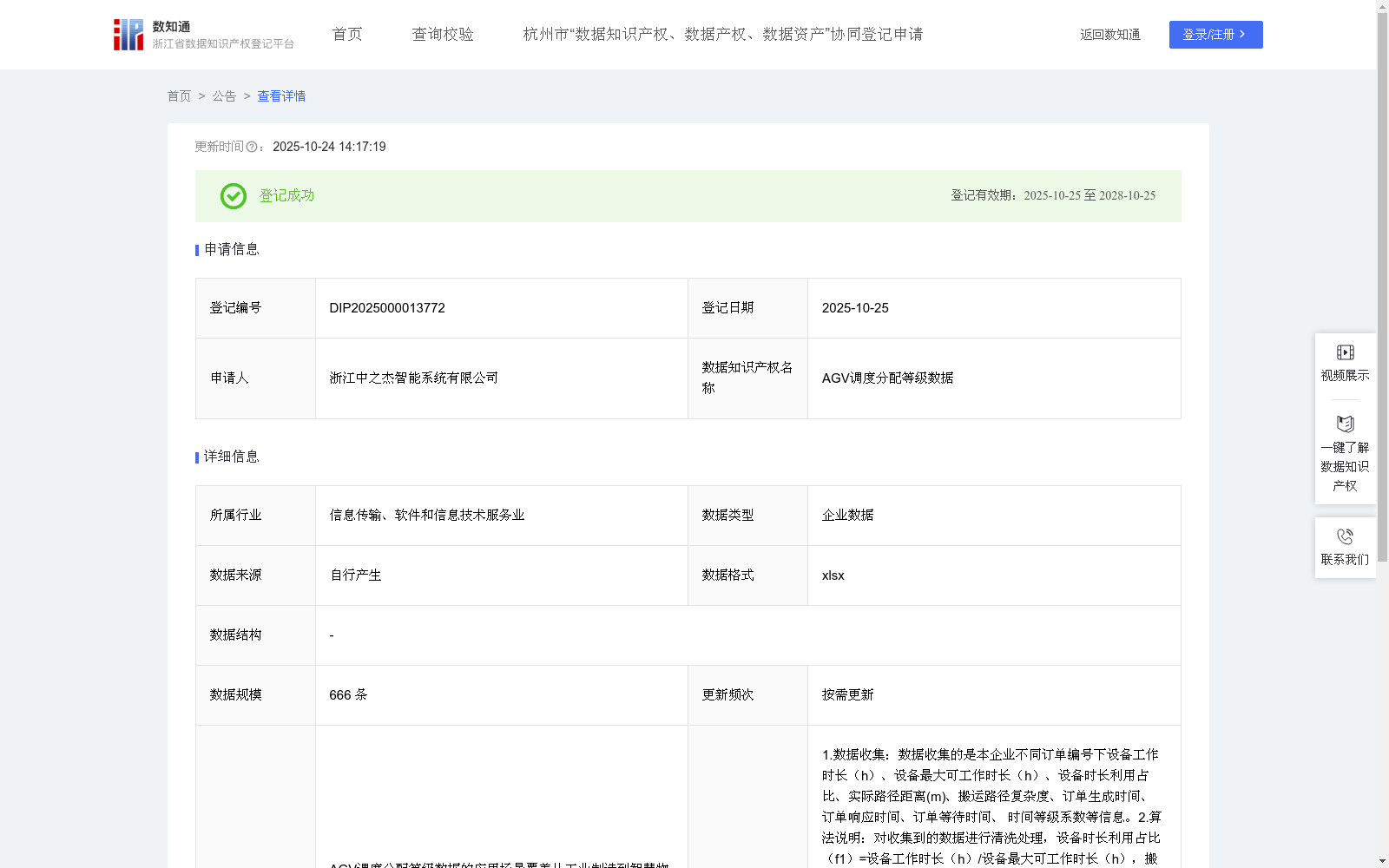
AGV调度分配等级数据
收藏浙江省数据知识产权登记平台2025-10-24 更新2025-10-25 收录
下载链接:
https://www.zjip.org.cn/home/announce/trends/5094425
下载链接
链接失效反馈官方服务:
资源简介:
AGV调度分配等级数据的应用场景覆盖从工业制造到智慧物流的多个领域。通过合理的等级划分和动态调度,企业可实现:生产效率最大化、应急响应敏捷化、资源成本最低化,其核心价值是通过优先级划分,确保AGV资源优先分配给高价值任务,避免“所有AGV挤向低效任务”的问题,通过历史任务等级数据分析,可识别瓶颈环节(如高频高优先级任务集中区域),进而优化AGV布局或路径规划。1.数据收集:数据收集的是本企业不同订单编号下设备工作时长(h)、设备最大可工作时长(h)、设备时长利用占比、实际路径距离(m)、搬运路径复杂度、订单生成时间、订单响应时间、订单等待时间、 时间等级系数等信息。2.算法说明:对收集到的数据进行清洗处理,设备时长利用占比(f1)=设备工作时长(h)/设备最大可工作时长(h),搬运路径复杂度(f2)=实际路径距离(m)/最短可能距离(m)-1,订单等待时间=订单响应时间-订单生成时间,赋予订单等待时间一个时间等级系数(f3),若等待时间<5分钟,系数为0.2;等待时间<30分钟,系数为0.4;等待时间<60分钟,系数为0.6;等待时间<90分钟,系数为0.8;等待时间<120分钟,系数为1;AGV分配等级系数=f1*a+f2*b+f3*c,其中a、b、c是权重系数,根据不同因子对AGV分配等级的影响力赋值a、b、c的值分别为0.4、0.3、0.3。若AGV分配等级系数<0.5,则AGV分配等级为低优先级;若0.5≤AGV分配等级系数<0.7,则AGV分配等级为中优先级,反之则为高优先级。对于高优先级任务需要及时响应,平衡系统整体效率。
The application scenarios of AGV scheduling and allocation level data cover multiple fields ranging from industrial manufacturing to smart logistics. Through reasonable level division and dynamic scheduling, enterprises can achieve maximized production efficiency, agile emergency response, and minimized resource costs. Its core value is to prioritize the allocation of AGV resources to high-value tasks via priority classification, avoiding the problem of "all AGVs crowding into low-efficiency tasks". By analyzing historical task level data, bottleneck links (such as areas with concentrated high-frequency and high-priority tasks) can be identified, thereby optimizing AGV layout or path planning.
1. Data Collection
The collected data includes, under different order numbers of the enterprise, equipment working duration (h), maximum equipment working duration (h), equipment duration utilization rate, actual path distance (m), handling path complexity, order generation time, order response time, order waiting time, time level coefficient and other relevant information.
2. Algorithm Description
The collected data is first cleaned. The equipment duration utilization rate (f1) is calculated as: equipment working duration (h) / maximum equipment working duration (h). The handling path complexity (f2) is calculated as: actual path distance (m) / shortest possible path distance (m) - 1. The order waiting time is equal to order response time minus order generation time. A time level coefficient (f3) is assigned to the order waiting time: the coefficient is 0.2 if the waiting time < 5 minutes; 0.4 if 5 minutes ≤ waiting time < 30 minutes; 0.6 if 30 minutes ≤ waiting time < 60 minutes; 0.8 if 60 minutes ≤ waiting time < 90 minutes; 1 if 90 minutes ≤ waiting time < 120 minutes. The AGV allocation level coefficient is calculated as: f1*a + f2*b + f3*c, where a, b, and c are weight coefficients. Based on the influence of each factor on the AGV allocation level, the values of a, b, and c are assigned as 0.4, 0.3, and 0.3 respectively. If the AGV allocation level coefficient < 0.5, the AGV allocation level is low priority; if 0.5 ≤ AGV allocation level coefficient < 0.7, the AGV allocation level is medium priority; otherwise, it is high priority. High-priority tasks require timely response to balance the overall efficiency of the system.
提供机构:
浙江中之杰智能系统有限公司
创建时间:
2025-08-05
搜集汇总
数据集介绍
背景与挑战
背景概述
该数据集名为'AGV调度分配等级数据',包含666条企业数据,用于AGV调度优化,通过算法计算分配等级系数(基于设备时长利用、路径复杂度和时间等级),划分低、中、高优先级任务,以提升工业制造和智慧物流中的资源效率和应急响应能力。
以上内容由遇见数据集搜集并总结生成


