
铝合金轮毂刚度识别预测数据
收藏浙江省数据知识产权登记平台2024-10-29 更新2024-10-30 收录
下载链接:
https://www.zjip.org.cn/home/announce/trends/77479
下载链接
链接失效反馈官方服务:
资源简介:
通过综合分析铝合金轮毂样式的轮廓点采样数据,生成相应的三维CAD模型,并利用模态分析技术计算出轮毂的固有频率 f 和质量 m,进而应用简谐振子公式计算出铝合金轮毂的刚度。利用大量此类铝合金轮毂数据训练深度学习模型,实现通过输入铝合金轮毂样式图片直接预测刚度值,为铝合金轮毂的设计、制造及性能优化提供科学依据。
通过刚度预测数据,快速评估不同铝合金轮毂设计的力学性能,缩短设计周期,提高设计效率。确保生产的铝合金轮毂具备理想的刚度,增强产品在市场中的竞争力。汽车企业可以获得精准的铝合金轮毂刚度数据,支持悬挂系统和动力传动系统的优化设计,提升整车的平衡性和操控性。汽车维修与检测中心,通过刚度值评估铝合金轮毂的使用状态,及时发现和预防潜在的安全隐患。1. 数据采集
采集海量不同轮毂样式的轮廓点采样数据,每个样本由一组二维坐标点构成,精确描述轮毂的几何形状。通过生成轮毂的三维CAD模型并进行模态分析,获取每个轮毂对应的固有频率f和质量m,为刚度k的计算和模型训练提供精准的标签数据。
2. 数据处理
(1)数据预处理
对采集到的轮廓点数据进行标准化处理,包括平移、缩放和旋转,以消除不同样本之间的尺度和位置差异,确保数据的一致性和可比性。
(2)特征提取
基于二维轮廓点采样数据,生成对应的三维CAD模型。可以采用拉伸、旋转或其他建模技术,将二维点集转化为三维几何形状。对生成的三维CAD模型进行模态分析,计算出每个轮毂的固有频率f和质量m。这些参数作为刚度k计算及深度学习模型的标签数据。
3. 数据应用
利用训练好的模型,通过输入轮毂轮廓点数据,预测质量m和固有频率f,然后应用简谐振子公式计算刚度k:k=m×(2πf)^2 。其中:m:预测的质量,单位为kg。f:预测的固有频率,单位为Hz。k:刚度,单位为kN/m。
By comprehensively analyzing the contour point sampling data of aluminum alloy wheel hub styles, the corresponding 3D CAD models are generated. The natural frequency f and mass m of the hub are calculated using modal analysis technology, and then the stiffness of the aluminum alloy wheel hub is derived via the simple harmonic oscillator formula. A deep learning model is trained on a large volume of such aluminum alloy hub data to directly predict the stiffness value by inputting images of aluminum alloy hub styles, providing a scientific basis for the design, manufacturing and performance optimization of aluminum alloy wheel hubs.
Using the stiffness prediction data, the mechanical performance of different aluminum alloy hub designs can be rapidly evaluated, shortening the design cycle and improving design efficiency. This ensures that the produced aluminum alloy wheel hubs have ideal stiffness, enhancing the product's market competitiveness. Automotive enterprises can obtain accurate aluminum alloy hub stiffness data to support the optimal design of suspension systems and powertrains, improving the overall vehicle's balance and handling performance. Automotive maintenance and testing centers can evaluate the service status of aluminum alloy wheel hubs through stiffness values, timely detecting and preventing potential safety hazards.
1. Data Collection
Collect massive amounts of contour point sampling data for various aluminum alloy hub styles. Each sample consists of a set of 2D coordinate points, which accurately describe the geometric shape of the hub. By generating the 3D CAD model of the hub and conducting modal analysis, the natural frequency f and mass m corresponding to each hub are obtained, providing accurate label data for the calculation of stiffness k and model training.
2. Data Processing
(1) Data Preprocessing
Standardize the collected contour point data, including translation, scaling and rotation, to eliminate the scale and position differences between different samples, ensuring the consistency and comparability of the data.
(2) Feature Extraction
Generate the corresponding 3D CAD model based on the 2D contour point sampling data. Techniques such as extrusion, rotation or other modeling methods can be used to convert the 2D point set into a 3D geometric shape. Modal analysis is performed on the generated 3D CAD model to calculate the natural frequency f and mass m of each hub. These parameters serve as label data for stiffness k calculation and deep learning model training.
3. Data Application
Using the trained model, input the hub contour point data to predict the mass m and natural frequency f, then calculate the stiffness k via the simple harmonic oscillator formula: k = m × (2πf)². Where: m: Predicted mass, unit: kg. f: Predicted natural frequency, unit: Hz. k: Stiffness, unit: kN/m.
提供机构:
浙江远算科技有限公司
创建时间:
2024-09-29
搜集汇总
数据集介绍
特点
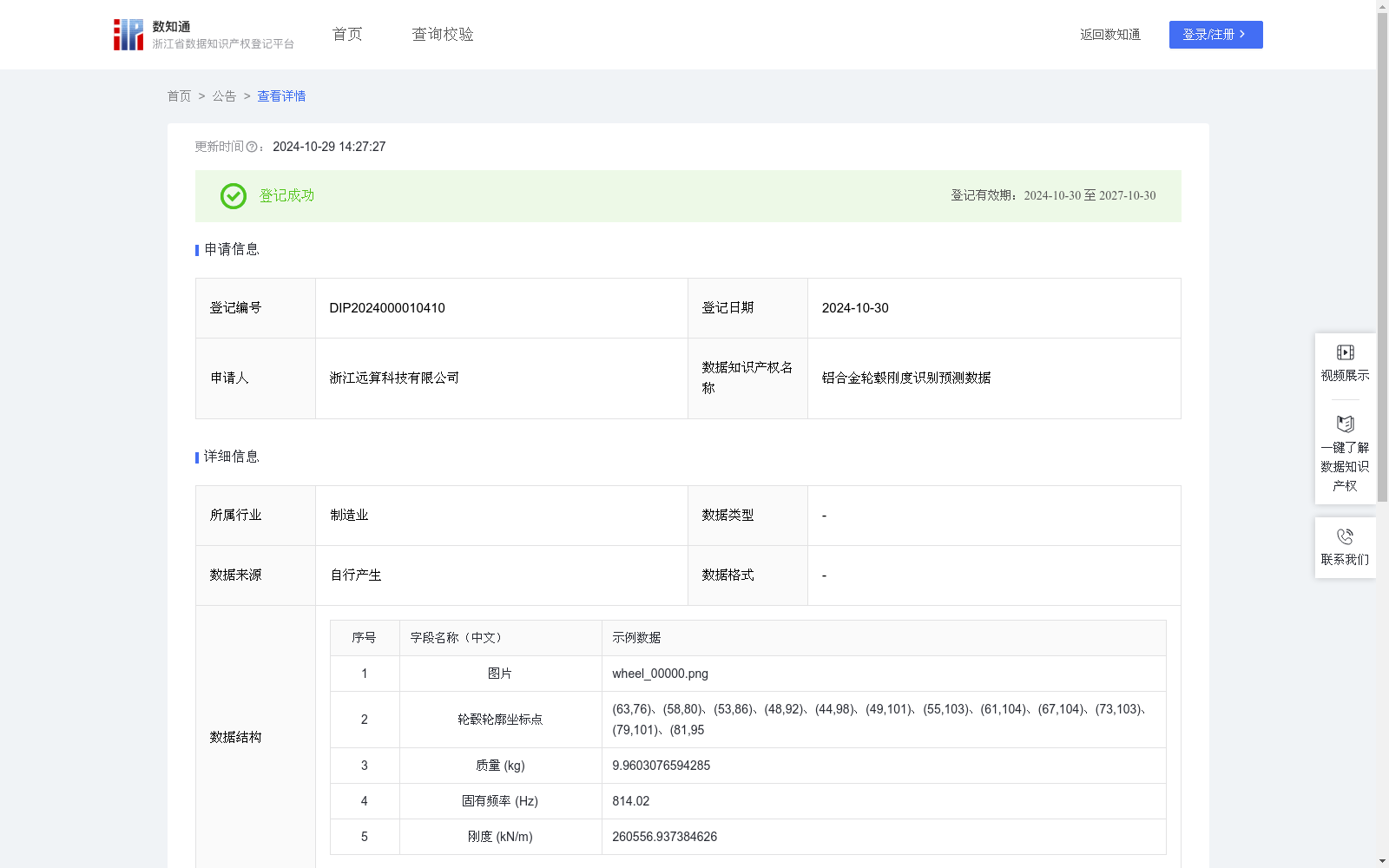
该数据集包含701条铝合金轮毂的刚度识别预测数据,每条数据包括图片、轮毂轮廓坐标点、质量、固有频率和刚度等字段。数据通过模态分析技术计算出轮毂的固有频率和质量,进而应用简谐振子公式计算出刚度,应用于铝合金轮毂的设计、制造及性能优化等领域。
以上内容由遇见数据集搜集并总结生成



