Battery and Heating Data in Real Driving Cycles
收藏资源简介:
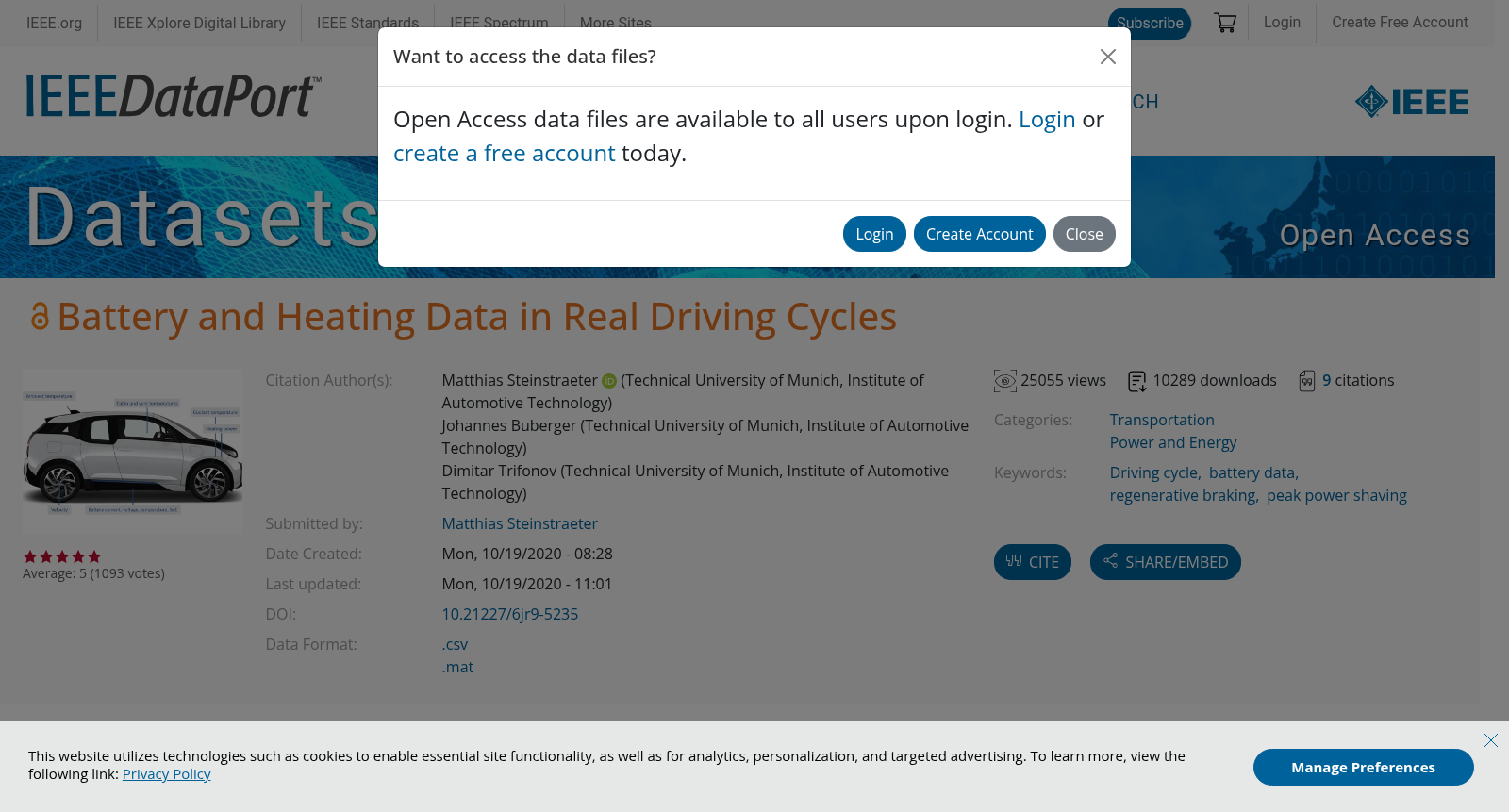
High-voltage batteries in battery electric vehicles face significant load fluctuations due to driving behavior. High accelerations cause high discharge currents, while regenerative braking leads to charging currents. This dynamic performance of the powertrain is contrasted by the almost constant load of the auxiliary consumers. The highest auxiliary consumption is generated by the heating and air conditioning system, which decreases the vehicles range significantly. This data set contains real driving data and simulated data. The real driving was recorded with a BMW i3 (60 Ah) and serves for the model development and validation of a full vehicle model consisting of the powertrain and the heating circuit. Each ride contains: Environmental data (temperature, elevation, etc.)Vehicle data (speed, throttle, etc.)Battery data (voltage, current, temperature, SoC)Heating circuit data (indoor temperature, heating power, etc.) Using the validated model, strategies for electrothermal recuperation, which describes the direct use of power in regenerative braking operations for heating, were implemented and the range advantage was determined. This approach was further developed to a peak power shaving. Depending on the drive power, the heating power is controlled. The simulation data* show this approach and the resulting improvement in range and battery life. *The corresponding paper was submitted.
纯电动汽车的高压动力电池会因驾驶行为承受显著载荷波动。急加速会产生大放电电流,而再生制动则会带来充电电流。动力总成的这种动态特性,与辅助用电设备近乎恒定的载荷形成鲜明对比。其中,辅助用电设备的最高能耗来自加热与空调系统,该系统会大幅缩短车辆续航里程。 本数据集包含实车行驶数据与仿真数据。实车行驶数据采集自宝马i3(60 Ah)车型,用于构建并验证包含动力总成与加热回路的整车模型。 每一段行驶数据均包含:环境数据(温度、海拔等)、车辆数据(车速、油门开度等)、动力电池数据(电压、电流、温度、荷电状态(SoC))以及加热回路数据(车内温度、加热功率等)。 基于该验证后的模型,研究人员开发了电热回收策略——该策略指在再生制动过程中直接利用电能用于加热,并据此测算出了续航提升效果。该方法进一步被拓展至峰值功率削峰场景:即根据驱动功率实时调节加热功率。 仿真数据*表明,该方案可有效提升车辆续航并延长动力电池使用寿命。 *相关论文已投稿。