
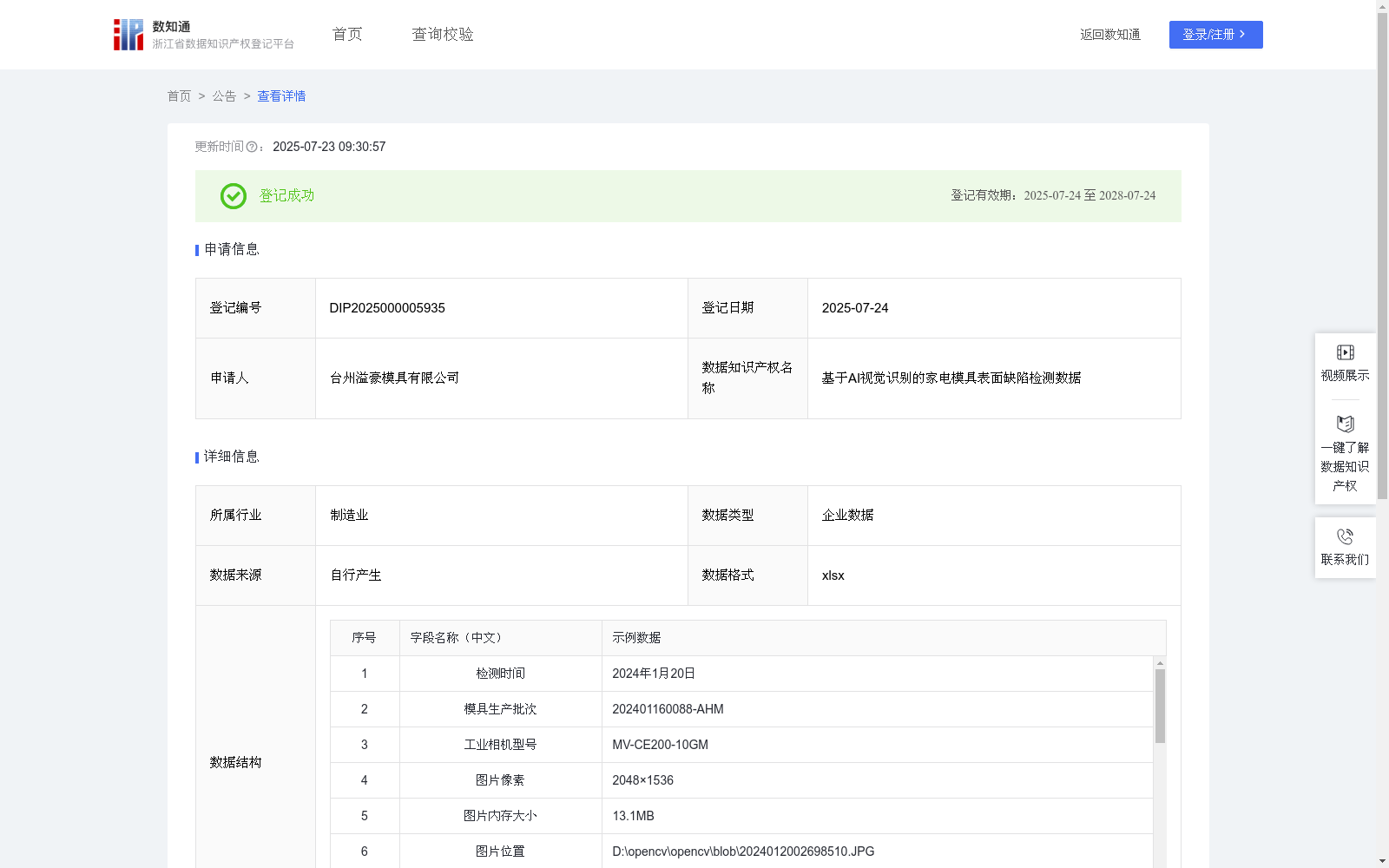
基于AI视觉识别的家电模具表面缺陷检测数据
收藏浙江省数据知识产权登记平台2025-07-23 更新2025-07-24 收录
下载链接:
https://www.zjip.org.cn/home/announce/trends/153082
下载链接
链接失效反馈官方服务:
资源简介:
通过工业相机采集家电模具表面图像,利用深度学习算法识别划痕、凹陷、毛刺等7类典型缺陷的技术,融合YOLOv5目标检测与ResNet34分类网络,实现对塑料模具表面多维缺陷的自动化识别。本缺陷检测数据具有以下应用场景:在企业内部,1. 通过实时采集模具表面缺陷数据,构建注塑工艺参数与缺陷类型的关联模型,实现工艺参数动态调整。2.可持续监测模具缺陷演变规律,建立磨损生命周期预测模型。在企业外部,1. 积累的数万条缺陷样本数据库,为行业协会制定《塑料模具表面缺陷分级标准》提供数据支撑。2. 与机器视觉厂商合作开发专用检测设备,集成本缺陷识别模型后,使同类企业检测效率大大提升。首先,图像采集:采用2000万像素工业相机,配合环形LED光源多角度照射。其次,特征提取:通过CNN卷积层提取缺陷纹理、几何等特征。再次,量化模型,构建缺陷指数公式:P=w1*S+w2*D+w3*C+w4*T+w5*L,其中,w1至w5为各个输入量参数的权重,其大小值利用Halcon深度学习框架构建缺陷检测模型时,通过反向传播算法自动调整大小。S为缺陷面积比,D为最大深度,C为颜色对比度差异(相邻阶灰度差≥5%时C为0.35,相邻阶灰度差≥10%时C为0.55,相邻阶灰度差≥15%时C为0.72,否则C为0),T为缺陷类型系数(划痕T=0.52、毛刺T=0.61、裂纹T=0.73,否则T为0),L为缺陷位置影响因子(边缘L=0.68,中心L=0.52,否则L为0)。最后,根据计算得到的P值对家电模具表面缺陷进行分级,优级(P≤0.26),良级(0.26<P≤0.49),差级(P>0.49)。
This technology collects surface images of household appliance molds using industrial cameras, identifies 7 typical defects including scratches, dents, and burrs via deep learning algorithms, and integrates YOLOv5 object detection and ResNet34 classification networks to achieve automated recognition of multi-dimensional surface defects on plastic molds.
The defect detection data has the following application scenarios:
1. Within the enterprise:
(1) Construct a correlation model between injection molding process parameters and defect types by collecting real-time mold surface defect data, so as to realize dynamic adjustment of process parameters.
(2) Sustainably monitor the evolutionary law of mold defects, and establish a wear life prediction model.
2. Outside the enterprise:
(1) An accumulated database of tens of thousands of defect samples provides data support for industry associations to formulate the "Classification Standard for Surface Defects of Plastic Molds".
(2) Cooperate with machine vision manufacturers to develop dedicated testing equipment; after integrating this defect recognition model, the detection efficiency of similar enterprises will be significantly improved.
The specific implementation process is as follows:
First, image acquisition: A 20-megapixel industrial camera is employed, paired with a ring LED light source for multi-angle illumination.
Second, feature extraction: Extract features including defect texture and geometry via CNN convolutional layers.
Third, quantitative model construction: Establish a defect index formula: (P = w_1 imes S + w_2 imes D + w_3 imes C + w_4 imes T + w_5 imes L), where (w_1) to (w_5) are the weights of each input parameter, which are automatically adjusted through the backpropagation algorithm when building the defect detection model using the Halcon deep learning framework. The meanings of each parameter are as follows:
- (S): Defect area ratio
- (D): Maximum defect depth
- (C): Color contrast difference (C = 0.35 when the adjacent grayscale difference ≥ 5%, C = 0.55 when ≥ 10%, C = 0.72 when ≥ 15%, otherwise C = 0)
- (T): Defect type coefficient (scratch: T = 0.52, burr: T = 0.61, crack: T = 0.73, otherwise T = 0)
- (L): Defect location impact factor (edge: L = 0.68, center: L = 0.52, otherwise L = 0)
Finally, classify the surface defects of household appliance molds based on the calculated P value: Excellent grade (P ≤ 0.26), Good grade (0.26 < P ≤ 0.49), Poor grade (P > 0.49).
提供机构:
台州溢豪模具有限公司
创建时间:
2025-05-22
搜集汇总
数据集介绍
背景与挑战
背景概述
该数据集是一个基于AI视觉识别的家电模具表面缺陷检测数据集,包含9493条记录,每日更新,用于通过深度学习算法识别模具表面的多种缺陷,并应用于工艺优化和设备开发。
以上内容由遇见数据集搜集并总结生成



