
IMU raw and processed data for computing human joint angles
收藏Mendeley Data2024-03-27 更新2024-06-28 收录
下载链接:
https://ieee-dataport.org/open-access/imu-raw-and-processed-data-computing-human-joint-angles
下载链接
链接失效反馈官方服务:
资源简介:
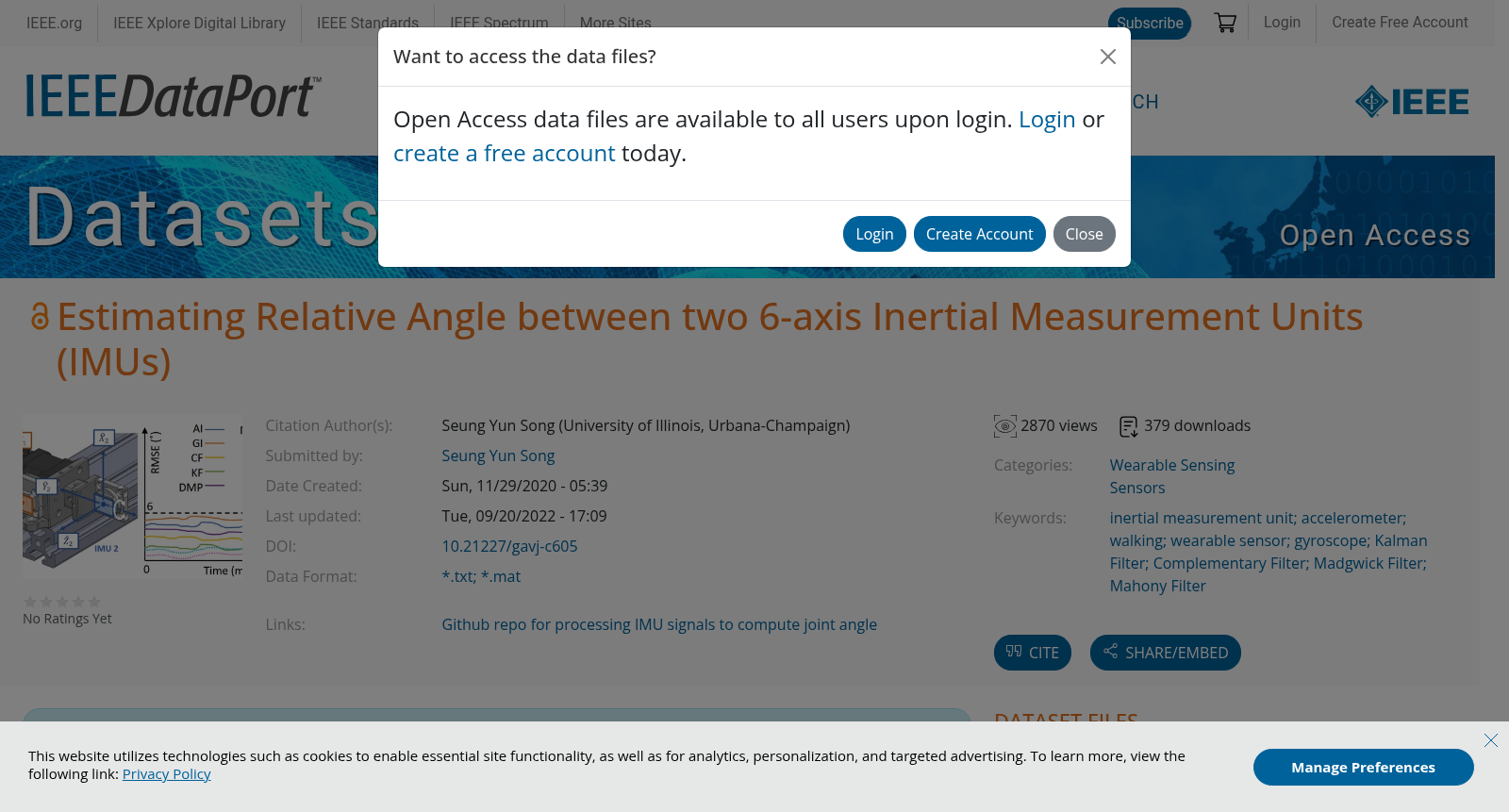
The goal of this study was to compute the relative angle of human joints such as the knee flex/extension angle using two IMUs. To do so, we utilized two 6-axis (accelerometer, gyroscope) low-cost IMUs (MPU6050, TDK-Invensense, CA, USA) that were mounted on a custom developed test apparatus that replicated the human knee motion. The custom test apparatus contained a single motor that repeatedly rotated one of the IMUs from 0 ~ 180 degrees at a one of three predefined speeds (slow - max speed of 25 deg/s, medium - max speed of 100 deg/s, fast = max speed of 200 deg/s) about one of the three rotation axes (yaw - rotation about gravity vector, pitch - rotation orthogonal to yaw and roll, roll - rotation orthogonal to yaw and pitch) for 25 minutes. One IMU was stationary and mounted securely on the side of the test apparatus while the other IMU was mounted on the motor axis and rotated about the motor-axis. The motor speed could be programmed via a microcontroller. The rotation axis could be changed by re-configuring the orientation of the IMUs. An optical encoder, which was placed on the motor shaft, was used to measure the true rotated angle. As the test apparatus rotated the IMU, raw accelerometer and gyroscopic data from the two IMUs as well as the encoder data were collected using a microcontroller. Five computational algorithms (i.e., accelerometer inclination angle, gyroscopic integration, Complementary Filter, Kalman Filter, Digital Motion Processing) IMU data were used (see https://github.com/ssong47/get_joint_angles_using_imus) to calculated the relative angle between the two IMUs. These computed angles were compared to the gold standard (i.e., encoder angle). A total of 9 trials were collected = three rotation axes (yaw, pitch, roll) x three speeds (slow, medium, fast). Each trial contained two phases: 1) a short calibration phase where the IMUs were stationary and placed such that the origins were parallel to each other, and 2) test phase when the one of the IMUs started to move at the pre-defined speed and rotation axis.
本研究的目标为利用两个惯性测量单元(Inertial Measurement Unit,IMU)计算人体关节的相对角度,例如膝关节屈伸角度。为此,我们采用了两款低成本6轴(加速度计、陀螺仪)IMU(MPU6050,TDK-Invensense,美国加利福尼亚州),将其安装于定制开发的模拟人体膝关节运动的测试装置上。该定制测试装置搭载单台电机,可围绕三种旋转轴之一(偏航——绕重力矢量旋转;俯仰——垂直于偏航与滚转的旋转;滚转——垂直于偏航与俯仰的旋转),以三种预设速度之一(慢速:最大速度25 deg/s;中速:最大速度100 deg/s;快速:最大速度200 deg/s)反复旋转其中一个IMU,单次实验时长为25分钟。其中一个IMU固定安装于测试装置侧壁,另一个安装于电机轴上并随电机轴旋转。电机速度可通过微控制器编程设定,旋转轴可通过重新配置IMU的安装朝向进行调整。电机轴上安装有光学编码器,用于测量真实旋转角度。当测试装置带动IMU旋转时,我们通过微控制器采集两个IMU的原始加速度计、陀螺仪数据以及编码器数据。我们采用五种计算算法(即加速度计倾角法、陀螺仪积分法、互补滤波法、卡尔曼滤波法、数字运动处理法)处理IMU数据,以计算两个IMU之间的相对角度(详见https://github.com/ssong47/get_joint_angles_using_imus)。将计算得到的角度与金标准(即编码器测量角度)进行对比。本次实验共收集9组试验数据:三种旋转轴(偏航、俯仰、滚转)×三种速度(慢速、中速、快速)。每组试验包含两个阶段:1)短校准阶段:此时IMU处于静止状态,且二者的原点相互平行;2)测试阶段:此时其中一个IMU开始以预设速度和旋转轴进行运动。
创建时间:
2023-06-28
搜集汇总
数据集介绍
背景与挑战
背景概述
该数据集包含两个6轴IMU的原始和处理数据,用于计算人体关节角度,并比较了7种不同的角度估计算法。数据集提供了详细的测试条件和结果,适用于生物力学和临床研究。
以上内容由遇见数据集搜集并总结生成



