target-morphology
收藏资源简介:
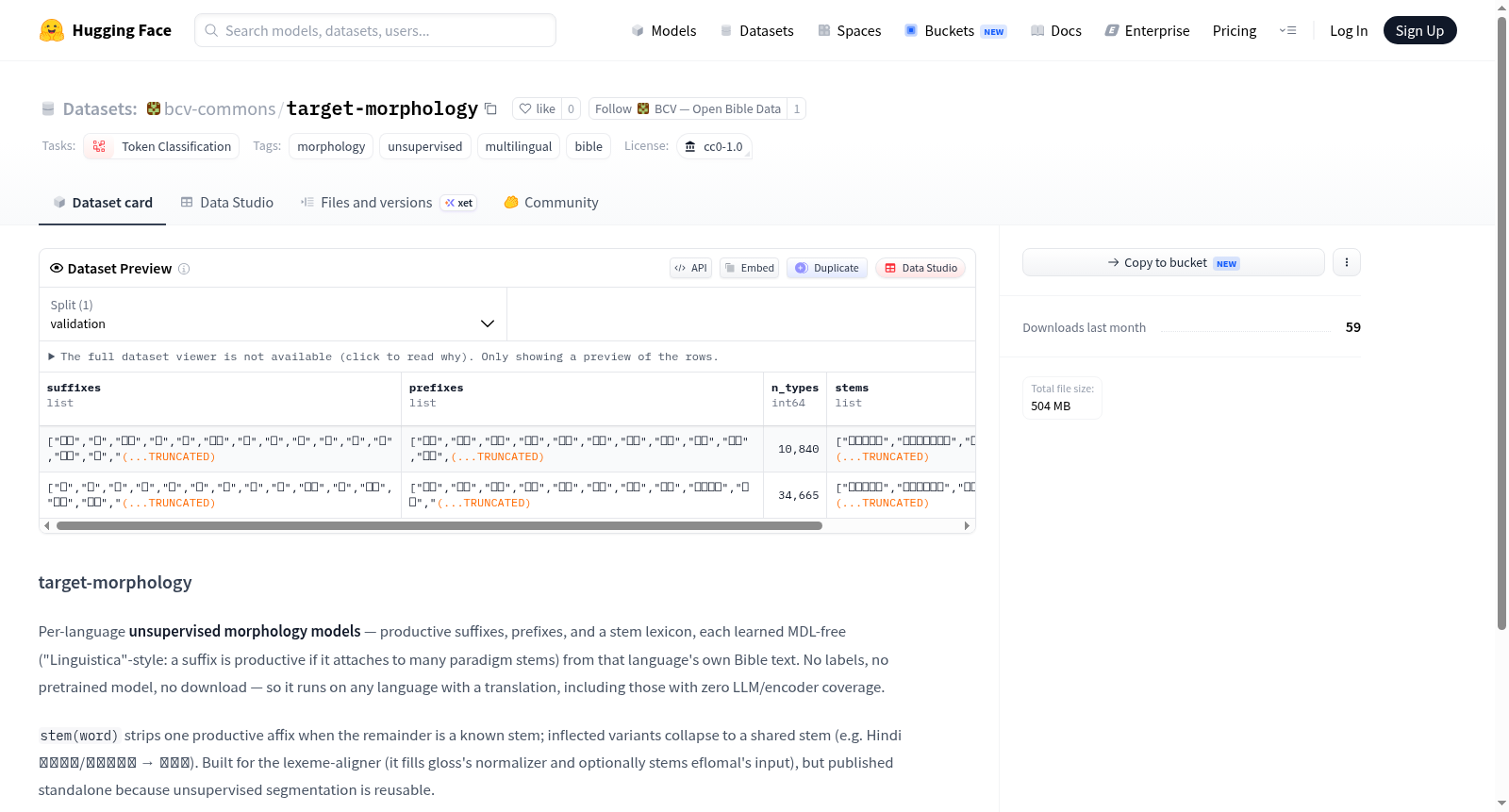
target-morphology 是一个多语言非监督形态学数据集,旨在从圣经文本中自动学习有生产力的后缀、前缀和词干词典。该数据集基于 Linguistica 风格方法,通过最小描述长度无关的方式识别词缀的生产力,即一个词缀需附着于多个范式词干才被视为有生产力。数据内容包括针对每种语言的衍生统计模型,涵盖词缀清单和词干列表,但不包含原始源文本。数据集提供了 stem(word) 功能,用于剥离一个词缀并将屈折变体映射到共享词干,例如在印地语中将 बोला 和 बोलता 归一到 बोल。该数据集最初为词位对齐器设计,用于填充注释的正常化部分并可选地对 eflomal 输入进行词干提取,但作为独立资源发布,适用于多语言形态学分析、词干提取和 token-classification 任务。数据规模可通过 manifest.json 文件查看每种语言的统计信息和内容哈希。数据集采用 CC0-1.0 许可证,确保模型作为统计数据自由重用。
Target-morphology is a multilingual unsupervised morphological dataset dedicated to automatically learning productive suffixes, prefixes, and stem lexicons from biblical texts. Built upon a Linguistica-style methodology, it identifies affix productivity via a Minimum Description Length (MDL)-agnostic approach, where an affix is deemed productive only when it attaches to multiple paradigm stems. The dataset includes derived statistical models for each language, covering affix inventories and stem lists, but does not contain the original source texts. It provides the `stem(word)` function, which is used to strip an affix and map inflectional variants to a shared stem. For example, it normalizes the Hindi words बोला and बोलता to बोल. Originally designed for lexeme aligners to fill in the normalized sections of annotations and optionally perform stemming on eflomal inputs, the dataset is released as an independent resource applicable to multilingual morphological analysis, stemming, and token-classification tasks. The dataset's scale, along with statistical information and content hashes for each language, can be accessed via the manifest.json file. Licensed under CC0-1.0, the dataset ensures free reuse of the models as statistical data.
数据集概述:target-morphology
- 许可证:CC0-1.0
- 任务类别:Token 分类(token-classification)
- 标签:形态学(morphology)、无监督(unsupervised)、多语言(multilingual)、圣经文本(bible)
核心内容
- 描述:为每种语言提供的无监督形态学模型,包含能产性后缀、前缀以及词干词典。模型以该语言的圣经文本为基础,采用类似“Linguistica”的方法(MDL-free)学习:如果一个后缀能附加到多个范式词干上,则被视为能产。
- 特点:
- 不依赖标签、预训练模型或外部下载,因此适用于任何有翻译的语言,包括那些没有大语言模型或编码器覆盖的语言。
stem(word)函数可去除一个能产词缀,当剩余部分为已知词干时生效;形态变化形式可归约为共同词干(例如印地语:बोला/बोलता → बोल)。- 原本为词位对齐器(lexeme-aligner)构建,用于填充词汇表(gloss)的归一化器,也可用于语义角色标注(eflomal)的输入词干化,但作为无监督分割工具独立发布。
- 数据来源:模型基于统计派生(词缀清单 + 词干列表),未重新分发源文本。
- 附加文件:提供
manifest.json,包含每种语言的统计信息和内容哈希值。