Shanxi Enculturation
收藏资源简介:
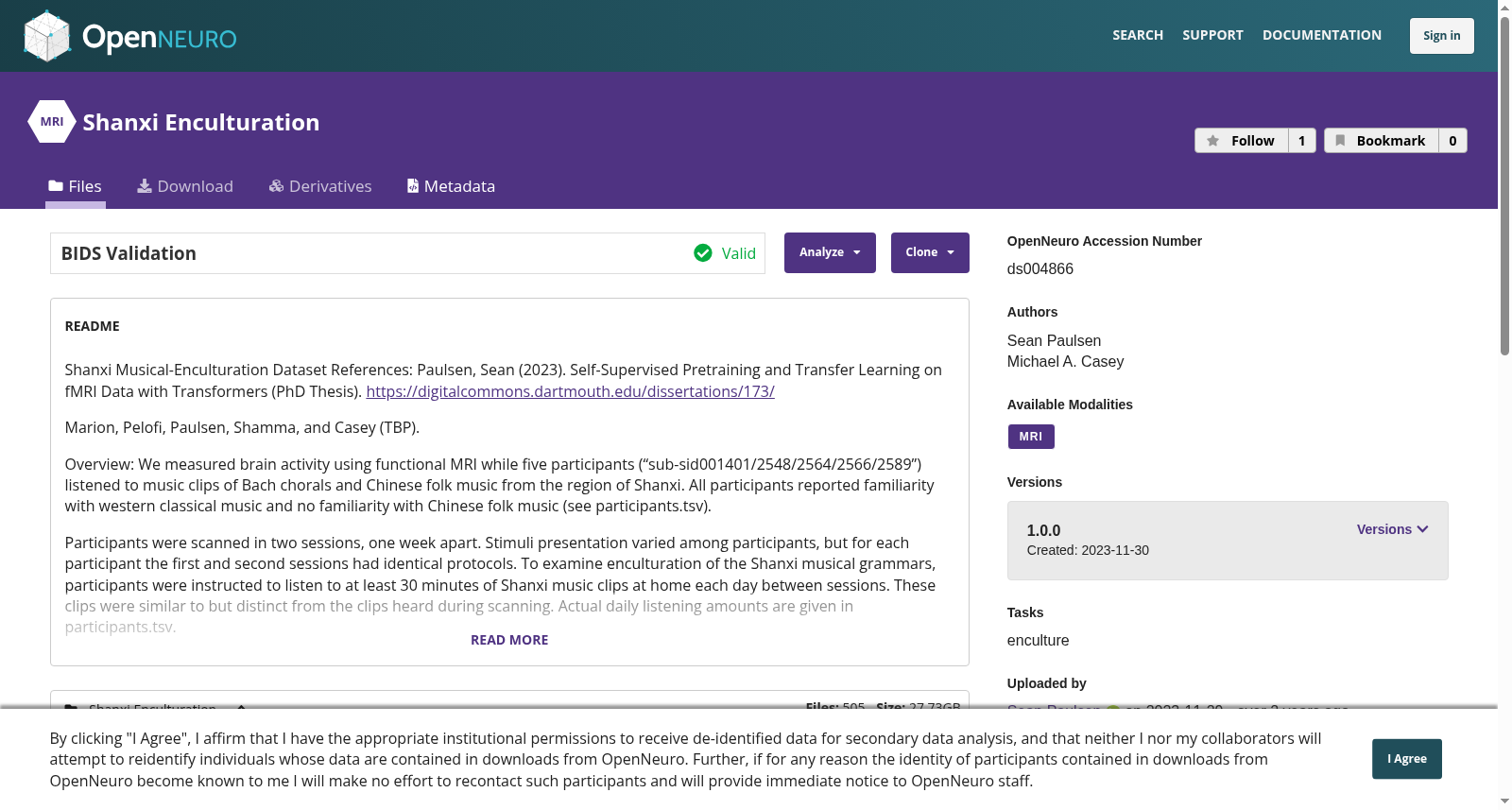
Shanxi Musical-Enculturation Dataset References: Paulsen, Sean (2023). Self-Supervised Pretraining and Transfer Learning on fMRI Data with Transformers (PhD Thesis). https://digitalcommons.dartmouth.edu/dissertations/173/ Marion, Pelofi, Paulsen, Shamma, and Casey (TBP). Overview: We measured brain activity using functional MRI while five participants (“sub-sid001401/2548/2564/2566/2589”) listened to music clips of Bach chorals and Chinese folk music from the region of Shanxi. All participants reported familiarity with western classical music and no familiarity with Chinese folk music (see participants.tsv). Participants were scanned in two sessions, one week apart. Stimuli presentation varied among participants, but for each participant the first and second sessions had identical protocols. To examine enculturation of the Shanxi musical grammars, participants were instructed to listen to at least 30 minutes of Shanxi music clips at home each day between sessions. These clips were similar to but distinct from the clips heard during scanning. Actual daily listening amounts are given in participants.tsv. The top-level folder of this dataset consists of participant-wise subfolders (“sub-sid001401”,…). Each participant’s folder contains two subfolders, corresponding to the two sessions ("ses-A005515","ses-A005552",...). The greater of the two numbers indicates the second session. Each session folder contains two subfolders: 1) anat: T1-weighted structural images 2) func: functional signals (multi-band echo-planar images) and events files Each session consisted of 8 functional runs, each of which had 4 blocks, with 3 trials in each block. Each block was either all Bach or all Shanxi trials. Each trial lasted 45s with no time in between trials, and presented one music clip. Half of all blocks for each participant were Bach and the other half Shanxi. The arrangement of blocks was randomized for each participant. After each block the participant was asked to rate the pleasure they felt during the preceding block. The functional data for each run are named as follows: sub-sid*_ses-A00*_task-enculture_acq-mb8_run-*_bold.nii.gz Each *_event.tsv file contains following information: 1) Onset: stimulus onset 2) Duration: Each clip was constructed to be approximately 30 seconds 3) Trial_type: Either Bach or Chinese 4) Value: The track number of this trial's music clip, e.g value 49 with trial_type Bach indicates Bach_49.mp3 was played. Further details of the protocol design can be found in Section 3.2.2 of Paulsen (2023). All music clips used in the collection of this dataset were created by Marion and Barbarot (TBP). Caution: This dataset can be used for research purposes only. The data were anonymized and de-faced with pydeface, and users shall not perform analyses to re-identify individual participants. Contributors: Sean Paulsen Department of Computer Science, Dartmouth College, USA Guilhem Marion Laboratoire des Systèmes Perceptifs, Département d’Étude Cognitive, École Normale Supérieure, PSL, Paris, France Claire Pelofi Center for Language, Music and Emotion, New York University, Max Planck Institute for Empirical Aesthetics Michael A. Casey Department of Computer Science & Department of Music, Dartmouth College, USA Shihab Shamma Department of Electrical and Computer Engineering Institute for Systems Research University of Maryland College Park, USA & Laboratoire des Systèmes Perceptifs, Département d’Étude Cognitive, École Normale Supérieure, PSL, Paris, France Camille Barbarot Centre PsyCLÉ, Université Aix-Marseille, Aix-en-Provence, Provence-Alpes-Côte d’Azur, France ## ezbids This dataset was converted to BIDS using ezBIDS (https://brainlife.io/ezbids)
山西音乐文化适配数据集(Shanxi Musical-Enculturation Dataset) 参考文献: Paulsen, Sean (2023). 基于Transformer的fMRI数据自监督预训练与迁移学习(博士学位论文). https://digitalcommons.dartmouth.edu/dissertations/173/ Marion, Pelofi, Paulsen, Shamma, and Casey (TBP). 概述: 本研究通过功能磁共振成像(functional MRI, fMRI)采集了5名被试(编号为sub-sid001401/2548/2564/2566/2589)聆听巴赫合唱曲与山西民间音乐片段时的脑活动数据。所有被试均报告熟悉西方古典音乐,但不熟悉中国民间音乐(详情参见participants.tsv文件)。 被试分两次进行扫描,两次扫描间隔一周。不同被试的刺激呈现方案存在差异,但同一被试的两次扫描方案完全一致。为探究山西音乐语法的文化适配过程,实验要求被试在两次扫描期间每日在家至少聆听30分钟山西音乐片段,这些片段与扫描时使用的刺激相似但不完全相同。被试实际每日聆听时长详见participants.tsv文件。 数据集的顶层目录包含按被试划分的子文件夹("sub-sid001401",…)。每个被试的文件夹下包含两个子文件夹,对应两次扫描会话("ses-A005515"、"ses-A005552"等),其中编号更大的会话为第二次扫描。每个会话文件夹下包含两个子文件夹: 1) anat:T1加权结构像 2) func:功能信号(多波段回波平面成像数据)与事件文件 每次扫描会话包含8次功能成像扫描,每次扫描分为4个块(block),每个块包含3个试次(trial)。每个块仅包含巴赫音乐或仅包含山西音乐试次。每个试次时长45秒,试次之间无间隔,每次试次播放一段音乐片段。每名被试的试次块中,巴赫音乐块与山西音乐块各占一半。试次块的排列顺序对每名被试均为随机化处理。每一个试次块结束后,要求被试对该试次块期间感受到的愉悦度进行评分。 单次功能成像扫描的文件命名规则如下: sub-sid*_ses-A00*_task-enculture_acq-mb8_run-*_bold.nii.gz 每个*_event.tsv文件包含以下信息: 1) Onset:刺激 onset时间 2) Duration:每段音乐片段时长约为30秒 3) Trial_type:试次类型,分为巴赫音乐或中国民间音乐 4) Value:当前试次音乐片段的曲目编号,例如当trial_type为Bach且Value为49时,表示播放Bach_49.mp3。 实验方案的更多细节可参见Paulsen (2023)的第3.2.2节。本数据集采集所用的全部音乐片段均由Marion与Barbarot(TBP)制作。 注意事项:本数据集仅可用于科研用途。所有数据已通过pydeface工具进行匿名化与面部去除处理,使用者不得通过分析尝试重新识别单个被试身份。 贡献者: Sean Paulsen 美国达特茅斯学院计算机科学系 Guilhem Marion 法国巴黎高等师范学院认知研究系感知系统实验室,PSL大学 Claire Pelofi 纽约大学语言、音乐与情感中心,马克斯·普朗克经验美学研究所 Michael A. Casey 美国达特茅斯学院计算机科学系与音乐系 Shihab Shamma 马里兰大学帕克分校电气与计算机工程系,系统研究所 & 法国巴黎高等师范学院认知研究系感知系统实验室,PSL大学 Camille Barbarot 法国艾克斯-马赛大学PsyCLÉ中心,普罗旺斯-阿尔卑斯-蓝色海岸大区艾克斯普罗旺斯 ezBIDS 本数据集通过ezBIDS工具(https://brainlife.io/ezbids)转换为BIDS格式。