
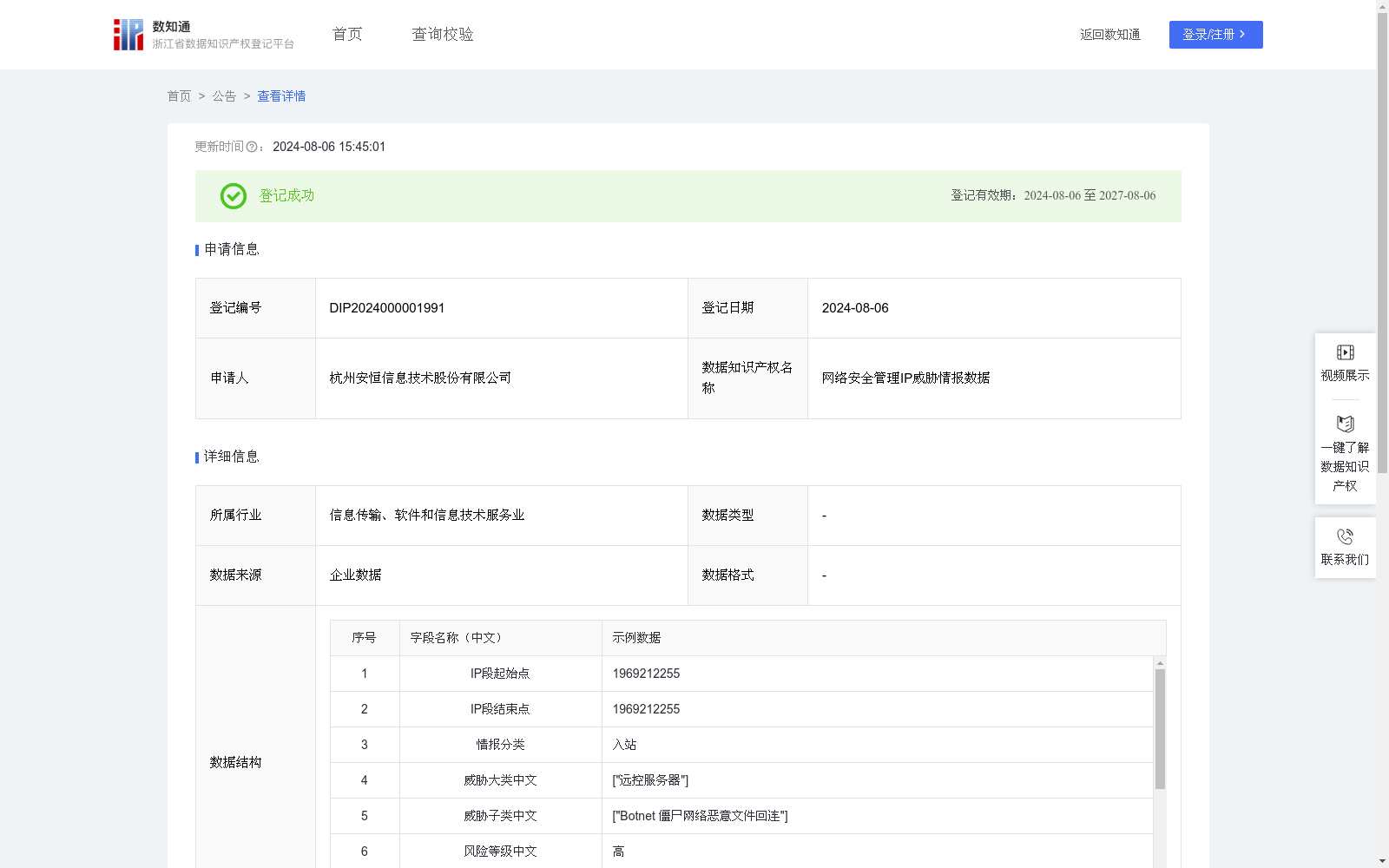
网络安全管理IP威胁情报数据
收藏浙江省数据知识产权登记平台2024-08-06 更新2024-08-07 收录
下载链接:
https://www.zjip.org.cn/home/announce/trends/47948
下载链接
链接失效反馈官方服务:
资源简介:
1.安全管理平台/态势感知: 多源情报汇聚:IP威胁情报数据能够整合来自多个不同来源的IP相关情报,如网络流量分析、入侵检测系统(IDS)、防火墙日志等,从而极大地丰富了安全管理平台的数据基础。 提升情报丰富性:通过汇聚多源情报,IP威胁情报数据(可称IP原始情报)能够提供更全面、更深入的IP行为分析,帮助安全团队更好地理解网络威胁的全貌。 实时态势感知:基于IP威胁情报数据,安全管理平台能够实时监控网络中的异常行为,快速识别潜在的安全威胁,为安全团队提供及时的告警和响应支持。 2.威胁情报(TI): 恶意IP识别:IP威胁情报数据包含大量已知的恶意IP地址信息,通过比对分析,威胁情报系统能够迅速识别出网络中的恶意IP,为安全团队提供重要的威胁线索。 情报分析与关联:利用IP威胁情报数据中的丰富数据,威胁情报系统可以对各种安全事件进行深度分析和关联,发现隐藏在复杂网络环境中的潜在威胁。 情报共享与协作:IP威胁情报数据不仅服务于内部安全团队,还可以与其他组织或机构进行情报共享,共同提升网络安全防护能力,实现更广泛的威胁情报协作。
数据采集:通过事件采集系统获取网络安全攻击相关事件,内容包括但不限于攻击事件名称、攻击行为、相关的IOC,技术细节,及样本等。通过恶意文件监控系统获取内外部流行恶意文件样本。并综合收集各类产品日志、SaaS监测数据、SaaS防护数据、狩猎数据、资产测绘数据、APT研究、漏洞研究攻防研究、数据安全研究、应用安全研究、物联网安全研究、云安全研究、开源情报、商业情报等
数据清洗:对采集到的数据进行结构化转换和标准化处理,清洗不必要的字段,并进行多维信息的聚合。以更好地满足后续对IP威胁情报进行数据分析和生产的需求。
数据加工:
1. 利用AI大模型、LSTM+CRF算法等技术进行自然语言处理和安全文章分析,提取分析相关IP威胁情报信息。
2. 采用多因子AI威胁评分模型,对恶意IP的威胁程度进行评估。
3. 采用MinHashLSH、Xgboost等算法结合海量数据进行恶意IOC挖掘
4. 利用威胁信息治理模型,结合多源情报及关联数据,进行原始威胁情报生产输出
1. Security Management Platform/Situational Awareness:
Multi-source Intelligence Aggregation: IP threat intelligence data integrates IP-related intelligence from multiple sources, such as network traffic analysis, Intrusion Detection System (IDS), firewall logs, etc., which greatly enriches the data foundation of the security management platform.
Enhanced Intelligence Richness: By aggregating multi-source intelligence, IP threat intelligence data (also referred to as raw IP intelligence) can provide more comprehensive and in-depth IP behavior analysis, helping security teams better grasp the full picture of cyber threats.
Real-time Situational Awareness: Based on IP threat intelligence data, the security management platform can monitor abnormal behaviors in the network in real time, quickly identify potential security threats, and provide timely alert and response support for security teams.
2. Threat Intelligence (TI):
Malicious IP Identification: IP threat intelligence data contains a large amount of known malicious IP address information. Through comparison and analysis, the threat intelligence system can quickly identify malicious IPs in the network, providing important threat clues for security teams.
Intelligence Analysis and Correlation: Leveraging the rich data in IP threat intelligence data, the threat intelligence system can conduct in-depth analysis and correlation of various security incidents, uncovering potential threats hidden in complex network environments.
Intelligence Sharing and Collaboration: IP threat intelligence data not only serves internal security teams, but also can be shared with other organizations or institutions to jointly improve cyber security protection capabilities and achieve broader threat intelligence collaboration.
Data Collection: Cyber security attack-related events are collected through the event collection system, including but not limited to attack event names, attack behaviors, relevant Indicators of Compromise (IOCs), technical details, samples, etc. Popular malicious file samples from internal and external environments are obtained through the malicious file monitoring system. In addition, various types of product logs, SaaS monitoring data, SaaS protection data, threat hunting data, asset mapping data, APT research, vulnerability research and offensive-defensive research, data security research, application security research, IoT security research, cloud security research, open source intelligence (OSINT), commercial intelligence and other data are comprehensively collected.
Data Cleaning: The collected data is subjected to structured transformation and standardization processing, unnecessary fields are removed, and multi-dimensional information aggregation is performed, so as to better meet the needs of subsequent data analysis and production of IP threat intelligence.
Data Processing:
1. Leverage technologies such as AI Large Language Models (LLMs) and LSTM+CRF algorithms to perform natural language processing (NLP) and security article analysis, and extract and analyze relevant IP threat intelligence information.
2. Adopt a multi-factor AI threat scoring model to evaluate the threat level of malicious IPs.
3. Use algorithms such as MinHashLSH and XGBoost combined with massive data to mine malicious IOCs.
4. Use the threat information governance model, combined with multi-source intelligence and associated data, to produce and output original threat intelligence.
提供机构:
杭州安恒信息技术股份有限公司
创建时间:
2024-06-21
搜集汇总
数据集介绍
特点
网络安全管理IP威胁情报数据是一个每日更新的企业数据集,包含501条记录,涵盖IP威胁情报的多个维度,如威胁分类、风险等级等,主要用于安全管理平台和威胁情报分析。数据处理采用多种先进算法,确保情报的准确性和实用性。
以上内容由遇见数据集搜集并总结生成


