
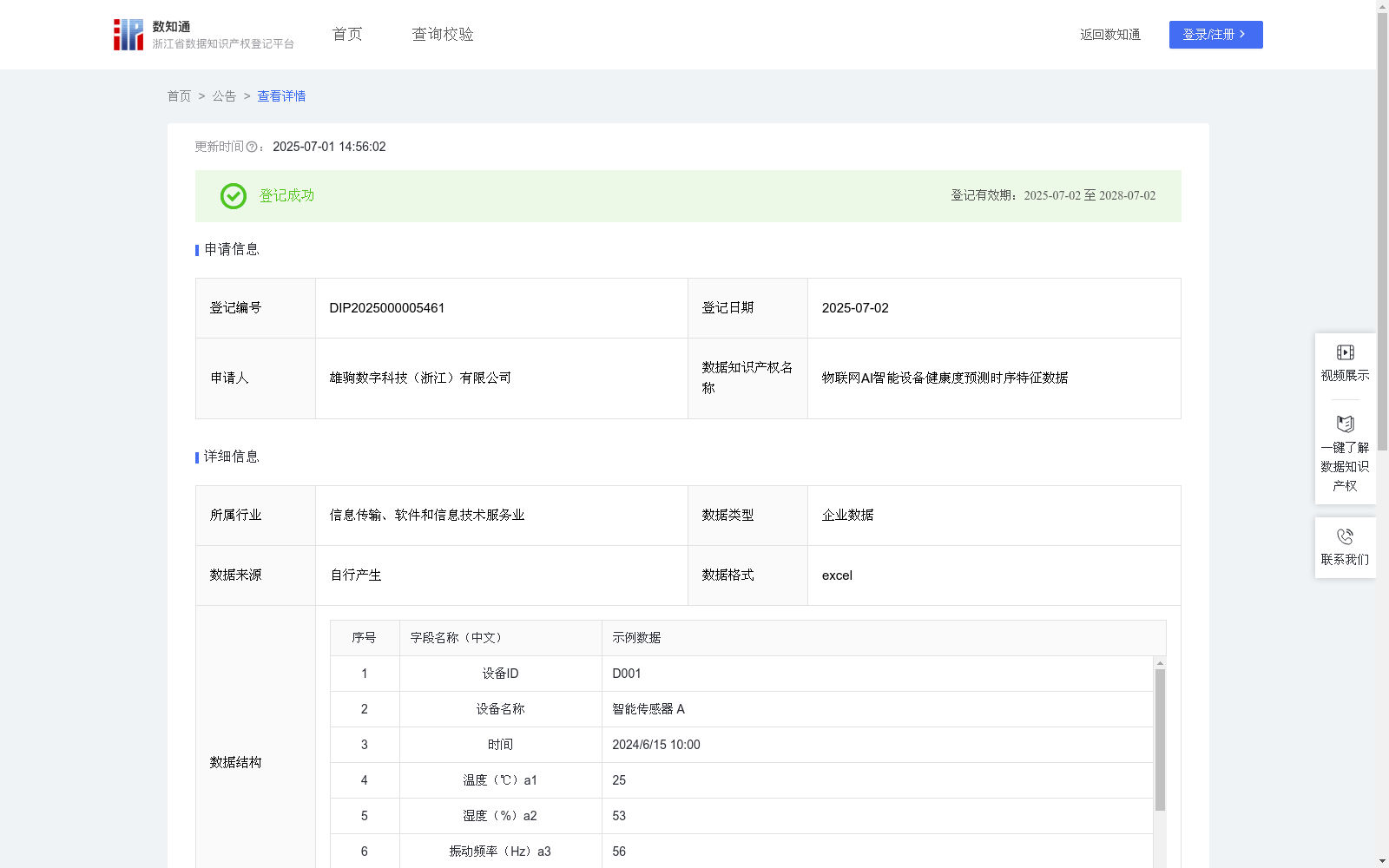
物联网AI智能设备健康度预测时序特征数据
收藏浙江省数据知识产权登记平台2025-07-01 更新2025-07-02 收录
下载链接:
https://www.zjip.org.cn/home/announce/trends/143974
下载链接
链接失效反馈官方服务:
资源简介:
本数据集适用于各类涉及物联网 AI 智能设备管理与维护的场景,涵盖工业制造、智能家居、智能交通、环境监测等多个领域。适用于需要对智能设备健康状况进行实时监测、故障预警和维护规划的企业、机构和个人。在工业制造领域,通过分析设备运行的时序特征数据,可提前预测设备故障,安排预防性维护,减少停机时间,提高生产效率;智能家居场景下,能及时发现智能家电的潜在问题,保障家居设备稳定运行,提升用户生活品质;智能交通中,对车辆或交通设施上的智能设备进行健康度预测,确保交通安全;环境监测时,及时掌握传感器设备健康状况,保证监测数据的准确性。数据采集:通过物联网设备内置的传感器、监测模块以及设备管理系统,实时采集设备运行过程中的各类数据,包括温度、湿度、振动频率、电压、运行时长等。同时,利用网络通信技术将数据传输至数据存储中心。
数据处理:首先对采集到的数据进行清洗,去除因传感器故障、网络传输异常等导致的错误数据和异常值。对时间数据进行标准化处理,统一时间格式。对设备 ID 进行匿名化处理,保护设备相关信息安全。对温度、湿度等数值型数据进行归一化处理,使其在同一量纲下便于计算和比较。
算法加工:运用 AI 时序分析算法构建设备健康度预测模型。根据设备类型、运行环境以及历史故障数据的相关性分析,为每个特征变量(如温度、湿度等)赋予相应的权重。健康度预测指数 P 的计算公式为:P = {a1× 温度权重 + a2× 湿度权重 + a3× 振动频率权重 + a4× 电压权重 + a5× 运行时长权重}×k。其中,k 为健康度系数,不同类型设备 k 值不同,通过大量设备运行数据统计和经验分析确定。其中温度权重:估计值约为 0.20; 湿度权重:估计值约为 0.15 ;振动频率权重:估计值约为 0.20 电压权重:估计值约为 0.15 ; 运行时长权重:估计值约为 0.30;数据分类分级:根据计算出的健康度预测指数 P,将设备健康等级划分为 “高(1000分及以上)”“低(1000 分以下)” 两个级别,为设备运维人员和相关企业提供直观的设备健康评估结果,以便及时采取相应措施。
This dataset is applicable to a wide range of scenarios concerning the management and maintenance of IoT-powered AI smart devices, covering multiple domains including industrial manufacturing, smart homes, intelligent transportation, and environmental monitoring. It is suitable for enterprises, institutions, and individuals that need to perform real-time monitoring of smart device health status, fault early warning, and maintenance planning.
In industrial manufacturing, analyzing the time-series characteristic data of equipment operation enables proactive prediction of device failures, arrangement of preventive maintenance, reduction of downtime, and improvement of production efficiency. In smart home scenarios, potential issues of smart home appliances can be detected timely to ensure stable operation of household devices and enhance users' quality of life. In intelligent transportation, health status prediction of smart devices installed on vehicles or traffic facilities helps ensure traffic safety. In environmental monitoring, the health condition of sensor devices can be grasped in a timely manner to guarantee the accuracy of monitoring data.
Data Collection: Various data generated during equipment operation are collected in real time via built-in sensors, monitoring modules, and device management systems of IoT devices, including temperature, humidity, vibration frequency, voltage, operating duration, and other metrics. Meanwhile, data is transmitted to the data storage center through network communication technologies.
Data Processing: First, clean the collected data to eliminate erroneous data and abnormal values caused by sensor faults, abnormal network transmission, and other issues. Standardize the temporal data to unify the time format across all records. Anonymize device IDs to safeguard the confidentiality of device-related information. Normalize numerical data such as temperature and humidity to map them to the same dimension for convenient calculation and comparison.
Algorithm Processing: AI time-series analysis algorithms are employed to develop a device health prediction model. Correlation analysis of device type, operating environment, and historical fault data is conducted to assign appropriate weights to each feature variable (e.g., temperature, humidity, vibration frequency, voltage, operating duration). The formula for the health prediction index P is as follows: P = {a1×temperature weight + a2×humidity weight + a3×vibration frequency weight + a4×voltage weight + a5×operating duration weight} × k. Herein, k represents the health coefficient, which varies across different device types and is determined via statistical analysis of large-scale device operation data and empirical studies. The estimated weights are specified as follows: temperature weight: ~0.20; humidity weight: ~0.15; vibration frequency weight: ~0.20; voltage weight: ~0.15; operating duration weight: ~0.30.
Data Classification and Grading: Based on the calculated health prediction index P, device health levels are categorized into two tiers: "High (1000 points and above)" and "Low (below 1000 points)". This provides intuitive health assessment results for equipment operation and maintenance personnel and related enterprises, enabling timely implementation of targeted maintenance measures.
提供机构:
雄驹数字科技(浙江)有限公司
创建时间:
2025-05-15
搜集汇总
数据集介绍
背景与挑战
背景概述
该数据集是由雄驹数字科技(浙江)有限公司产生的企业数据,包含900条物联网智能设备的时序特征数据,涵盖温度、湿度、振动频率等多个指标,适用于工业制造、智能家居等多个领域的设备健康度预测和故障预警。数据通过AI时序分析算法处理,计算健康度预测指数并划分设备健康等级。
以上内容由遇见数据集搜集并总结生成



