2025年12月埃及、沙特阿拉伯和也门500m沙漠蝗遥感监测数据集
收藏资源简介:
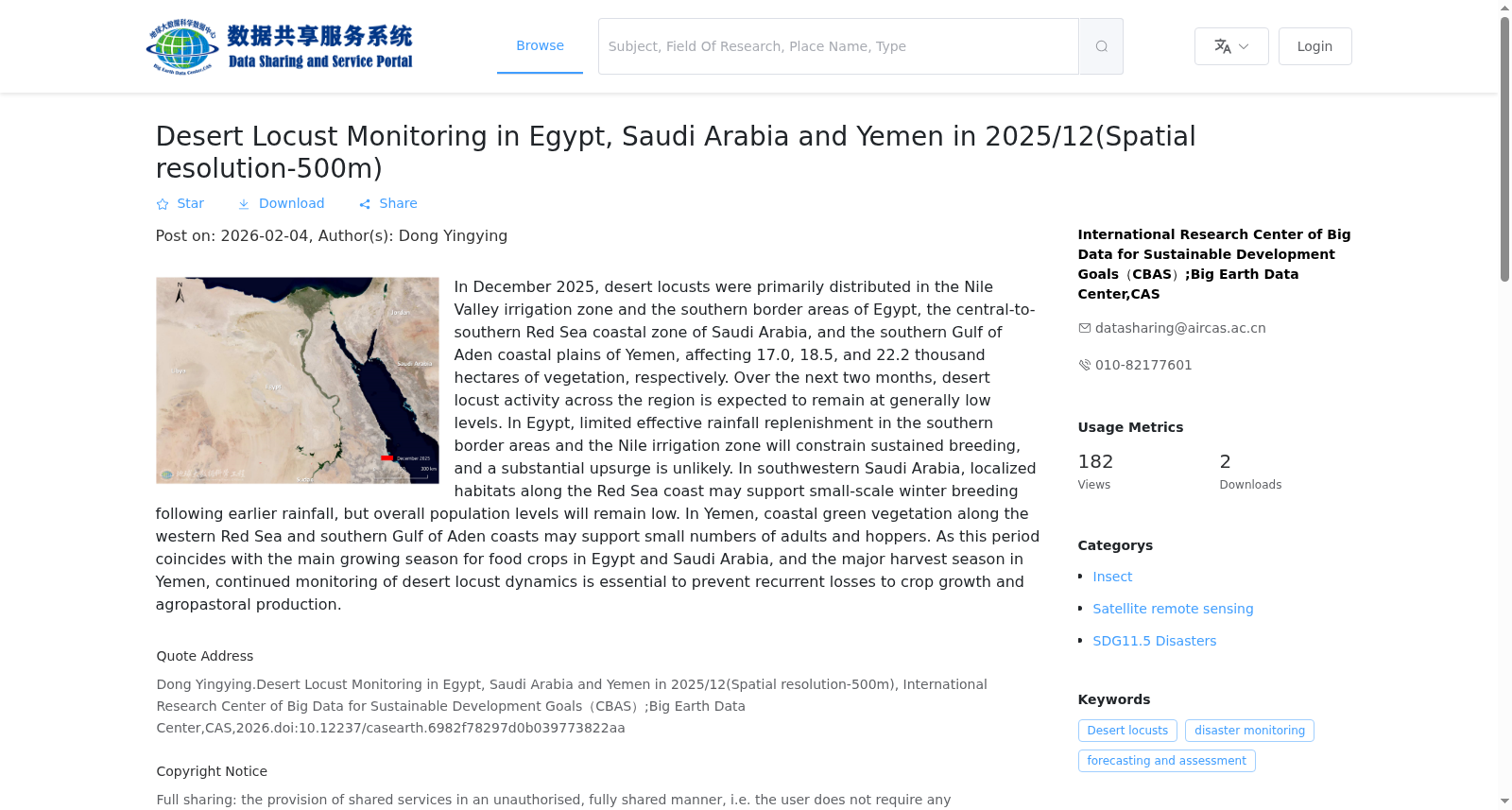
2025年12月,沙漠蝗主要分布于埃及尼罗河河谷灌溉区和南部边境地区、沙特阿拉伯红海沿岸中南段地区,以及也门南部亚丁湾沿岸平原,危害植被面积分别为1.70万公顷、1.85万公顷和2.22万公顷。预计未来两个月,区域内沙漠蝗活动仍将维持低水平状态,其空间格局将进一步向红海和亚丁湾沿岸收敛。埃及南部边境地区及尼罗河灌溉区在缺乏有效降雨补给的情况下,沙漠蝗以少量散居成虫残留为主,持续繁殖和灾情明显扩大的可能性较低。沙特阿拉伯西南部红海沿岸受前期降雨影响,局地仍具备小规模冬季繁殖的生态条件,但整体表现以沿海带状零星活跃为主,难以形成扩展。也门西部红海及南部亚丁湾沿岸在沿海绿色植被尚可维持的背景下,个别区域可能继续出现少量成虫与若虫活动。该时期为埃及和沙特阿拉伯粮食作物的主要生长季,以及也门粮食作物的主要收获季,故仍需持续关注沙漠蝗灾情动态,以防灾情反复对农牧业生产造成损失。
In December 2025, Desert Locusts (Schistocerca gregaria) were primarily distributed in three regions: the irrigation areas of the Nile River Valley and southern border regions of Egypt, the mid-southern stretch of the Red Sea coast in Saudi Arabia, and the coastal plains along the Gulf of Aden in southern Yemen. The total areas of damaged vegetation in these regions were 17,000 hectares, 18,500 hectares, and 22,200 hectares, respectively. It is projected that over the next two months, the activity of Desert Locusts in the region will stay at a low level, and their spatial distribution pattern will further converge toward the coasts of the Red Sea and the Gulf of Aden. In the southern border regions of Egypt and the Nile River irrigation areas, where effective rainfall replenishment is lacking, the locust populations will mainly comprise a small number of residual solitary adult individuals, with a low likelihood of sustained reproduction and significant expansion of the locust plague. Along the southwestern Red Sea coast of Saudi Arabia, influenced by preceding rainfall, local areas still possess ecological conditions for small-scale winter breeding, but the overall situation is characterized by sporadic locust activity in coastal belt zones, making large-scale spread unlikely. Along the western Red Sea coast and southern Gulf of Aden coast of Yemen, where coastal green vegetation remains viable, a small number of adult locusts and nymphs may be detected in individual areas. This period corresponds to the main growing season for grain crops in Egypt and Saudi Arabia, and the main harvest season for grain crops in Yemen. Therefore, continuous monitoring of the dynamics of the Desert Locust plague is necessary to prevent losses to agricultural and livestock production caused by plague recurrence.