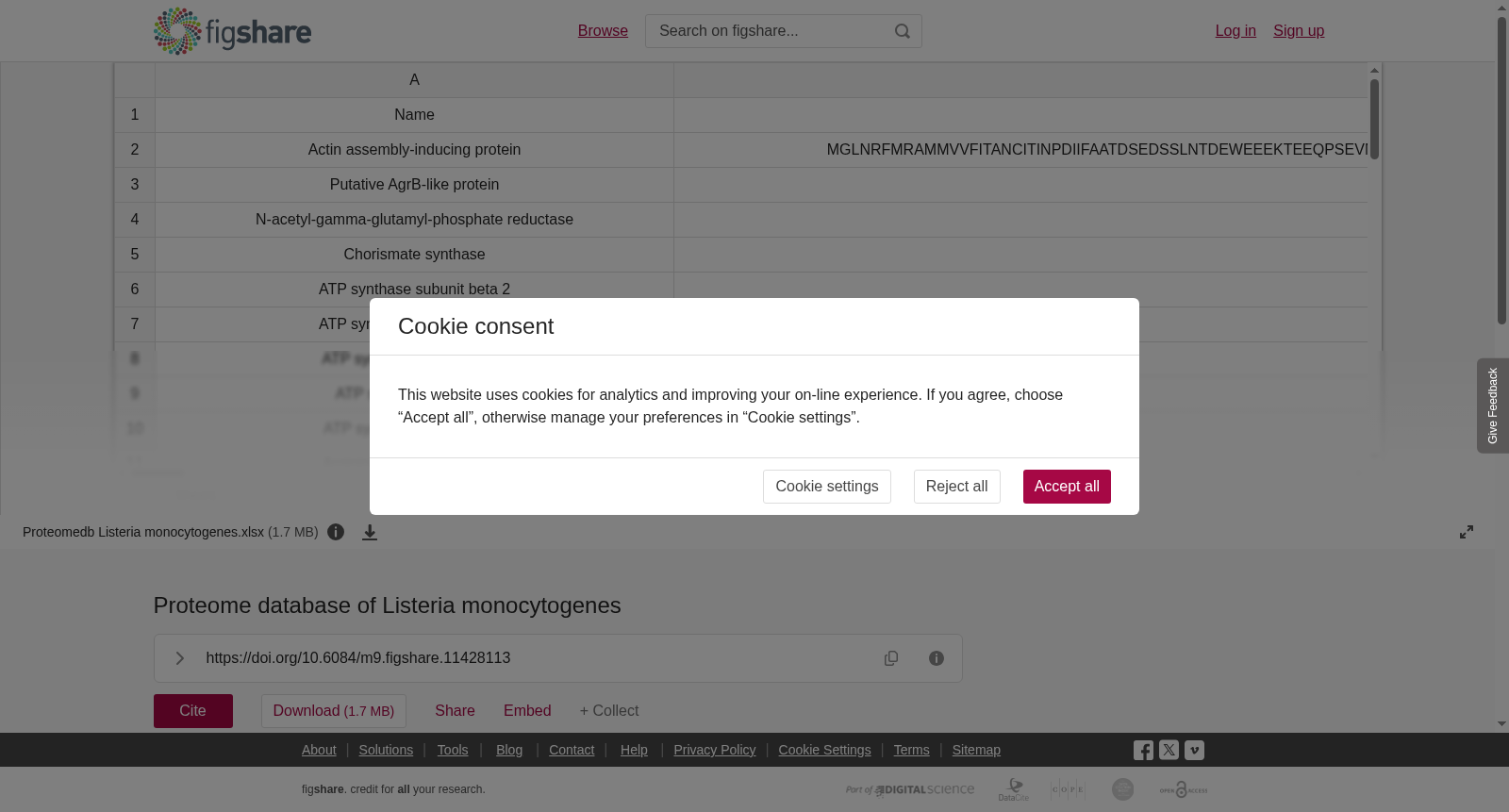
Proteome database of Listeria monocytogenes
收藏资源简介:
<i>Listeria monocytogenes</i> is a human pathogen, but this is not the only reason why it is attracting medical attention. Of more intrigue is the ability of the single celled bacterium to adopt an intracellular lifestyle within mammalian cells and remain successful in cell replication and transmission to other cells of the body. This thus set forth a flurry of research utilizing contemporary cell biological and genetics techniques to decipher the molecular mechanisms that underpin the ability of <i>L. monocytogenes</i> to evade immune detection as well as gaining entry to host cells. Although some understanding of the mechanisms underlying pathogenesis has been elucidated, there remain many outstanding questions awaiting scientific investigation and illumination. This study sought to provide fundamental information that could enable a genetics-based strategy seeking to unveil the molecular mysteries that guide <i>L. monocytogenes</i> to maintaining a successful intracellular lifestyle and exerting pathogenic pressure on the host cell. Specifically, an in-house MATLAB software was used in parsing the UniProt proteome file of <i>L. monocytogenes</i>, which yields a database of protein names, amino acid sequence, number of residues, molecular weight and nucleotide sequence that could collectively inform the metabolic, signalling and regulatory mechanisms native to this human pathogen. More importantly, fundamental insights could be gleaned when protein names and pathways could be used to decide the molecular targets that should be deleted in generating mutants useful for both cell-line and animal model-based interrogation of pathogenesis mechanisms of this species. Overall, modern genetics and biomedical research requires support from omics technologies in generating a global map of molecular effectors whose selective inactivation could help unentangle complex relationships between different disease pathways. <br><br>
单核细胞增生李斯特菌(Listeria monocytogenes)是一种人类致病菌,但这并非其受到医学界关注的唯一原因。更引人关注的是,这种单细胞细菌能够在哺乳动物细胞内建立胞内寄生生活模式,并在宿主细胞内成功增殖、传播至机体其他细胞。这一特性引发了大量相关研究,研究者借助当代细胞生物学与遗传学技术,解析单核细胞增生李斯特菌逃避免疫检测、侵入宿主细胞的分子机制。尽管目前已阐明部分致病相关机制,但仍有诸多悬而未决的问题等待科学研究进一步探索与阐明。 本研究旨在提供基础信息,助力开发基于遗传学的研究策略,以揭示指导单核细胞增生李斯特菌维持成功胞内寄生生活、并对宿主细胞施加致病压力的分子奥秘。具体而言,本研究使用一款自研MATLAB软件解析单核细胞增生李斯特菌的UniProt蛋白质组文件,构建得到包含蛋白质名称、氨基酸序列、残基数量、分子量及核苷酸序列的数据库,可用于阐释该人类致病菌固有的代谢、信号传导与调控机制。更为重要的是,若能通过蛋白质名称与信号通路确定分子靶点并对其进行敲除以构建突变株,即可用于细胞系与动物模型实验,深入解析该菌的致病机制,届时可获得更多基础性研究见解。总体而言,现代遗传学与生物医学研究需要组学(omics)技术的支撑,以绘制分子效应因子的全局图谱,通过选择性灭活这些效应因子,有助于厘清不同疾病通路间的复杂关联。